Positive teacher feedback examples are specific, evidence-based comments that administrators, principals, and instructional coaches deliver to teachers after classroom observations.
Unlike student feedback (comments teachers give to learners), these examples name a teaching practice observed in real time, describe its impact on students, and suggest a next step for growth.
When feedback lacks clarity, it becomes just another task instead of a growth tool. This article gives you 50+ simple, specific, ready‑to‑use examples that you can copy and customize in minutes.
Each one ties praise to real classroom practices, so your comments feel genuine, not generic.
These examples help you build confidence, strengthen instruction, and support a culture where teachers want to grow, not just get through the day.
In this article, you’ll find answers to key questions like:
- How can I provide constructive yet positive feedback that inspires improvement?
- What are effective ways to recognize and reinforce excellent teaching practices?
- How do I tailor feedback to different teacher performance levels?
- What strategies ensure feedback is timely and impactful?
- How can I use feedback to foster a culture of continuous professional growth?
Ready to transform your feedback approach? Read on to start empowering teachers today!
النقاط الرئيسية
- Specific, timely, and actionable feedback is essential for driving meaningful teacher growth and improving classroom practices.
- Positive feedback should focus on concrete teaching strategies, student impact, and encourage teachers to sustain or scale successful approaches.
- Tailoring feedback to different teacher performance levels ensures support is appropriate, whether celebrating excellence or guiding foundational rebuilding.
- Building a culture of ongoing, consistent feedback fosters trust, motivation, and active teacher participation in professional development.
Why Does Specific Positive Feedback Drive Teacher Growth?
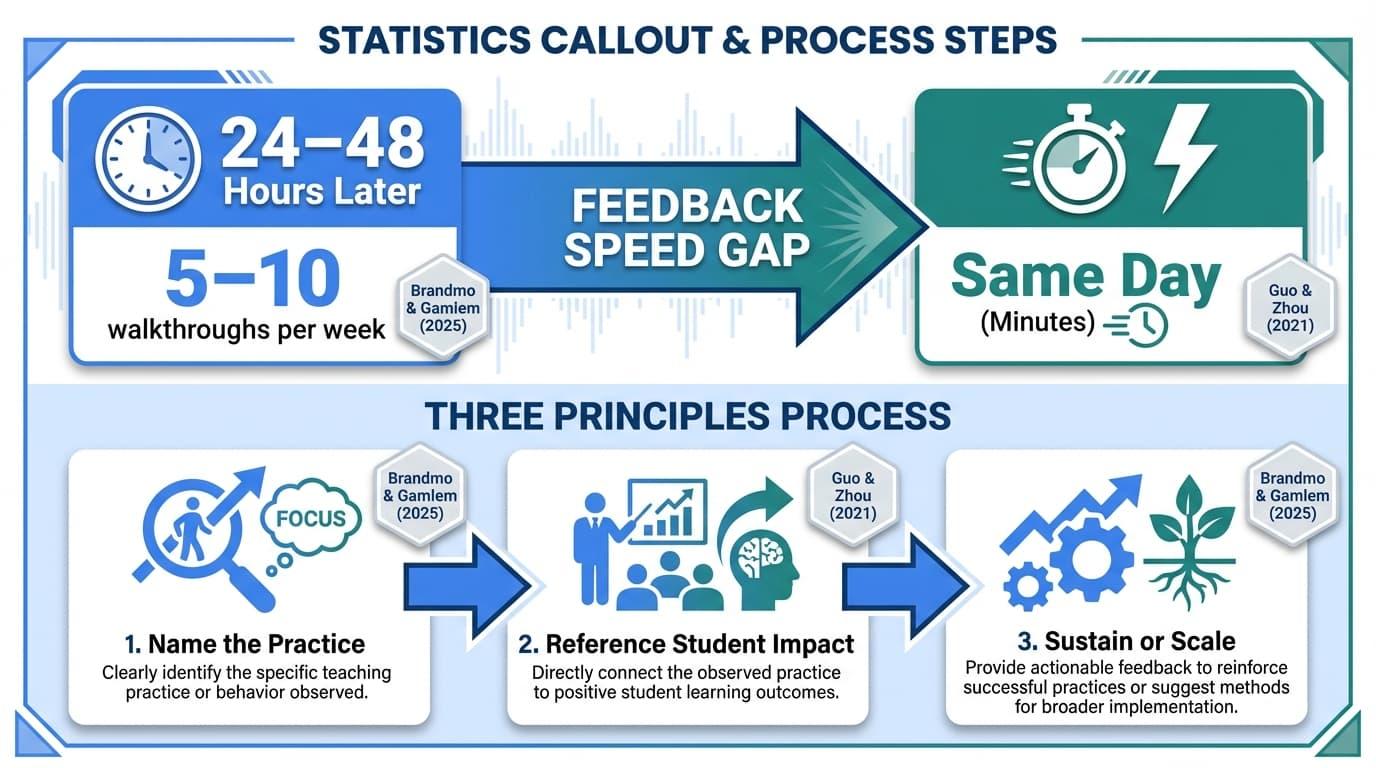
Principals conduct an average of 5–10 classroom walkthroughs per week, yet most feedback arrives 24–48 hours later — well past the teachable moment.
At Adair Elementary, switching to same-day feedback after every walkthrough cut the feedback gap from 3–4 days to minutes, and teachers began requesting more observations rather than dreading them.
That speed gap is exactly why structured templates matter — they give observers ready-made language so feedback reaches teachers while the lesson is still fresh.
That’s where this guide steps in with exactly 50 ready-to-use positive teacher feedback examples organized by the look-fors you’re already tracking: classroom management, engagement, assessment, differentiation, and more.
Each of the 58 feedback templates below names a specific teaching practice, describes the student response observed, and suggests a concrete next step.
The research backs this approach. Brandmo & Gamlem (2025) found that high-quality, tailored teacher feedback boosts student achievement, motivation, and engagement while cutting avoidance behaviors. Guo & Zhou (2021) showed a strong link where specific scaffolding feedback and praise predict motivation best for both boys and girls.
Specific, practice-named feedback comments are not just nice words. They recognize consistent effort and work inside a same-day feedback system with shared rubrics, so your comments feel like coaching instead of judgment. That way your comments feel like coaching instead of judgment.
Every example follows three key principles:
- Name the practice.
- Reference student impact.
- Encourage the teacher to sustain or scale what’s working.

How to Use Positive Teacher Feedback Examples as Copy-Paste Templates
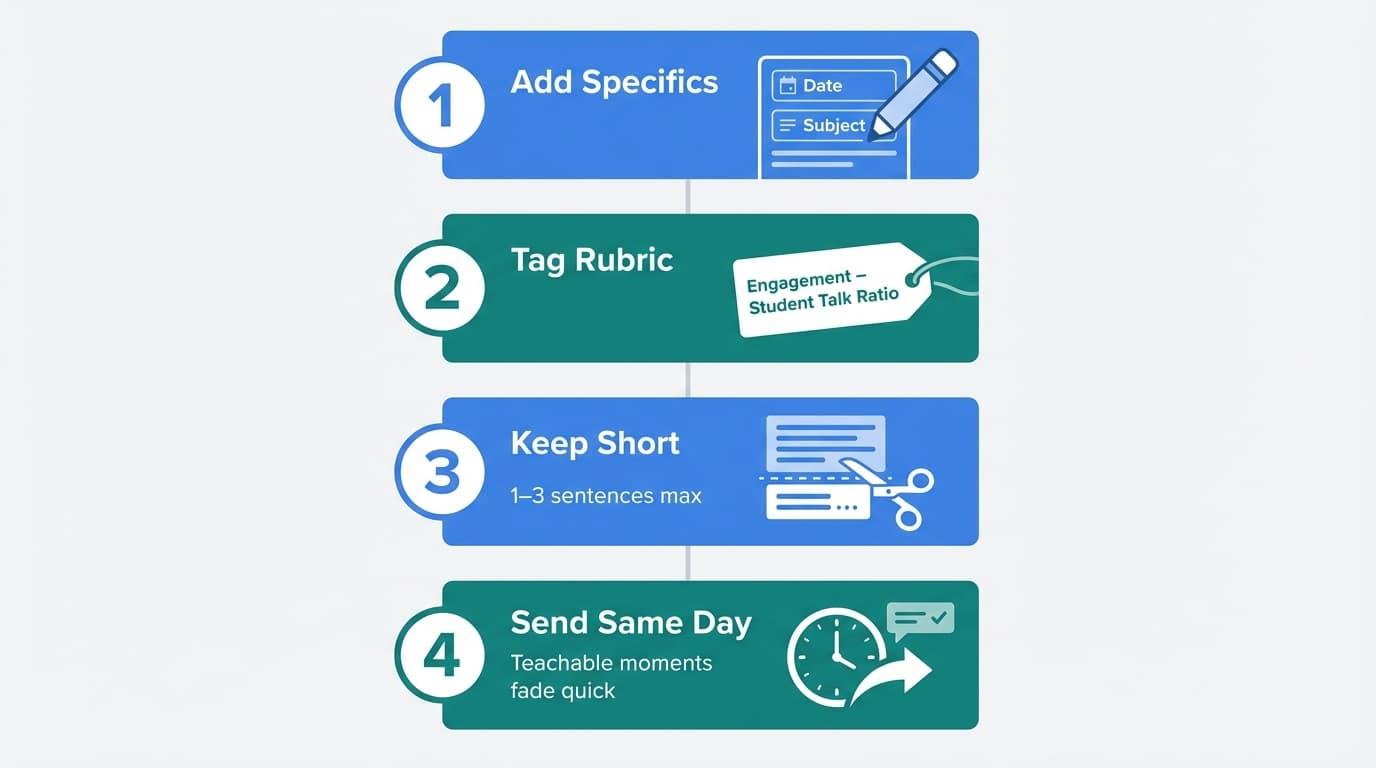
Skim this section once, then jump straight to the 50 examples below when you need copy-paste language.
- Add Specifics: Swap in subjects (8th-grade algebra), date (March 29, 2026), and student behaviors. Skip negative feedback. Focus on positives.
- Tag Rubric: Tag with labels like “Engagement – Student Talk Ratio”. Teachers see praised areas fast.
- Keep Short: 1–3 sentences max. Fits walkthroughs, notes, or growth comments.
- Send Same Day: Deliver same day when possible. Teachable moments fade quick.
50 Positive Teacher Feedback Examples by Category
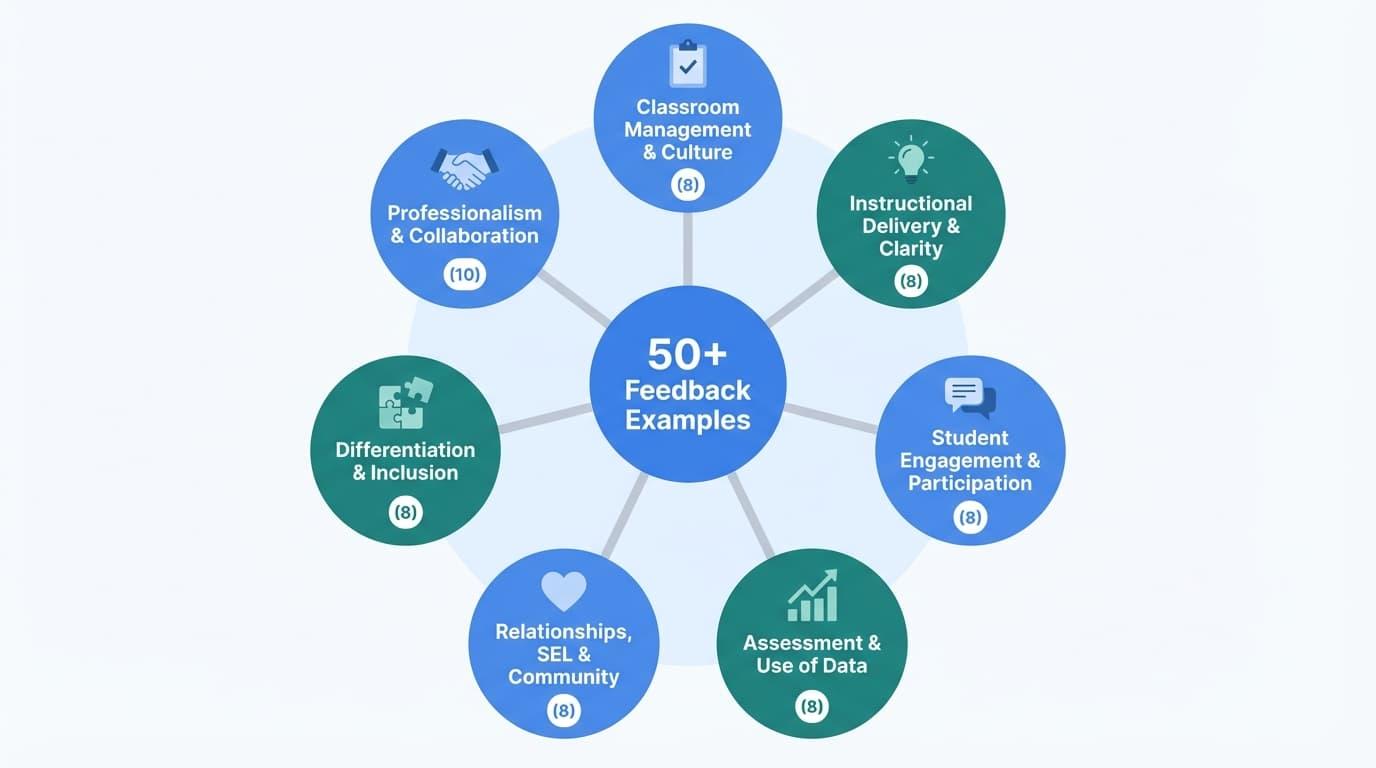
This section gives numbered, concrete, copy-paste comments grouped by instructional look-fors. Each sounds like it came from a real observation, not generic praise.
Each example names the practice, shows how students respond, and suggests whether to sustain or scale it when useful. The total across all subcategories adds up to over 50 distinct examples.
Classroom Management & Culture (8 Examples)
A recent survey found 54% of teachers name stress and burnout as major dissatisfaction drivers. Classroom management ranks high among the top stressors at 48%.
Specific positive comments hit hard here. They speak to pain points and reinforce routines that show a solid understanding of what works.
- Your students entered the room on April 2, 2026, found their seats, and began the warm-up within 90 seconds. No redirection needed. That efficiency gave you an extra 10 minutes of guided practice time.
- The visual schedule in your 4th-grade classroom on March 18, 2026, kept transitions smooth. Students referenced it on their own. This cut questions and maximized instructional minutes.
- Your consistent use of positive narration this spring semester, like “I see Table 3 ready to learn,” reinforced expectations without stopping instruction. Students self-corrected before you had to step in.
- After the conflict during partner work on March 25, 2026, your 2-minute restorative conversation with Marcus reset the relationship. He re-engaged within 10 minutes.
- Your 9th-grade ELA seminar uses student-led norms they clearly own. On March 12, 2026, a student reminded a peer of the “one voice” rule without your help.
- The calm transitions between stations in your 2nd-grade math class this spring show strong organizational skills. Students know exactly where to go and what to bring.
- Your proactive use of schoolwide expectations, visible on the wall and referenced in lessons, likely cut office referrals from your classroom this quarter.
- Students follow rules consistently in your room thanks to predictable routines. The March 2026 walkthrough showed students who struggle elsewhere thriving in your structured space.
Instructional Delivery & Clarity (8 Examples)
Clear explanations and modeling link to higher achievement. Brandmo & Gamlem (2025) confirm that action-oriented feedback on delivery improves outcomes, especially for new challenges. These comments highlight specific moves teachers can repeat that strengthen responsible behavior and social skills.
- Your learning target on the board during your February 2026 algebra lesson, “By the end of class, you will solve two-step equations,” gave students a clear destination. They referenced it twice during independent work.
- The think-aloud modeling you used for word problems in 6th-grade math on March 4, 2026, made invisible thinking visible. Students echoed your language during practice.
- Your explanation of photosynthesis in 7th-grade science used diagrams and a real plant students could touch. That multi-modal approach kept visual and kinesthetic learners engaged. Check related reading for more ideas.
- You paused to reteach multi-step equations when several students showed confusion on the quick check. That adjustment kept the whole class moving together.
- Your lessons break complex formulas into basic math concepts that are easily digestible. On March 11, 2026, you scaffolded place value from basics to application problems seamlessly.
- The strategic questioning in your 8th-grade ELA lesson, from “What happened?” to “Why does that matter?”, checked understanding and pushed critical thinking.
- Your language arts instruction on sentence structure on March 20, 2026, included mentor sentences students annotated together. Consider recording that mini-lesson so others could benefit.
- You use verbal communication to signal transitions and refocus attention. Students respond right away because your cues build responsible behavior.
Student Engagement & Participation (8 Examples)
Engagement feedback ties directly to motivation. Engagement feedback ties directly to motivation. When observers name the specific strategy — Socratic seminar, turn-and-talk, cold call with warm tone — teachers can replicate that move in tomorrow’s lesson instead of guessing what “good engagement” means.
Name specific strategies so teachers know what to repeat for a strong understanding and active participation.
- Your Socratic seminar on “The Giver” in January 2026 had nearly every student speaking at least twice. The question sequence you designed gave all learners entry points.
- The turn-and-talk structure during your 5th-grade social studies lesson on March 14, 2026, generated on-task chatter at every table. Students were eager to share their partner’s thinking with the whole group.
- Your use of cold calls with a warm tone during the March 2026 math lesson kept all students accountable without creating anxiety. Even quieter students participated confidently.
- Students weren’t just participating in your March 18, 2026, class discussions—they were pushing each other’s thinking with follow-up questions. That’s evidence of deep engagement.
- Your student choice board for the research project encouraged students to take ownership of their learning process. The variety of products showed genuine investment.
- The hands-on activities in your 3rd-grade science lesson kept every student actively engaged. I saw zero off-task behavior during the 15-minute exploration.
- Your use of sentence stems during small-group discussion brought in multilingual learners who might otherwise stay quiet. I heard Soraya use “I agree because…” three times in 10 minutes.
- Wait time after questions lets ideas form. On March 21, 2026, three usually quiet students raised their hands after your five-second pause.
Assessment, Feedback to Students & Use of Data (8 Examples)
Formative assessment is one of the strongest levers for student achievement. Black & Wiliam (1998) found that schools using formative feedback effectively can double the speed of student learning.
When observation comments name specific assessment moves — exit tickets, rubric conferences, data-driven regrouping — teachers see exactly which practices drive that impact.
Your March 21, 2026, exit ticket in 5th‑grade math showed four students still struggling with fraction equivalence. You regrouped them for Tuesday’s intervention before moving on. That’s quick, student‑focused teaching.
- The quick check using whiteboards during your algebra lesson gave real‑time data. You adjusted your explanation of math concepts right away.
- Your rubric‑based conferences for the 7th‑grade essay laid out clear success criteria. Students annotated their drafts against the 4‑point rubric as they worked.
- The color‑coded highlighting on essays—green for strong evidence, yellow for areas to fix—gave clear, action‑oriented next steps.
- You collected homework data and used it to form targeted small groups. That moves from simply collecting data to truly data‑driven instruction.
- Your feedback on 8th‑grade writing skipped vague lines like “good effort.” Instead, you named specific grammatical errors students could fix on their own.
- The mid‑lesson poll on March 25, 2026, revealed a pattern of confusion about story time sequence. You addressed it that day, not weeks later.
- Students could keep referring to success criteria because you co‑created a large rubric poster. That transparency likely lifted the quality of their work.
Relationships, SEL, and Classroom Community (8 Examples)
Strong teacher-student relationships support behavior, attendance, and academic outcomes. Cornelius-White (2007) meta-analyzed 119 studies and found that positive teacher-student relationships have a 0.72 effect size on student outcomes — among the highest of any instructional variable.
Feedback that names specific relationship-building moves tells teachers exactly which moments to replicate.
- Your daily greeting at the door with a handshake or high-five by name takes 90 seconds. It signals that you see every learner. Students say it helps them follow classroom rules.
- After getting upset in group work on March 12, 2026, Marcus came to you. You listened without judgment. In 2 minutes, he rejoined his group. That trust strengthens classroom routines.
- The January 2026 class circle re-established norms after winter break. It rebuilt the community fast. Students referenced those agreements throughout the spring while tackling complex concepts.
- Your check-in with absent students shows care beyond academics. Jaylen said your call while sick made him want to return and follow classroom rules.
- The calm corner in your 2nd-grade room builds self-regulation. On March 19, 2026, a student used it alone and returned to group work in three minutes.
- Your 7th-grade advisory emotion check-in uses a feelings chart. Students add their name. In 3 minutes, you spot who needs support during complex concepts.
- You hold high expectations with warmth. Students who struggled earlier now seek your help. That’s the “warm demander” approach guiding classroom routines.
- Your restorative chat after the March 22, 2026, hallway incident rebuilt ties instead of just consequences. Both students returned ready to learn and follow classroom rules.
Differentiation, Inclusion & Support for Diverse Learners (8 Examples)
Inclusive, differentiated instruction is central to equitable outcomes. Tomlinson (2014) established that differentiation works best when teachers adjust content, process, and product based on student readiness — and observation feedback that names specific scaffolds and extensions tells teachers which adjustments are working.
- Your visuals on the social studies timeline helped emerging bilingual students grasp event sequences without full English reliance. Fatima navigated it independently, boosting reading comprehension.
- Sentence frames in your March 2026 science lesson gave multilingual learners confidence for group discussions and public speaking.
- Your 3rd-grade math checklist for multi-step directions broke down processes. It made thinking visible and built problem-solving skills for a good understanding.
- Challenge problems for advanced learners on March 18, 2026, kept them engaged. You supported other students needing extra practice at the same time.
- Your collaboration with the special educator in co-taught 6th-grade used shared guided reading notes. They shaped her small-group work on grammatical errors.
- Students with IEPs access grade-level content thanks to your scaffolds like visual aids and peer partnerships. They maintain rigor while building a good understanding.
- Your 7th-grade texts featured diverse authors. Students connected characters to their lives, strengthening reading comprehension with other students.
- You affirmed your home language during partner work, code-switching between English and Spanish. This shifts bilingualism to a resource for problem-solving and public speaking.
Professionalism, Collaboration & Family Communication (10 Examples)
Structured feedback and public acknowledgment boost teacher motivation and school culture. The 10 professionalism examples below spotlight professional practices that strengthen school culture and model growth-focused language.
- Your March 2026 PLC prep with analyzed student data and ready questions lifted the team’s talk on progress and respect for school property.
- You shared the exit ticket templates with the 6th-grade team. Three teachers adopted them. That generosity shows excellent effort in group activities.
- Your February 2026 PD leadership on formative assessment gave practical strategies others now use. Document your learning for a May share-out on writing report card comments.
- You volunteered to mentor the new teacher this semester. Your co-planning and open classroom eased her transition during group activities.
- Your grading stayed current before spring conferences. You shared specific student success evidence instead of vague notes or negative comments.
- Your mid-year assessment reflection looked at individual data and class patterns. It shows a growth mindset and excellent effort.
- Bilingual newsletters give Spanish-speaking families real communication, not just translated English. They feel included in group activities.
- Calling families with good news before report cards shares specific strengths. It shifts focus from problems to progress without negative comments.
- Your 2025–26 proactive family communication built home learning partnerships. It supports students and protects school property through involvement.
- Your cross-content group activities with other teachers model the thinking we want students to develop. Excellent effort all year.
Sample Phrasing: 58 Ready-to-Use Positive Feedback Comments
The 50 examples above work for quick copying. Each stays 1–3 sentences and is self-contained. Drop them into emails, walkthrough forms, or evaluation documents.
Use category labels for fast navigation:
- Examples 1–8: Classroom Management
- Examples 9–16: Instructional Delivery
- Examples 17–24: Engagement
- Examples 25–32: Assessment
- Examples 33–40: Relationships/SEL
- Examples 41–48: Differentiation
- Examples 49–58: Professionalism
Comments mix celebratory, appreciative, and future tones. They stay specific with no generic “Good job!” praise. Each ties to concrete practices, dates, or lessons from this school year to show great progress and keep it real.
When and How Should You Deliver Teacher Feedback for Maximum Impact?
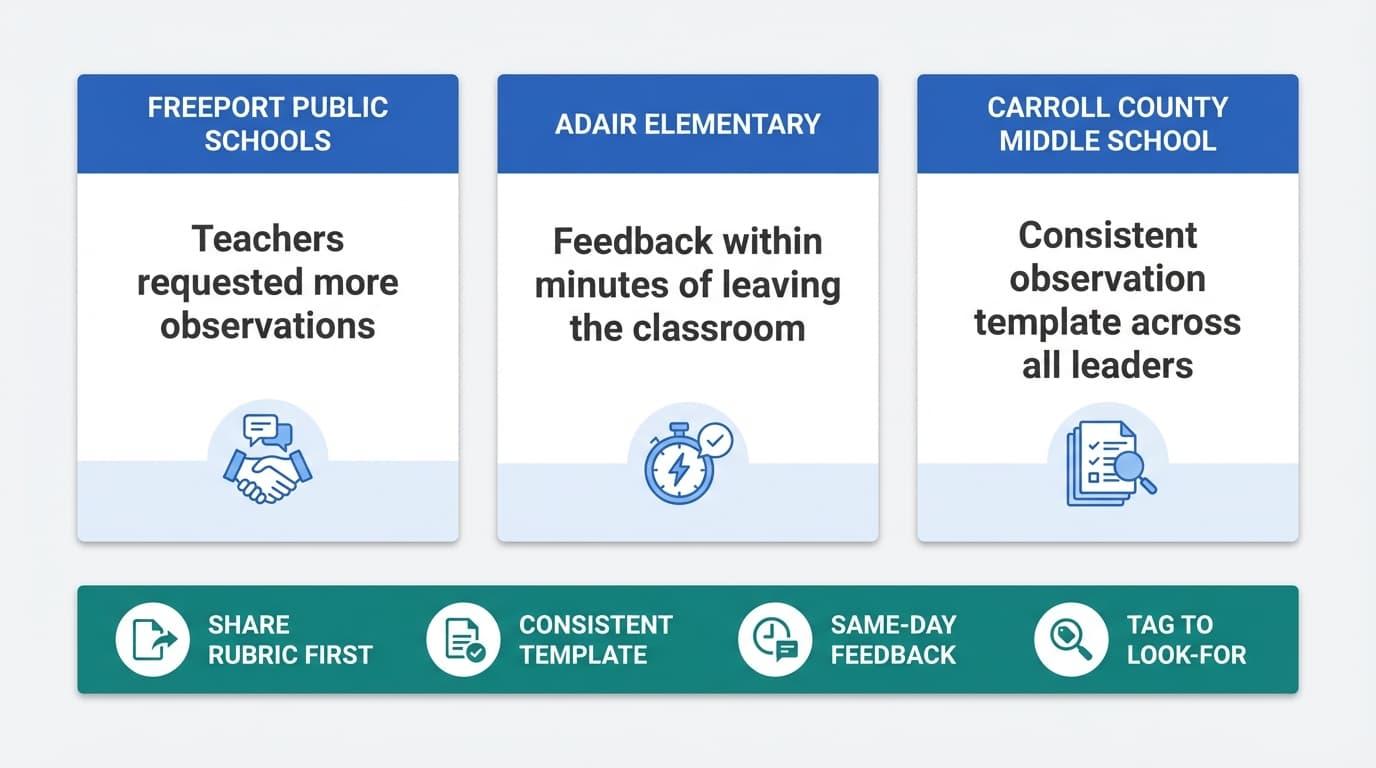
How and when you deliver feedback matters more than the exact words you use. Schools that get this right turn walkthroughs into real coaching moments, not just evaluation checklists.
Freeport Public Schools used Education Walkthrough to standardize their process. Leaders shared rubrics and key points with teachers before visits. Teachers felt less anxious and started requesting more observations, seeing them as a chance to practice new skills.
At Adair Elementary, leaders focused on speed. They sent feedback within minutes of leaving the classroom. Teachers used suggestions in the very next lesson, including during group projects. The fast turnaround kept the teachable moment alive.
Carroll County Middle School designed a clear system. They used a consistent observation template across all leaders. Teachers knew feedback was linked to shared expectations and connected to new skills over the school year.
Four Recommendations for Your System
- Share the rubric and key points with teachers before entering the room, so they know what to watch for.
- Use a consistent observation template across all observers to avoid mixed messages.
- Commit to same‑day feedback. Even short notes beat long emails three days later.
- Tag every comment to a clear look‑for, so teachers see how specific practices connect to new skills and growth.

How Should You Adapt Positive Feedback by Teacher Performance Level?
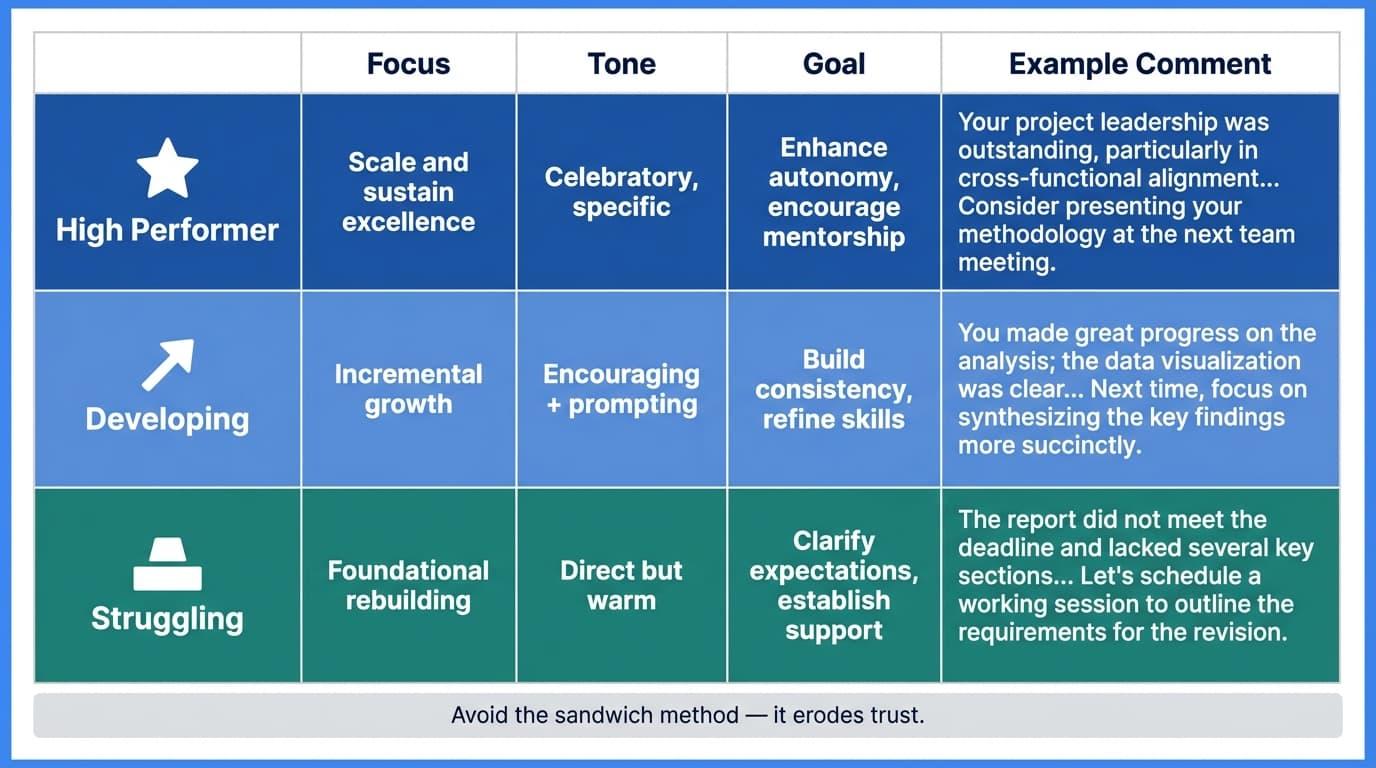
While all 58 examples are positive, emphasis and tone should adapt based on performance level.
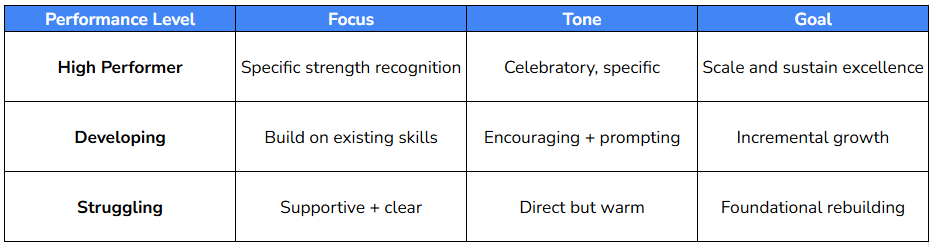
Same base comment, three adaptations:
- High performer: “Your exit ticket data on March 21 showed exactly which students needed reteaching. Consider leading a 10-minute PD share on this practice so other teachers can replicate your approach.”
- Developing: “Your exit ticket on March 21 gave you useful data. What do you think you might try differently with the three students who showed confusion? Let’s discuss during our Thursday check-in.”
- Struggling: “The exit ticket on March 21 showed four students need reteaching. Let’s co-plan a small-group session for tomorrow, and I’ll model the first five minutes.”
The goal shifts by level: sustain excellence, grow incrementally, or rebuild foundations with structured support. Avoid using positive feedback to soften or hide concerns—that’s the outdated sandwich method, and it erodes trust.
Common Pitfalls: When “Positive” Comments Fall Flat
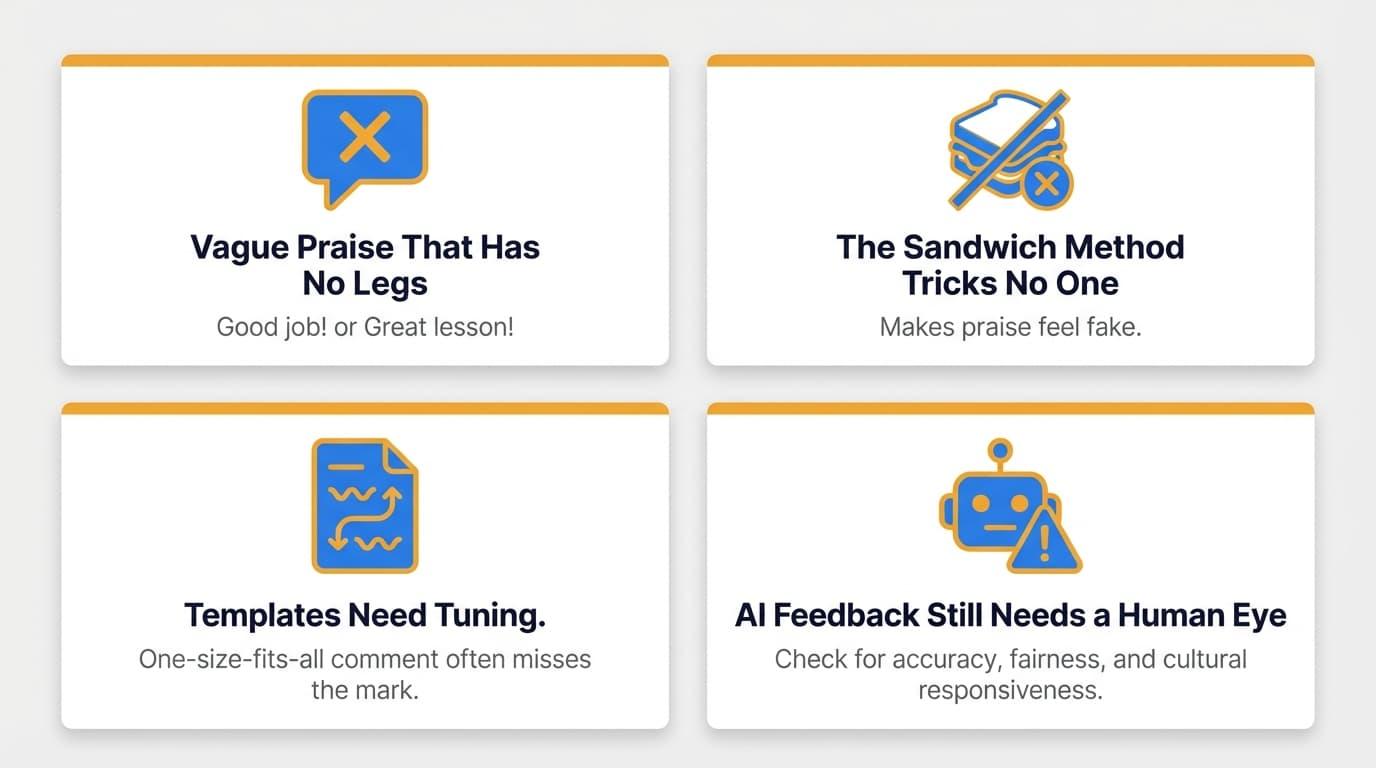
Even well-intentioned feedback backfires when it falls into one of four common traps — and most observers hit at least one without realizing it.
Vague Praise That Has No Legs
“Good job!” or “Great lesson!” feels supportive but gives no clear direction. Instead of “good effort,” name the practice: “Your use of wait time gave students space to think.” Specific comments help teachers see what to repeat and where they have made great progress.
The Sandwich Method Tricks No One
Hiding constructive criticism between two positive comments backfires. It can make praise feel fake and leave the teacher unsure what really matters. When a teacher needs improvement, say it clearly and kindly. Keep it direct, honest, and focused on growth across the school year.
Templates Need Tuning
A one‑size‑fits‑all comment often misses the mark. Teachers interpret feedback differently based on their background, experience, and past interactions. Read each situation closely. Adjust the tone so it fits this teacher, not just the template or look‑for.
AI Feedback Still Needs a Human Eye
Automated tools can help draft comments, but they should never be sent as-is. Check for accuracy, fairness, and cultural responsiveness. Personalize every note so it sounds like you were really there, not just a system recycling general phrases.
Building a Feedback Culture: A One-Month Pilot Plan for Schools
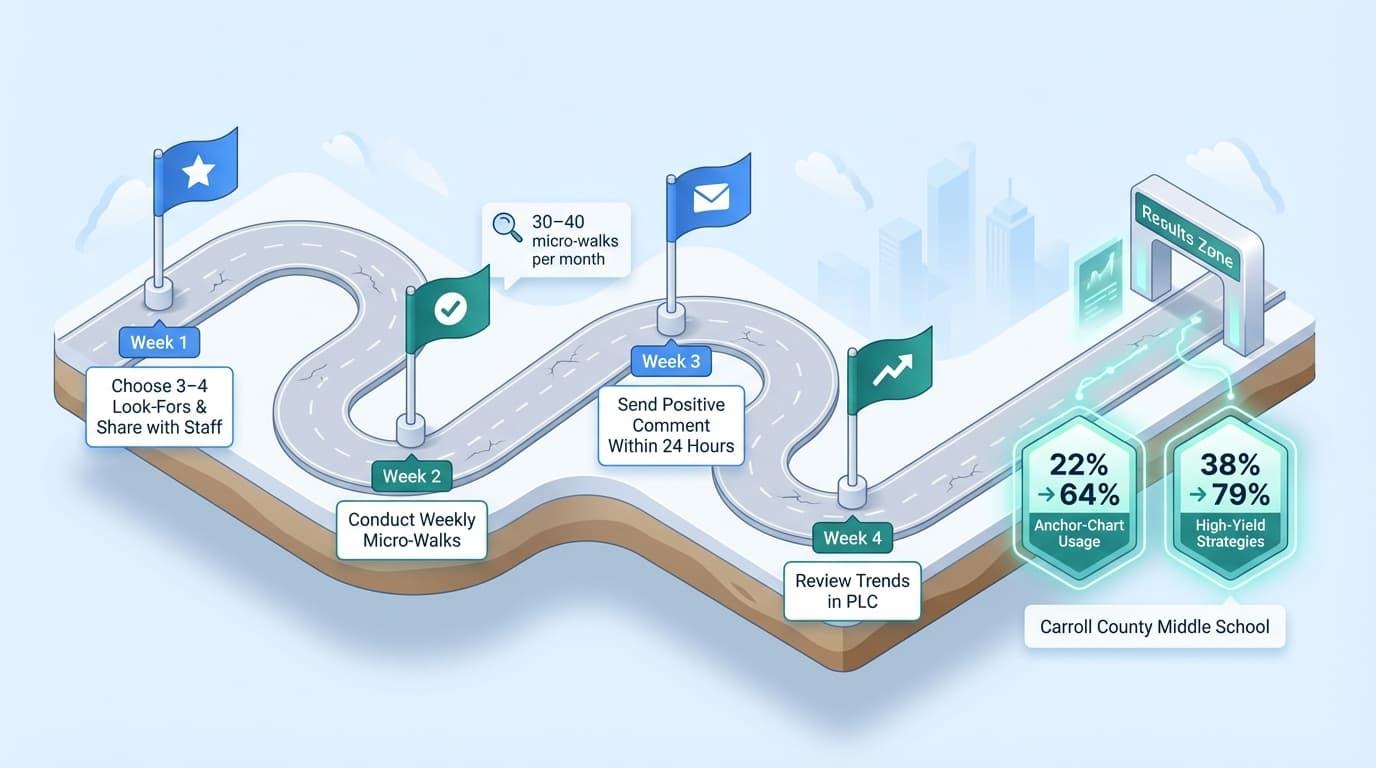
The 58 examples in this article are tools, but the system you build around them determines whether teachers experience feedback as coaching or judgment.
At Carroll County Middle School, sharing the observation template with every teacher before the first walkthrough shifted anchor-chart usage from 22% to 64% in three weeks — and by spring, classrooms demonstrating high-yield strategies rose from 38% to 79%.
At Paragon Mills Elementary, seven leaders conducting 30–40 micro-walks per month without adding a planning period moved new-to-profession teachers from “emerging” to “proficient” on the ELA rubric by winter break.
Positive feedback is most powerful when it’s specific, same-day, aligned to shared look-fors, and part of an ongoing dialogue. One detailed observation per semester isn’t enough. Weekly micro-walks with brief, targeted comments create the consistency that builds trust.
Try this one-month pilot:
- Choose 3–4 look-fors and share them with staff
- Conduct weekly micro-walks across all classrooms
- Send at least one positive, specific comment to every teacher within 24 hours
- Use PLC time to review aggregate, anonymized trends—invite teachers into the data conversation

When teachers see feedback as a shared improvement tool rather than a report card on their performance, the culture shifts. Teachers stop avoiding walkthroughs and start requesting them. They become active participants in their own growth.
Adapt these 58 examples. Refine them with your team. Build the system where teachers feel supported, motivated, and eager for the next pop-in — the way Carroll County teachers went from dreading walkthroughs to volunteering for extra visits after the school adopted transparent, rubric-aligned feedback through Education Walkthrough. When feedback becomes a shared improvement tool rather than a report card, the culture shifts permanently.
Final Thoughts: Making Feedback Work for Your Teachers
Positive feedback supports growth, confidence, and stronger classrooms. This post gave 58 specific, actionable examples to help you deliver clear, meaningful, tailored comments all year. Effective feedback celebrates strengths, offers constructive ideas, and stays focused on improvement.
Timely, personalized comments that name concrete practices help teachers see what works and how they can grow. Avoid generic praise; be specific, sincere, and supportive.
When teachers follow multi‑step directions successfully, highlight it. Building a culture of ongoing feedback encourages teachers to embrace growth and seek new challenges.
Use these strategies and templates to turn feedback into a steady driver of teacher development and better student outcomes. Keep celebrating progress and guiding your team with thoughtful, consistent feedback.
Education Walkthrough helps you turn these feedback ideas into real‑time practice with quick walkthroughs, shared rubrics, and simple same‑day comments that teachers can actually use. It keeps your feedback organized, visible, and connected to each teacher’s growth across the school year.
الأسئلة الشائعة (FAQs)
How can I provide constructive yet positive feedback to teachers?
Provide specific examples of their strengths, highlight the positive impact on students, and offer clear, actionable suggestions for improvement. Use a supportive tone that encourages growth without sugar-coating challenges.
How should I respond when negative feedback feels necessary?
Be direct but kind. Name the exact practice or behavior, explain its impact, and pair it with a clear next step. Keep the tone developmental, not punitive, and avoid burying it in a “sandwich” of praise.
What are some effective strategies for delivering timely teacher feedback?
Deliver feedback as soon as possible after observations, ideally the same day, to capitalize on the teachable moment. Use consistent observation templates and share clear expectations beforehand to make feedback more impactful.
How should feedback be tailored for teachers at different performance levels?
For high performers, focus on scaling and sustaining excellence with celebratory and specific comments. For developing teachers, use encouraging prompts to build skills incrementally. For struggling teachers, provide direct but warm support aimed at foundational rebuilding.
Why is it important to avoid generic praise in teacher feedback?
Generic praise like “Good job!” lacks direction and does not guide teachers on what to continue or improve. Specific, practice‑focused feedback helps teachers understand exactly what is effective and what needs attention.
What role does positive teacher feedback play in student outcomes?
Consistent positive feedback supports teacher motivation and growth, which correlates with lower suspension rates and higher student achievement in math and reading proficiency.
How can schools build a culture where teachers actively seek feedback?
Implement regular, brief walkthroughs with targeted positive comments, share clear look‑fors, deliver timely feedback, and foster open dialogue so teachers view feedback as a collaborative tool rather than judgment.