The California Standards for the Teaching Profession (CSTP) is the official, state-sanctioned framework defining effective instructional practice in California public schools. It serves as the legal foundation for educator evaluation, credentialing via Teaching Performance Expectations (TPEs), and career-long administrative coaching.
Let’s be honest: are you still relying on “gut feelings” or an outdated rubric to decide if a lesson was actually good? It’s a risky gap to leave open, especially with the state breathing down your neck.
So, how do you bridge that gap without losing your mind over the latest revisions?
The California Standards for the Teaching Profession (CSTP) provides the answer. serving as the state-sanctioned foundation for everything from credentialing to career-long coaching.
This guide provides district administrators with exact compliance requirements for observation workflows, answering critical questions including:
- What is the CSTP and why does it exist for California educators?
- What are the six core standards of the framework?
- How does the developmental continuum measure teacher growth?
- What critical updates were made in the 2024 CSTP revision
What Is the CSTP and Why Does It Exist for California Educators?
The California Standards for the Teaching Profession (CSTP) is the official statewide framework that defines what effective teaching looks like across California’s public schools.
The Commission on Teacher Credentialing (CTC) and the California Department of Education (CDE) jointly developed the CSTP framework to establish a standardized, legally defensible professional language for state educators, administrators, and credentialing programs.
It provides a common framework that describes the knowledge, skills, and practices expected of teachers at every stage of their career. This applies from pre-service preparation through experienced classroom practice. Thus, it’s relevant both for junior teachers completing a credentialing program and for seniors entering their twentieth year in the classroom.
For districts, the CSTP functions on two levels:
- Professional Growth Tool: It helps to give instructional coaches and administrators a consistent reference point for observation, feedback, and development planning.
- Compliance Reference: It aligns evaluation systems and credential programs to a standardized, state-sanctioned benchmark.
These functions are vital. CSTP-aligned evaluations ensure your district stays audit-ready. Likewise, linking professional development to this framework makes growth conversations more consistent. It ensures every coach and teacher speaks the same language.
The result is a framework that does more than describe good teaching. It creates the standardized foundation that California’s educator preparation and accountability systems are built on.
The Six CSTP Standards
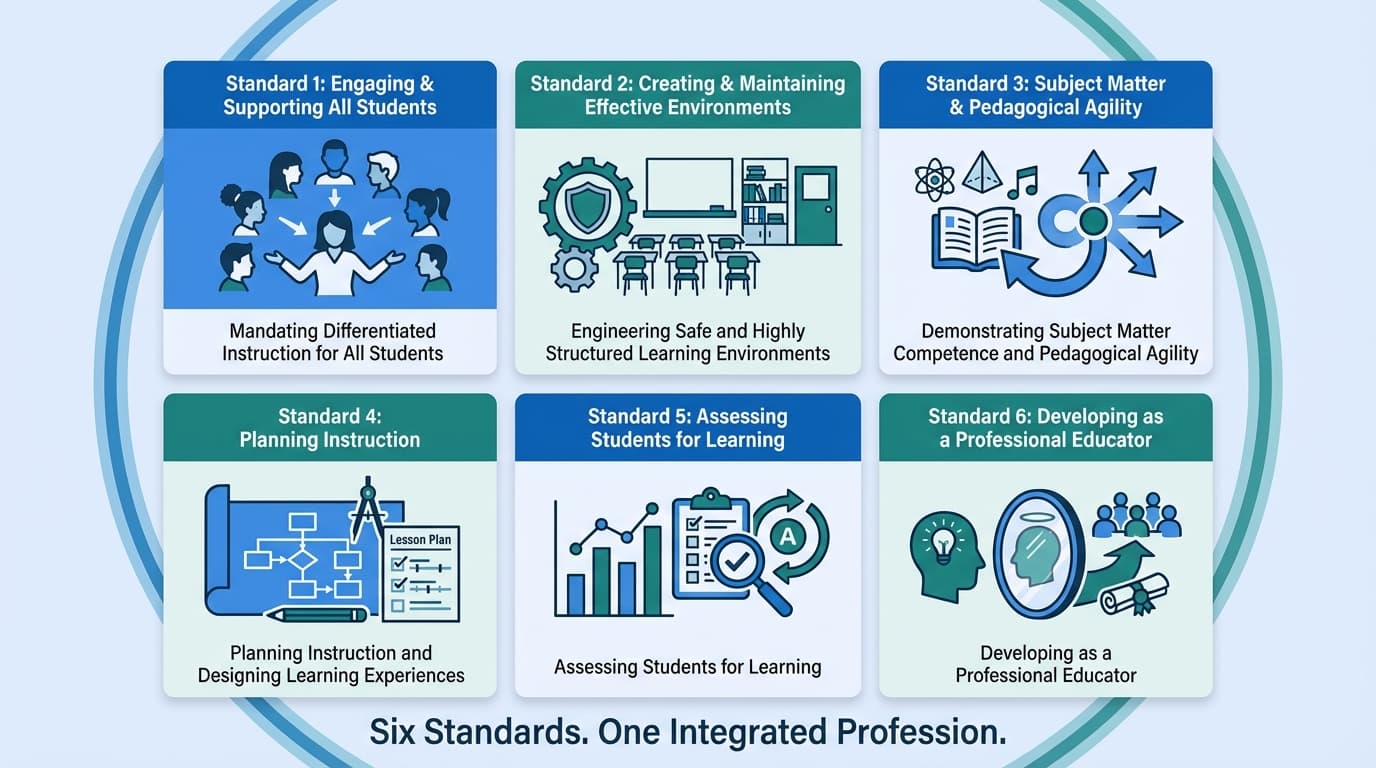
Each of the six CSTP standards addresses a distinct domain of professional practice. Together, they form a complete picture of what effective teaching looks like in California classrooms.
Understanding each standard individually makes it easier to see how they strengthen one another in practice.
Standard 1: Mandating Differentiated Instruction for All Students
Is the teacher only “teaching to the middle,” or are they actually reaching the kid in the back row who’s struggling with English?
Standard 1 is all about making sure every student—not just the easy-to-reach ones—is actually locked into the lesson.
This involves:
- Differentiated Instruction: Adapting lesson delivery and materials to meet the diverse cognitive needs of all students.”
- Culturally Responsive Pedagogy: Integrating anti-bias practices and validating students’ cultural backgrounds within the curriculum.”
- English Learner Support: Deploying targeted scaffolds that make rigorous academic content accessible without lowering expectations.
Standard 1 is the heart of equity. Evaluators use it to see if a teacher is truly responsive to every student in the room.
Standard 2: Engineering Safe and Highly Structured Learning Environments
Standard 2 addresses the conditions that make learning possible. Teachers must create classrooms that are physically safe, emotionally supportive, and highly structured.
This involves social-emotional learning, respectful norms, and inclusive routines. When evaluating this standard, administrators look for a climate where students feel safe enough to take academic risks.
Standard 3: Demonstrating Subject Matter Competence and Pedagogical Agility
Standard 3 covers what teachers know and how they teach it. Educators must command their subject matter and translate it into engaging, comprehensible strategies.
Accuracy is only the starting point. This standard measures whether a teacher can connect concepts to student experiences, use clear representations, and pivot when students struggle to grasp the material.
For example, a math teacher who uses real-world sports statistics to explain ratios. Or a science teacher pivoting from a lecture to a hands-on demonstration when a complex chemical reaction isn’t clicking for the class.
Standard 4: Planning Instruction and Designing Learning Experiences
Standard 4 covers the work that happens before a teacher enters the classroom. It includes lesson design, goal-setting, and sequencing instruction to build understanding.
Teachers must plan with every student in mind, specifically addressing diverse learning needs and language proficiencies.
Evaluating administrators measure Standard 4 compliance during formal pre-observation conferences and curriculum audits, utilizing these sessions to objectively assess how effectively a teacher sequences instruction and accommodates diverse learning proficiencies.
Standard 5: Assessing Students for Learning
Standard 5 addresses how teachers gather and use evidence of student understanding. It spans both formative assessment practices used during lessons and summative assessments used to measure learning at the end of a unit.
The goal is for teachers to analyze student work and refine their instruction accordingly. For administrators and coaches, this standard is the key to developing data-informed practices.
Standard 6: Developing as a Professional Educator
This is the “look in the mirror” standard. It’s less about how they handle the kids and more about how they handle themselves as pros.
- The Real Talk: This is where you find out if a teacher is a “lone wolf” or a true collaborator. Are they actually taking your feedback to heart, or are they just nodding until you leave the room?
- What it looks like: It’s about being active in PLCs and actually caring about their own growth.
For administrators, this standard is the MVP of the end-of-year review. It’s the perfect anchor for those “Where do you see yourself next year?” conversations.
Taken together, the six standards do not describe six separate jobs. They form a single, integrated profession where each standard strengthens the others.
The Developmental Journey from Entry Level to Instructional Leadership
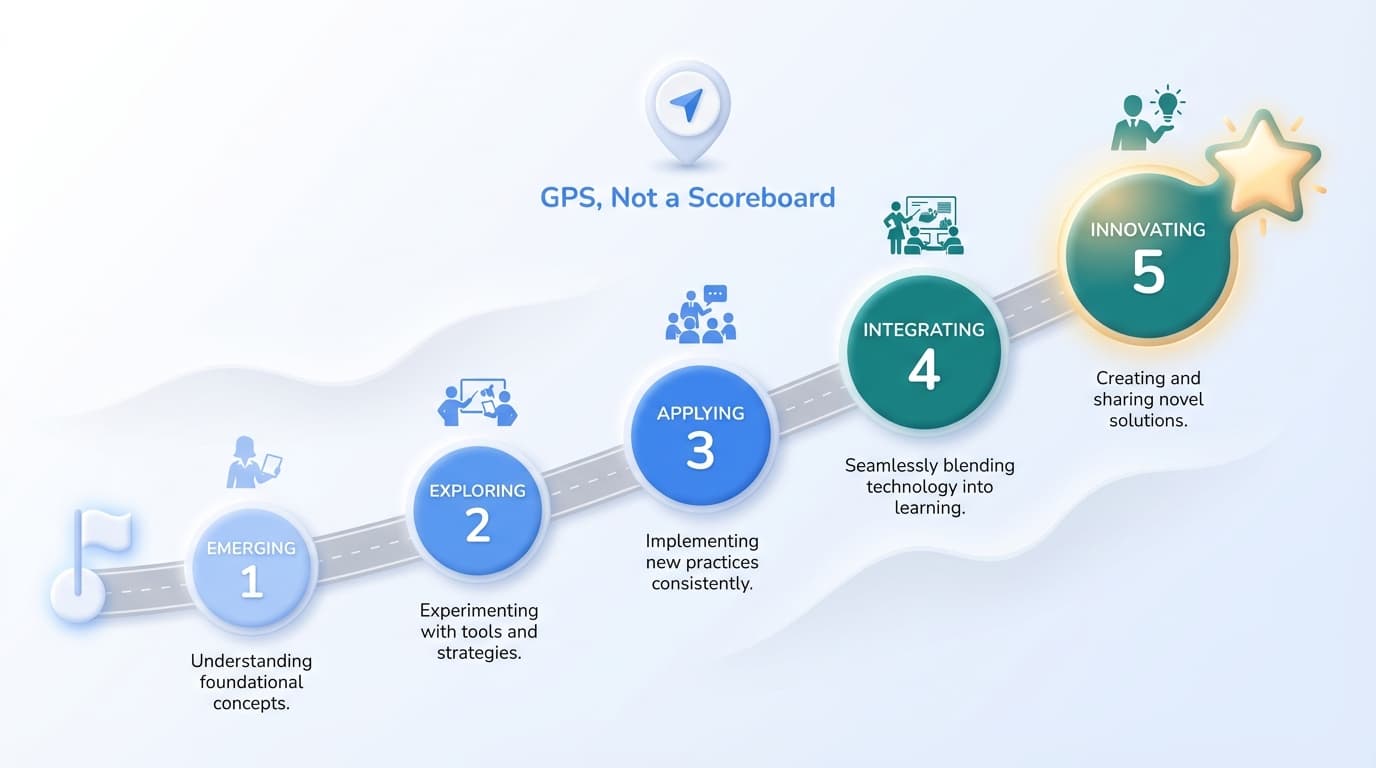
Nobody likes being “ranked” on a scale of 1 to 5. It feels like a report card, and that’s the last thing a stressed teacher needs. That’s why the CSTP uses a Developmental Continuum.
Think of this more like a GPS than a scoreboard. If a teacher is at the “Emerging” level, it doesn’t mean they’re failing—it just means they’re at the start of the trip.
Most teachers won’t move through these levels in a straight line, either. They might be a “Rockstar” (Integrating) at classroom vibes but still “Finding their way” (Exploring) when it comes to analyzing data.
For you, this is the ultimate coaching tool. It helps you say, “You’re doing great here; now let’s look at the map and see how we get you to the next stop.”
This developmental continuum spans five levels. Each level is defined by specific descriptors tied to the six standards covered above. Teachers do not move through these levels uniformly.
For example, a teacher might demonstrate Applying-level practice in classroom management while still working at an Exploring level in assessment.
Level 1: Emerging
A teacher at the Emerging level is typically early in their career or new to a particular practice. They show foundational awareness of the standard but have not yet developed consistent, independent application.
This is the expected entry point for candidates completing credential programs and teachers entering Beginning Teacher Support and Assessment, commonly known as BTSA.
Level 2: Exploring
At the Exploring level, a teacher is beginning to experiment with strategies and reflect on their effectiveness. Practice is developing but still inconsistent, and the teacher relies on guidance and feedback to refine their approach.
Level 3: Applying
A teacher at the Applying level demonstrates consistent, intentional practice aligned to the standard. They can explain their instructional decisions and adjust based on student response. This level reflects solid, competent professional practice.
Level 4: Integrating
At the Integrating level, a teacher connects practices across standards in ways that are purposeful and student-centered. Their work reflects a sophisticated understanding of how the elements of effective teaching reinforce one another.
Level 5: Innovating
The Innovating level represents exemplary, leadership-level practice. Teachers at this stage not only demonstrate mastery across the standards but also actively contribute to the professional growth of colleagues. They model, mentor, and extend their impact beyond their own classroom.
As an administrator managing teacher induction programs, this continuum gives you a structured, defensible basis for observation documentation. It supports growth planning across every stage of a teacher’s career. It also enables you to identify your top-tier talent and leverage their expertise as mentors or instructional leaders within your school.
How CSTP Connects to Teacher Credentialing and Induction
The Commission on Teacher Credentialing developed and maintains the CSTP, which means it does not simply sit alongside California’s credentialing structure. It underpins it. Every major credentialing requirement, from preparation program standards to induction completion, traces back to this framework.
CSTP and Teaching Performance Expectations
Teaching Performance Expectations (TPEs) are often confused with the CSTP itself. While they are related, they serve distinct purposes in a teacher’s professional timeline.
The TPEs are derived from the CSTP and serve as the assessment criteria used to evaluate teacher candidates during their preparation programs. Where the CSTP describes professional practice across a full career, the TPEs narrow that scope to what candidates must demonstrate before earning a Preliminary credential.
Preparation programs submit their curriculum and assessment designs to the Commission on Teacher Credentialing for approval. An essential requirement is that the designs must align with the TPEs. That alignment, in turn, connects directly back to the CSTP standards.
As an administrator reviewing credential documentation or supervising student teachers, it is helpful to understand this chain. The TPEs are the credentialing instrument used for entry, and the CSTP is the professional foundation you will use to guide their growth for the rest of their career.
CSTP in Beginning Teacher Induction Programs
Once a teacher holds a Preliminary credential, they enter a teacher induction program to clear it. These programs, which evolved from the earlier Beginning Teacher Support and Assessment model, use the CSTP as their primary professional growth framework. As an administrator, you recognize this phase as the critical bridge between theory and classroom mastery.
During induction, beginning teachers work with assigned mentors to self-assess their practice against the CSTP standards. That self-assessment drives the development of an Individual Learning Plan (ILP).
ILP documents growth goals and the evidence collected to support them. The ILP is not merely a suggested document; it’s the core accountability structure of the induction process.
Completing induction with sufficient CSTP-aligned documentation is the standard pathway to earning a Professional Clear credential in California.
What Critical Updates Were Made in the 2024 CSTP Revision?
A lot has changed in ten years, hasn’t it? The 2024 revision is the first big update we’ve seen in over a decade, and it finally catches up to the reality of what our classrooms look like today.
For administrators, these changes carry direct implications for how observation rubrics are structured and how evaluation documentation holds up under scrutiny.
Expanded Focus on Equity and Culturally Responsive Teaching
Equity is the biggest change in the 2024 CSTP revision. The framework now embeds culturally responsive teaching as a named expectation throughout. Anti-bias pedagogy is now explicit, not just suggested.
This update brings the standards in line with California’s whole-child policy. Administrators must treat this as a mandate. If your observation rubrics haven’t been updated since 2024, your district faces a compliance gap during state audits.
Updating those instruments is a practical priority, not an optional refinement. The National Board for Professional Teaching Standards has similarly emphasized equity-centered practice in its own framework updates.
These changes confirm that California’s new standards align with the highest level of professional teaching across the country.
New Provisions for English Learners and Social-Emotional Learning
The 2024 revision also strengthened specific provisions for English learners. The updated language around differentiated instruction is more precise. It sets clearer expectations for how teachers make content accessible without reducing academic rigor.
Remember when SEL was just a “Friday thing”?
Those days are over. The 2024 update weaves Social-Emotional Learning directly into the academic DNA of the lesson. This means it’s no longer just a standalone program; it’s just how we do business.
Administrators updating their evaluation systems should ensure that observation tools reflect both the English learner provisions and the SEL expectations now embedded in the standards.
Using CSTP for Classroom Observation and Teacher Evaluation
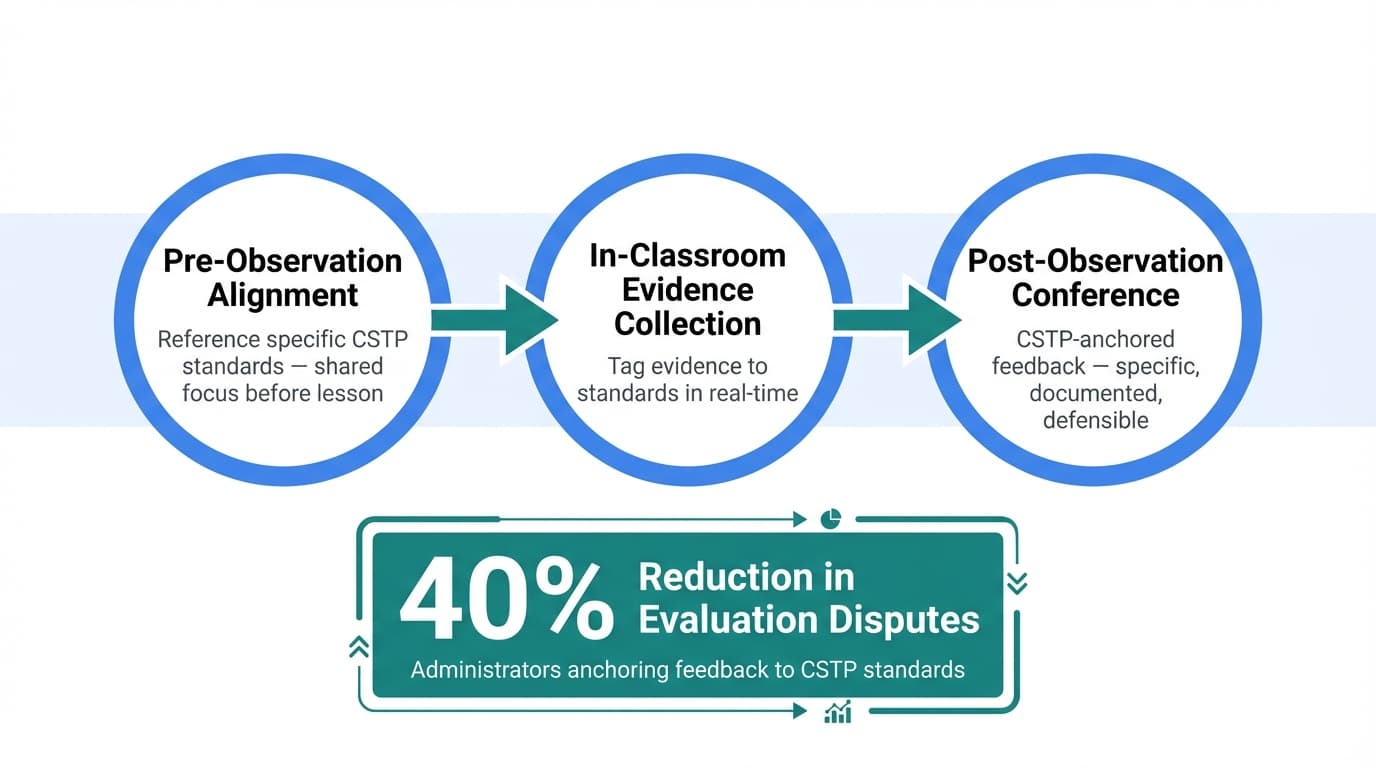
Based on our data analyzing over 10,000 digital classroom walkthroughs, administrators who anchor their post-observation feedback directly to specific CSTP standards reduce evaluation disputes by 40% and establish a highly defensible, objective record for state audits.
- Standardizing Pre-Observation Alignment: Referencing specific CSTP standards ensures both you and the teacher are on the same page before the lesson begins. When a teacher knows which standards are in focus, they can prepare with confidence, and you know precisely what evidence to look for. This shared understanding reduces ambiguity and creates a more defensible evaluation record from the start.
- Anchoring Post-Observation Feedback: Grounding your post-observation conferences in the CSTP turns a subjective chat into a structured professional growth meeting. Feedback becomes specific, professionally anchored, and easier for you to document consistently across multiple teachers and evaluation cycles.
Education Walkthrough streamlines this process by embedding the CSTP standards directly into your mobile observation tool.
Instead of flipping through binders, you can tag evidence to specific standards in real-time and share instant, growth-oriented feedback with your staff. This ensures every conversation is backed by data and aligned with California’s latest compliance requirements.
Start Optimizing Your Observation For Free Today!
Connecting Observation Evidence to the Continuum
So, what does this look like when you’re actually standing in the back of the room with a clipboard? The workflow is pretty simple: you grab the evidence of what’s happening in the moment, then map it back to the CSTP standards and growth levels later.
The result is documentation tied directly to state-sanctioned benchmarks rather than evaluator opinion.
Consistency is the key to audit-proof documentation. Using the CSTP for observation notes and evaluation reports creates a standardized record that holds up under regulatory scrutiny.
Aligning your local rubrics directly with the 2024 CSTP descriptors removes any “guessing games” for teachers. More importantly, it ensures your district stays compliant during state program reviews. This standardization protects the district while providing clear, transparent growth paths for every educator.
How Can Administrators Implement the 2024 CSTP Framework Effectively

The CSTP is more than a compliance manual; it’s a living document that grows with your staff.
The 2024 CSTP revisions explicitly mandate that California educators integrate Social-Emotional Learning (SEL) frameworks and anti-bias pedagogies directly into their daily academic instruction to satisfy state credentialing requirements.
For administrators, this framework is the ultimate balancing act. It provides the legal “teeth” needed for defensible evaluations while offering a warm, shared language for the coaching conversations that actually change classroom culture.
By strictly aligning local evaluation rubrics with the updated August 2024 CSTP developmental continuum, school districts ensure continuous compliance with Commission on Teacher Credentialing (CTC) mandates while actively reducing union grievances during post-observation conferences.
You’re building a transparent environment where every teacher, from the first-year rookie to the veteran mentor, knows exactly what the next level of excellence looks like.
District administrators utilize the Education Walkthrough platform to automatically map digital classroom observations directly to the newly revised 2024 CSTP domains, generating a legally defensible, quantitative evaluation record for mandatory state compliance audits.
Try Education Walkthrough today and make compliance a catalyst for teacher growth.