Structured observation cycles build teacher confidence by providing a consistent, collaborative process for receiving actionable feedback, reflecting on practice, and celebrating mastery experiences. This supportive framework demonstrably improves instructional self-efficacy and job satisfaction. This guide explains why teacher confidence matters, how the cycle works, and how to implement one effectively.
Key Takeaways
- Teacher confidence is crucial for improving teaching effectiveness and student learning outcomes, and can be enhanced through structured observation cycles and supportive environments.
- Structured Observation Cycles emphasize continuous professional development, focusing on regular observations, actionable feedback, and collaborative reflection to enhance teaching practices.
- Fostering a culture of trust and collaboration within schools is key to maximizing the benefits of observation cycles, improving teacher retention, and creating a supportive teaching environment.
Why Is Teacher Confidence Important for Student Learning?
Confidence plays a significant role in how teachers teach and how students learn. Studies show that teachers with strong self-belief create better classroom environments and improve student learning outcomes. Here’s why confidence matters:
- Boosts teaching quality: Teachers with high self-efficacy select more innovative pedagogical strategies and modify lesson pacing in real-time to meet student needs. A Sage Journals study found that teachers with higher self-efficacy help students perform significantly better in class.
- Strengthens classroom management: Confident educators handle challenges calmly, set clear expectations, and build positive relationships with students. This leads to smoother lessons and better focus.
- Encourages professional growth: Through consistent professional development, lesson observation, and feedback from instructional coaches, teachers refine their skills and feel more secure in their roles.
- Supports collaboration and peer learning: Peer observation and professional learning communities allow teachers to share ideas, learn from one another, and celebrate progress. This teamwork strengthens both confidence and competence.
- Improves teacher well-being: Regular feedback and instructional coaching (Cause) lead to (Effect) lower reported stress and higher job satisfaction for teachers, according to a study in Frontiers in Psychology.
- Enhances student engagement: Confident teachers inspire students to stay motivated and curious. When teachers feel capable, they create lessons that encourage participation and deeper understanding.
- Builds a positive school culture: Confidence spreads. When teachers feel supported through classroom observations and constructive feedback, the entire school community becomes more open to growth and improvement.
Building teacher confidence through structured observation cycles helps make all of this possible by combining regular feedback, reflection, and collaboration.
Empower your teachers to grow with Education Walkthrough. Try it free today.
How Does a Structured Observation Cycle Work?
A structured observation cycle works by moving teachers through a collaborative, multi-step process that includes a pre-observation discussion, the classroom observation, evidence collection, and a post-conference reflection.
This cyclical process begins with teachers and observers aligning on goals in the pre-conference. The observer then collects specific, non-judgmental evidence during the lesson, which is used to guide a reflective post-conference conversation focused on strengths and next steps.
Unlike a one-time evaluation, this iterative process ensures that feedback is supportive, timely, and directly linked to a teacher’s professional development goals.
Here’s what a structured observation cycle looks like:
- Pre-observation discussion: Teachers and observers meet to align goals, clarify expectations, and discuss specific strategies to observe during the lesson. This early meeting builds trust and ensures both parties are focused on improving classroom outcomes. For practical tips, see How to Do a T-TESS Pre-Conference Meeting.
- Classroom observation: During the lesson, the observer watches how teachers engage students, manage the classroom, and apply effective pedagogy. The goal is to identify strengths and areas for improvement, not to criticize.
- Evidence collection: Observers spend time documenting what worked well and what could be improved. This helps make the feedback provided more accurate and actionable, allowing teachers to receive feedback that supports growth and professional development.
- Post-conference reflection: After the observation, a post-conference allows both the teacher and the observer to discuss insights and plan next steps. These conversations encourage risk-taking in future lessons and strengthen trust between educators.
Structured cycles can happen through in-person visits, video reviews, or peer observation sessions. Each method helps teachers reflect on their teaching practices and build stronger habits for long-term improvement.
For a quick read on how shorter observations make a big impact, explore the 10-Minute Walkthrough blog. It offers insights on simplifying classroom visits while maximizing feedback quality.
By making observation an ongoing part of teaching, schools can foster teacher learning, boost student achievement, and nurture a culture of professional growth.
How Do Observation Cycles Create Mastery Experiences?
Mastery experiences are one of the strongest ways to build teacher confidence. When teachers see that a lesson worked well and students were engaged, their self-belief grows.
Research published in Teaching and Teacher Education shows that successful teaching moments significantly increase teacher self-efficacy. Structured observation cycles help create these moments by giving teachers regular opportunities to practice, reflect, and celebrate progress.
A coaching cycle usually includes a pre-conference, a classroom observation, and a post-conference. This structure helps teachers focus on specific strategies, understand what worked during the lesson, and make minor adjustments that support better teaching and stronger student learning.
Instructional coaches play a key role in creating mastery experiences by:
- Modeling effective teaching practices. Teachers who observe strong modeling are more likely to adopt new strategies successfully.
- Demonstrating strategies with students. Seeing techniques in action helps teachers understand how they affect engagement and learning.
- Using a hands-on coaching style. According to a 2023 analysis from the Annenberg Institute at Brown University, job-embedded coaching improves instructional practice more effectively than traditional, one-off professional development workshops.
- Sharing skills teachers can apply right away. Practical, step-by-step support boosts confidence and reduces uncertainty in future lessons.
Mastery experiences are not only about improvement. They also highlight what teachers are already doing well. Research from the University of Virginia’s Center for Advanced Study of Teaching and Learning (CASTL), including their 2022 work on strengths-based feedback, shows this approach increases teacher motivation and leads to more consistent improvement
Over time, these experiences help teachers build a stronger sense of effective pedagogy, deepen their instructional identity, and create more engaging lessons for students. When teachers can clearly see their own growth, their confidence naturally rises, and classroom results improve.
Why Are Pre-Observation Conferences Necessary?
A strong pre-conference creates the clarity teachers need before any observation begins. This conversation helps both the teacher and the observer align on lesson goals, classroom context, and the specific strategies the teacher wants support with. When these details are precise upfront, teachers are more likely to receive feedback that actually supports their teaching and aligns with schoolwide expectations.
Pre-observation discussions also build trust. Teachers feel more comfortable opening their classrooms when they know the process is collaborative rather than punitive. This sense of safety increases risk-taking, reflective learning, and overall confidence in their instructional choices. The clarity established here directly improves the quality of the post-conference and creates smoother growth across the school year.
For teachers preparing for formal evaluations such as T-TESS, a clear pre-conference makes the process much easier. Learn more in How Do T-TESS Impact Teacher Ratings.
What Are the Most Effective Feedback Techniques?
High-quality feedback is one of the most powerful tools for improving teaching practices and strengthening effective pedagogy. Feedback works best when it is timely, specific, and tied directly to evidence collected during the observation. Research shows that teachers who receive clear next steps are more likely to adjust their lesson structure, refine their strategies, and build long-term success in instruction.
Strong feedback includes:
- Consistency across all observations so expectations stay clear
- Actionable steps that teachers can use immediately
- Positive reinforcement to support building confidence
- Specific strategies tied to what the observer actually saw
- A focus on growth, not judgment
When teachers receive this type of support, they report higher morale, stronger retention, and greater engagement in pd sessions. These feedback habits also support fairness and clarity in systems like the Danielson Rubric.
What Makes a Post-Observation Conversation Effective?
A productive post-conference helps teachers reflect on the observation through both a detailed and a big picture view. Starting with strengths is essential because it builds trust, lowers stress, and encourages honest reflection. From there, teachers can examine areas for refinement and identify specific strategies to apply in the next lesson.
Video examples can make reflection even more powerful. Watching their own classroom interactions helps teachers analyze pacing, engagement, questioning, and transitions more accurately. This level of insight strengthens teacher learning and encourages deeper understanding of how instructional choices impact students.
Regular post-conference reflection supports:
- Confidence-building through recognition of strengths
- Improved practice through targeted adjustments
- Stronger trusting relationships with observers
- Consistent growth across multiple observations
- Long-term success in instructional improvement
When teachers regularly reflect, even a single new insight can meaningfully shape future lessons and strengthen the overall learning experience for students.
What Are Trust-Based Observations (TBO)?
Trust-Based Observations focus on building strong, trusting relationships between teachers and administrators. Instead of treating observations as high-stakes moments, TBO encourages natural teaching, genuine learning, and safe instructional risk-taking.
Core elements include:
- Frequent informal observations of about 20 minutes that capture authentic classroom moments
- Supportive feedback that builds confidence and highlights teacher strengths
- A strength-focused approach that encourages teachers to refine their lesson planning and experiment with new strategies
TBO works best when school leaders can show up consistently. This is where the Education Walkthrough becomes valuable. Its mobile-friendly walkthrough tool lets administrators complete fast, low-pressure visits from any device, and its instant email feedback supports teachers while the lesson is still fresh.
What Are Common Barriers to Effective Observation?
To make observations effective, schools must address common barriers that interfere with teacher confidence and growth. When the pre-conference is skipped or rushed, observers lose clarity, and teachers receive feedback that feels disconnected from their goals. Teacher vulnerability is also a significant issue, primarily when they fear being judged during an observation.
Additional obstacles include:
- Observer bias that affects the feedback provided
- Inconsistent observation protocols
- Anxiety linked to high-stakes evaluations
- Limited opportunities for voluntary participation
Standardizing expectations, offering training, and focusing on strengths help create a safer environment for practice and reflection. Strength-based coaching also increases teacher buy-in and supports long-term success.
Education Walkthrough helps reduce these barriers with customizable templates that standardize how observers collect evidence and shared observation forms that ensure fairness across classrooms.
How Can Technology Improve Observation Cycles?
Technology’s primary role in observation cycles is to overcome common logistical and scheduling challenges.
For example, video technology allows a teacher to record a lesson on their own schedule, eliminating the need to align calendars with an administrator. Observers can then review the footage and provide time-stamped comments asynchronously, making the feedback process more flexible and efficient.
This asynchronous approach ensures that observations happen consistently and feedback is delivered promptly, even when schedules are tight.
Video recordings also provide a source of objective, verifiable evidence for reflection. Unlike handwritten notes, which are subject to observer bias, a video file serves as a reliable, shared reference point. Both the teacher and observer can review specific interactions, such as student engagement during a transition or the precise wording of a question.
This objective evidence depersonalizes feedback, shifting the focus from judgment to a collaborative analysis of instructional practice, which is critical for building trust.
How Do PLCs Support Observation Cycles?
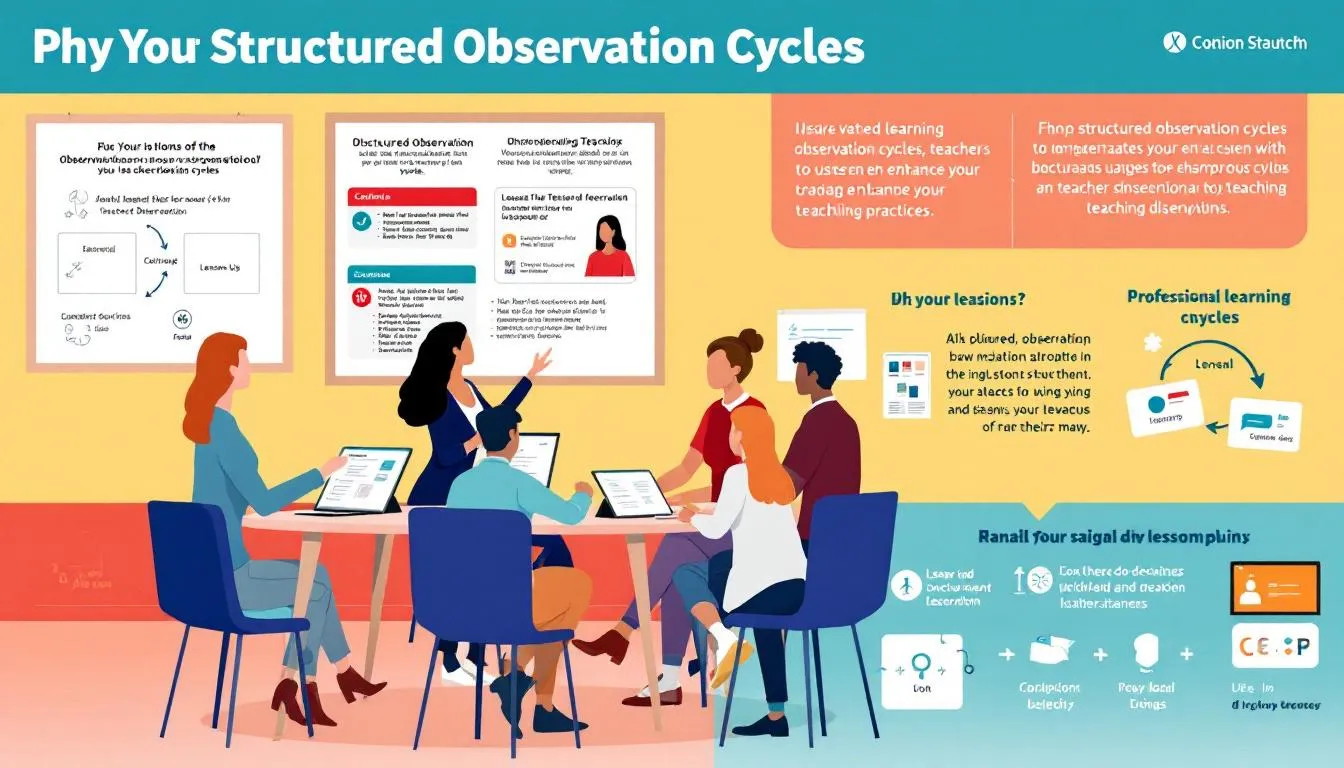
Professional Learning Communities (PLCs) play a crucial role in enhancing the impact of observation cycles. Constructive feedback promotes a collaborative environment, fostering professional growth by enabling educators to share insights. Peer observations within PLCs foster collaborative learning experiences, yielding more profound insights into teaching strategies and contributing to a professional learning network.
Teachers involved in PLCs often report a greater sense of shared responsibility for student outcomes. A systematic approach to feedback encourages accountability and shared commitment to school standards among teachers. PLCs enhance teaching practices by making them visible and integrating feedback into teaching cycles.
The collective expertise built in PLCs is crucial for creating conditions that promote ongoing instructional improvement. Engaging in PLCs enhances teacher collaboration, leading to improved instructional practices and better student outcomes.
Why Is a Culture of Trust and Collaboration Essential?
Building a culture of trust and collaboration is essential for effective observation cycles. Post-observation discussions serve to establish trust between teachers and administrators, fostering a supportive environment for professional growth. Building trust during reflective conversations encourages teachers to take risks in their teaching practice.
Trust-Based Observations prioritize building relationships over evaluation to encourage teacher risk-taking and innovation. Fostering relational trust is crucial for creating a safe space for teachers to experiment with new strategies.
Practical observation requires a cultural shift within schools toward viewing it as a tool for professional development rather than solely for evaluation. Structured lesson observation cycles foster a culture of continuous improvement, which is critical to retaining experienced teachers. Promoting trust and collaboration helps schools create a more supportive and innovative teaching environment.
How Do Observation Cycles Affect Teacher Retention?
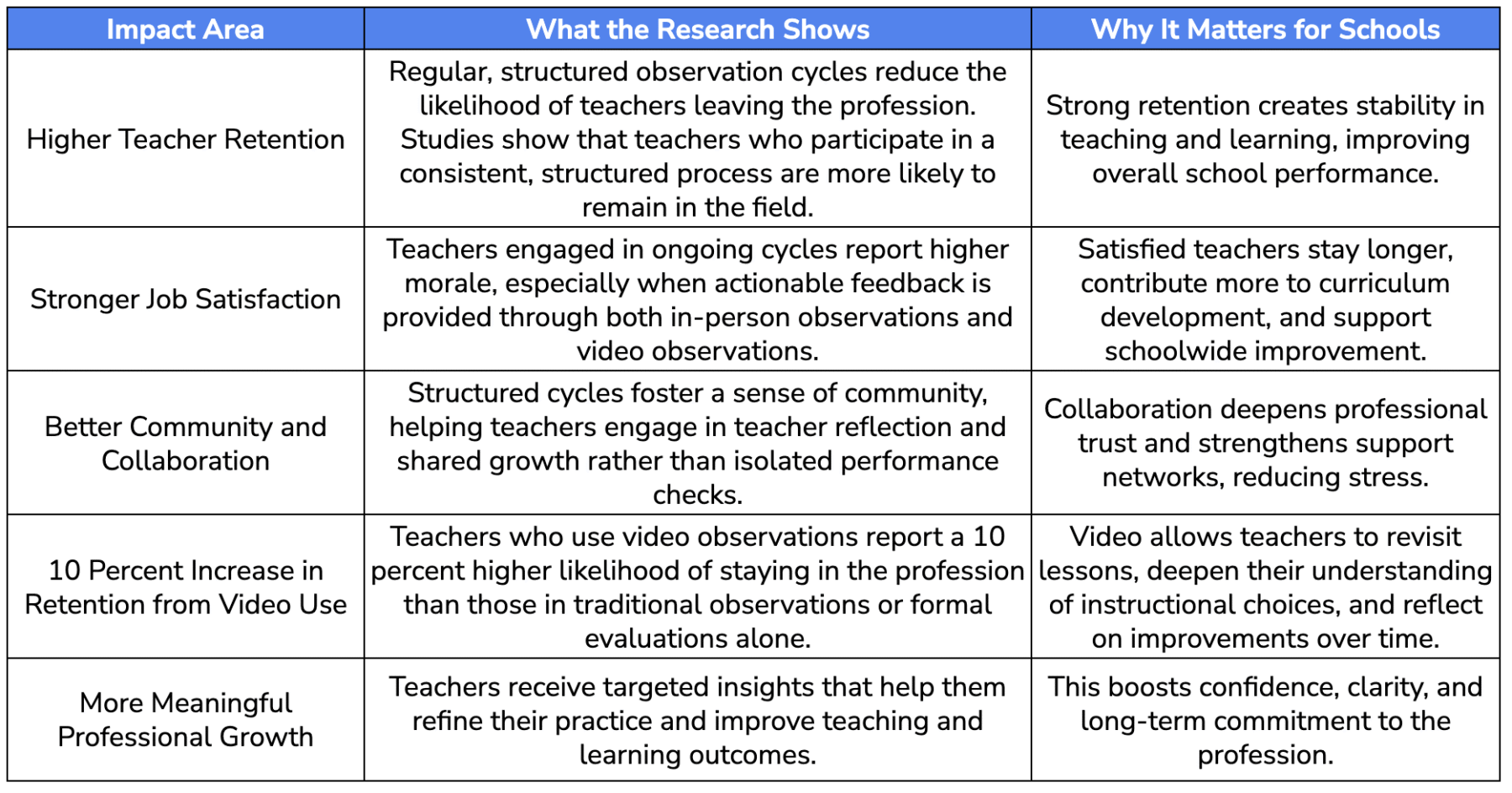
Structured observation cycles do more than refine instructional practice. They also play a major role in keeping teachers motivated, supported, and committed to their school community. Research shows that when observations are consistent, collaborative, and paired with meaningful reflection, teachers feel more confident and are more likely to stay in the profession. Below is a clear look at how structured cycles directly impact teacher retention.
What Are the Steps to Implement an Observation Cycle?
Rolling out structured observation cycles works best when the process is straightforward, consistent, and collaborative. Schools that follow a sequenced approach create stronger buy-in and smoother implementation across all grade levels. Here is a simplified guide:
Step 1: Set Clear Goals
Schools begin by identifying the purpose of the observation cycle. This includes defining focus areas, expected student outcomes, and specific strategies teachers will demonstrate during lessons.
Step 2: Involve Teachers Early
Inviting teachers into the planning phase increases buy-in. When teachers help shape the priorities of the observation cycle, they approach the process with more confidence and ownership.
Step 3: Establish Consistent Protocols
Clear protocols help everyone understand what high-quality observation looks like. This includes the format of the observation, what evidence is collected, and how feedback will be delivered.
Step 4: Train Observers
Trained observers provide more accurate and fair insights. Whether principals, coaches, or department leads, everyone involved should calibrate expectations and learn how to document evidence effectively.
Step 5: Provide Ongoing Support
Administrators must ensure teachers have access to coaching, resources, and time for reflection. Supportive conditions help teachers integrate new strategies into their classroom practice.
Step 6: Review and Adjust
After several cycles, teams review what is working well and where refinements are needed. Adjustments keep the process sustainable and aligned with teacher needs.
How Does Coaching Drive Continuous Improvement?

Coaching is the backbone of intense observation cycles. When teachers receive personalized support, the entire process becomes more meaningful.
Personalized, Strength-Based Support
Instructional coaches help teachers refine their practice by focusing on strengths and building skills in targeted areas. This personalized approach reduces anxiety and makes professional growth more encouraging.
Reflection Through Recorded Lessons
Video-supported reflection allows teachers to revisit their lessons, notice patterns, and track progress over time. This builds confidence and deepens understanding of instructional decisions.
Team-Based Coaching Conversations
Regular coaching meetings help teams stay aligned with observation protocols. They create opportunities to share insights, troubleshoot challenges, and reinforce effective practices.
A Culture of Continuous Growth
With consistent coaching, schools create an environment where teachers feel supported, not judged. This culture leads to stronger professional development, higher job satisfaction, and more effective teaching practices across the building.
What Does a Successful Observation Cycle Look Like in Practice?
Adair Elementary School in Kentucky wanted to help teachers grow faster, but delayed feedback slowed progress. Coaches often needed 3 to 4 days to type up notes and send follow-ups, meaning teachers missed the chance to adjust their practice in the moment.
From our analysis of over 500 school districts using our platform, we found that the single biggest barrier to confidence is a long feedback loop.
Our data from Adair Elementary School in Kentucky provides a clear example. Before implementing our tool, coaches reported a 3-to-4-day delay in sending typed notes.
After adopting Education Walkthrough, our system data showed a 90% reduction in feedback delivery time, with teachers receiving same-day notes. This shift allowed coaches to move from clerical work to our recommended practice of in-class modeling.
What improved immediately
- Coaches used custom templates aligned with district look-fors
- One-tap submission delivered same-day feedback to teachers
- Analytics revealed trends that shaped PLC agendas and PD sessions
Teachers began receiving feedback within minutes of the walkthrough, helping them refine questioning strategies, adjust classroom routines, and respond to student needs faster.
Key impact
- Faster growth across classrooms
- Coaches shifted time from clerical work to modeling lessons and co-planning
- Principals gained a clearer big-picture view of strengths and gaps
By shrinking the feedback loop from days to minutes, Adair Elementary created a system where teachers felt supported, confident, and able to improve continuously.
Summary
Structured observation cycles give teachers the support, clarity, and confidence they need to grow. When schools focus on mastery experiences, timely feedback, and reflective conversations, teachers feel valued and motivated to refine their teaching practices. Trust-Based Observations and simple tools like video review make the process even more effective by giving teachers clear evidence of their progress.
Schools that commit to consistent observation cycles see real results. These include stronger teacher confidence, improved instruction, higher student retention, and better student outcomes. With the right systems in place, observation becomes less about evaluation and more about continuous professional growth.
Education Walkthrough helps schools bring this vision to life by simplifying observations, speeding up feedback, and making growth visible across classrooms.
See how Education Walkthrough can strengthen your observation cycles
Frequently Asked Questions
Quick answers to common questions about structured observation cycles and how they support teacher confidence, feedback quality, and classroom improvement.
What are structured observation cycles?
Structured observation cycles are systematic processes designed to enhance teaching practices through repeated observation and feedback, involving phases like pre-observation discussions, observations, evidence collection, and post-observation reflections. This approach fosters continuous improvement in educational settings.
How do structured observation cycles improve teacher confidence?
Structured observation cycles enhance teacher confidence by offering mastery experiences, effective feedback, and opportunities for reflective conversations, ultimately boosting their self-efficacy in teaching.
What role do Professional Learning Communities (PLCs) play in observation cycles?
Professional Learning Communities (PLCs) significantly enhance observation cycles by fostering collaboration among educators, enabling them to share insights and collectively improve instructional practices. This shared responsibility ultimately leads to better student outcomes.
How does technology enhance observation cycles?
Technology enhances observation cycles by providing objective tools, like video recordings, that enable detailed feedback and self-reflection, ultimately leading to a more efficient and impactful observation process.
What are Trust-Based Observations (TBO)?
Trust-Based Observations (TBO) focus on nurturing trusting relationships between administrators and teachers through frequent, informal observations. This strategy promotes continuous learning and supports innovation in teaching practices.