The New York State APPR Evaluation System is transitioning to the §3012-e ‘STEPS’ framework, eliminating mandatory state test score requirements and expedited discipline.
This new model empowers local school districts and unions to collectively bargain multi-measure evaluation systems using a 1–4 numeric rating scale by June 30, 2032.
Meaningful evaluations require multiple measures. These tools capture the true complexity of a classroom. When leaders move beyond checking boxes to providing real-time coaching, they transform the culture of their buildings.
Effective systems prioritize people over paperwork. By diversifying the data you collect, from peer reviews to professional portfolios, you create a more accurate portrait of educator impact. This shift ensures that every evaluation serves as a bridge to better instruction rather than a hurdle to be cleared.
This guide provides district administrators with exact compliance requirements, answering critical questions including:
- How will the STEPS legislation change New York’s APPR evaluation system?
- What are the differences between legacy APPR (§3012-d) and the new STEPS model?
- How do you design a compliant STEPS plan under Education Law §3012-e?
- What are the transition timelines and submission requirements for STEPS?
Key Takeaways
- New York’s Annual Professional Performance Review system is transitioning from the legacy §3012-d model to the new §3012-e “STEPS” framework, with Governor Hochul signing Chapter 143 of the Laws of 2024 on June 28, 2024.
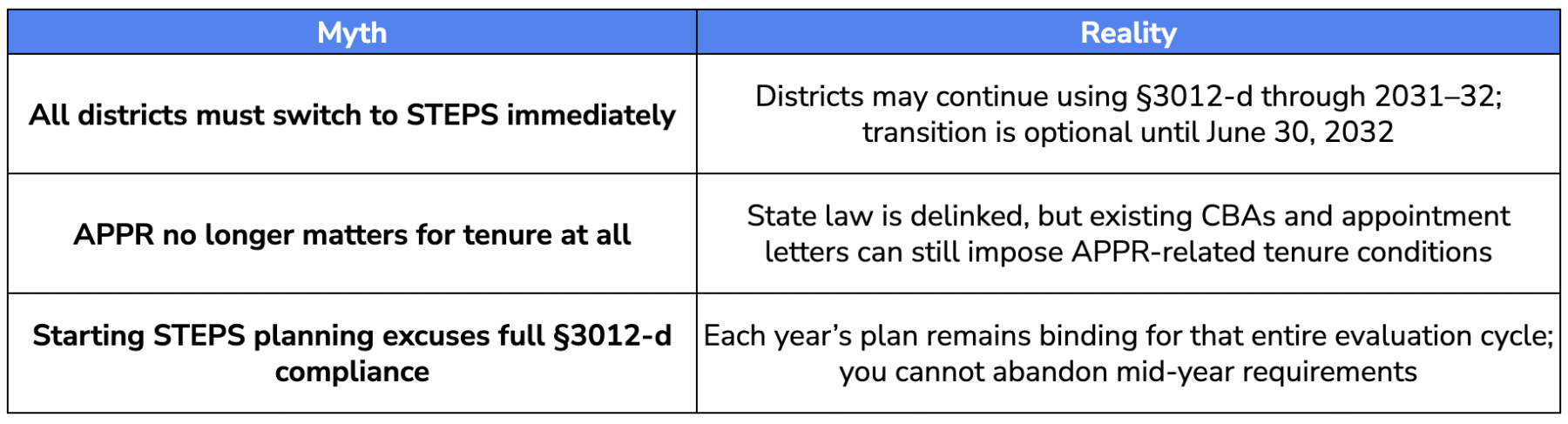
- School districts and BOCES can continue using §3012-d APPR plans through the 2031–32 school year, but must have a STEPS plan approved and in place no later than June 30, 2032.
- STEPS removes state-mandated test-score requirements and shifts to a 1–4 numeric rating scale, with plans locally negotiated between districts and unions before State Education Department approval.
- The new law eliminates expedited discipline under §3020-b and delinks APPR scores from tenure decisions at the state level, though existing collective bargaining agreements may still contain binding APPR-related provisions.
- This article focuses on how these changes affect instructional leaders’ daily observation practice, feedback cycles, and compliance obligations—not just the legal text.
How Will the STEPS Legislation Change New York’s APPR Evaluation System?
The legacy New York APPR framework generated significant administrative burden by prioritizing high-stakes standardized testing over instructional coaching.
By mandating rigid observation formulas and tying tenure to state assessment data, the §3012-d system structurally limited a principal’s ability to provide individualized feedback.
The new STEPS legislation dismantles these mandates, returning evaluation design authority directly to local districts to foster genuine professional development.
On June 28, 2024, Governor Hochul signed Chapter 143 of the Laws of 2024. This legislation amends Education Law §3012-d and introduces the new §3012-e “STEPS” framework. It is the most significant reform since 2010.
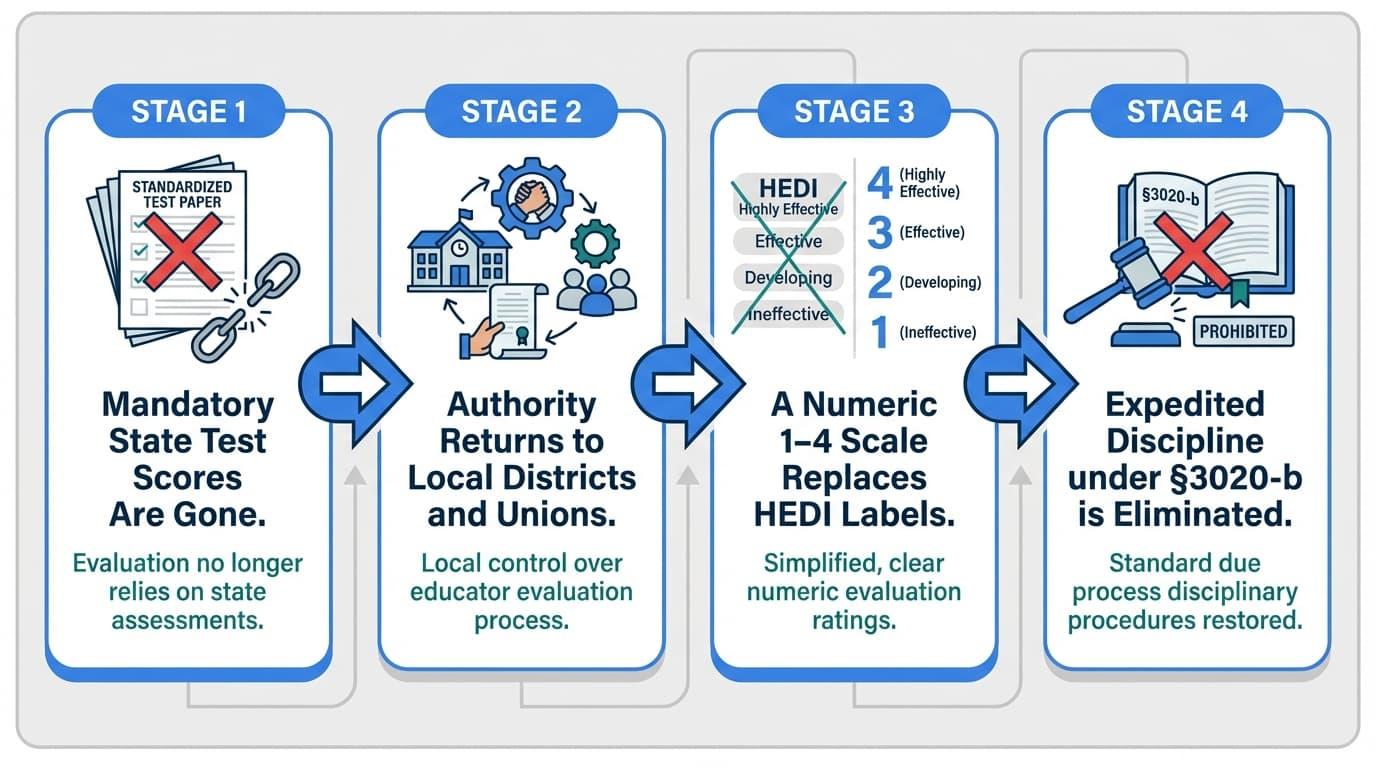
Although districts are encouraged to transition now, they have until June 30, 2032, to fully adopt the new model. Beyond the dense NYSED guidance, here is the core shift:
- Mandatory state test scores are gone.
- Authority returns to local districts and unions.
- A numeric 1–4 scale replaces HEDI labels.
- Expedited discipline under §3020-b is eliminated.
Successful implementation starts with a joint committee of administrators and teachers to negotiate the new standards.
To ensure your plan meets state criteria, contact the NYSED Office of Educator Quality and Professional Development for a preliminary review. This shift allows leaders to stop chasing compliance and start focusing on growth.

What Are the Differences Between Legacy APPR (§3012-d) and the New STEPS Model (§3012-e)?
The annual professional performance review (APPR) for classroom teachers and building principals has been required under Education Law §3012-d since 2010. The 2015-2016 budget cycle saw some revisions being made to the APPR.
But, this framework remains in effect during the transition period, and many districts continue to operate under it today.
The Compliance-Driven Architecture of Legacy §3012-d
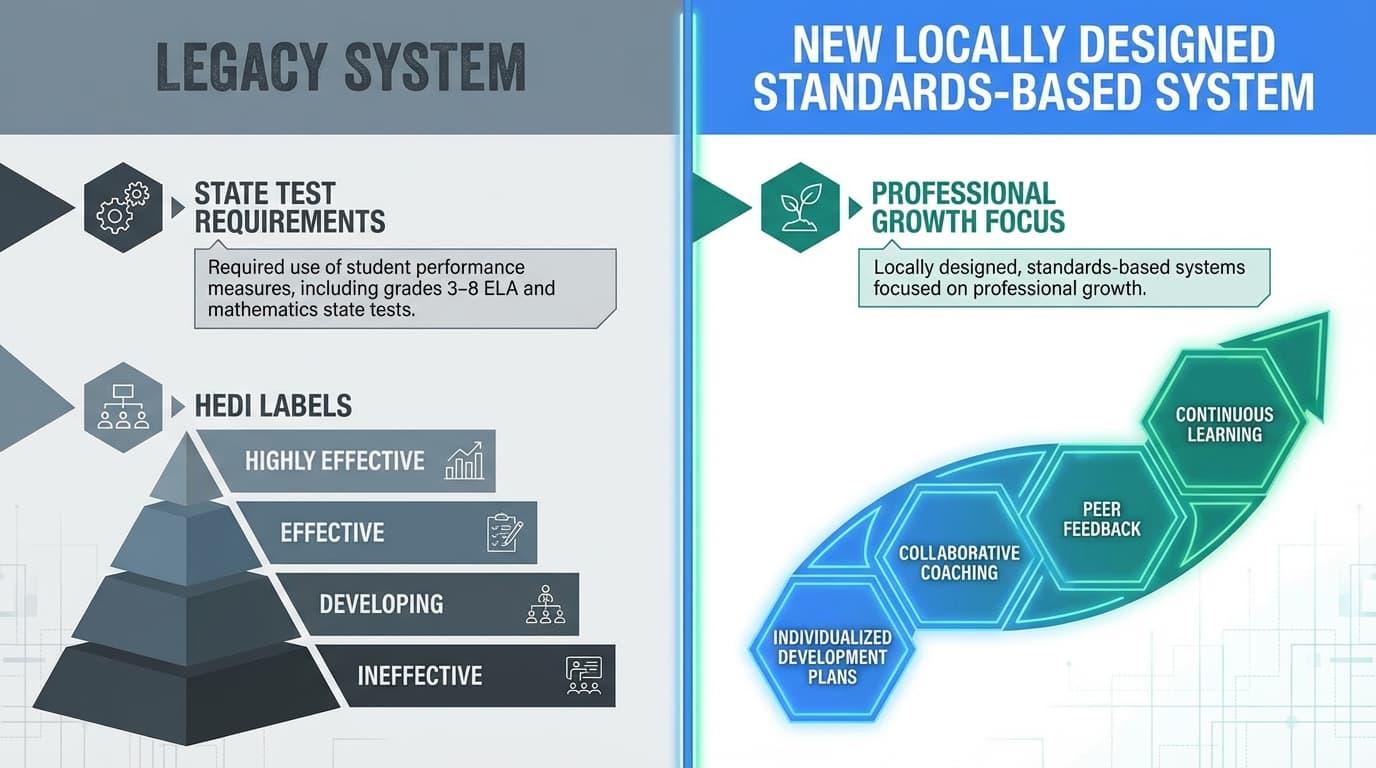
- Required use of student performance measures, including grades 3–8 ELA and mathematics state tests
- Four composite rating levels: Highly Effective, Effective, Developing, and Ineffective
- Observation structure mandating at least 80% conducted by the building principal or trained administrator, and at least 10% by an impartial independent evaluator
- All observations covering observable domains of the selected rubric (commonly the Danielson Framework for Teaching, 2013 edition)
However, educator and union concerns about overreliance on standardized tests and punitive consequences mounted quickly. In 2015, the Board of Regents enacted a four-year moratorium on using grades 3–8 assessment data in APPR decisions.
This was a temporary fix that did not result in any systemic reform.
The new §3012-e framework, branded as “Standards-based Educator Evaluation and Professional Support” (STEPS), represents a fundamental shift. Rather than a state-driven, test-heavy model imposed on districts, STEPS requires locally designed, standards-based systems focused on professional growth.
APPR applies to all classroom teachers and building principals in school districts and BOCES (Board of Cooperative Educational Services). However, this information does not extend to teaching assistants or aides. It also excludes pupil personnel titles like school psychologists or counselors.
How Do You Design a Compliant STEPS Plan Under Education Law §3012-e?
STEPS is the new APPR framework authorized under Education Law §3012-e. It inverts the basic policy architecture of the prior system by placing design authority at the local level.
The Board of Regents adopted permanent regulations for §3012-e on March 26, 2025, codified in 8 NYCRR Subpart 30-4. This immediately triggered the ability for districts and BOCES to begin negotiating and submitting STEPS plans for implementation.
Mandatory Collective Bargaining and Local Control Features of STEPS
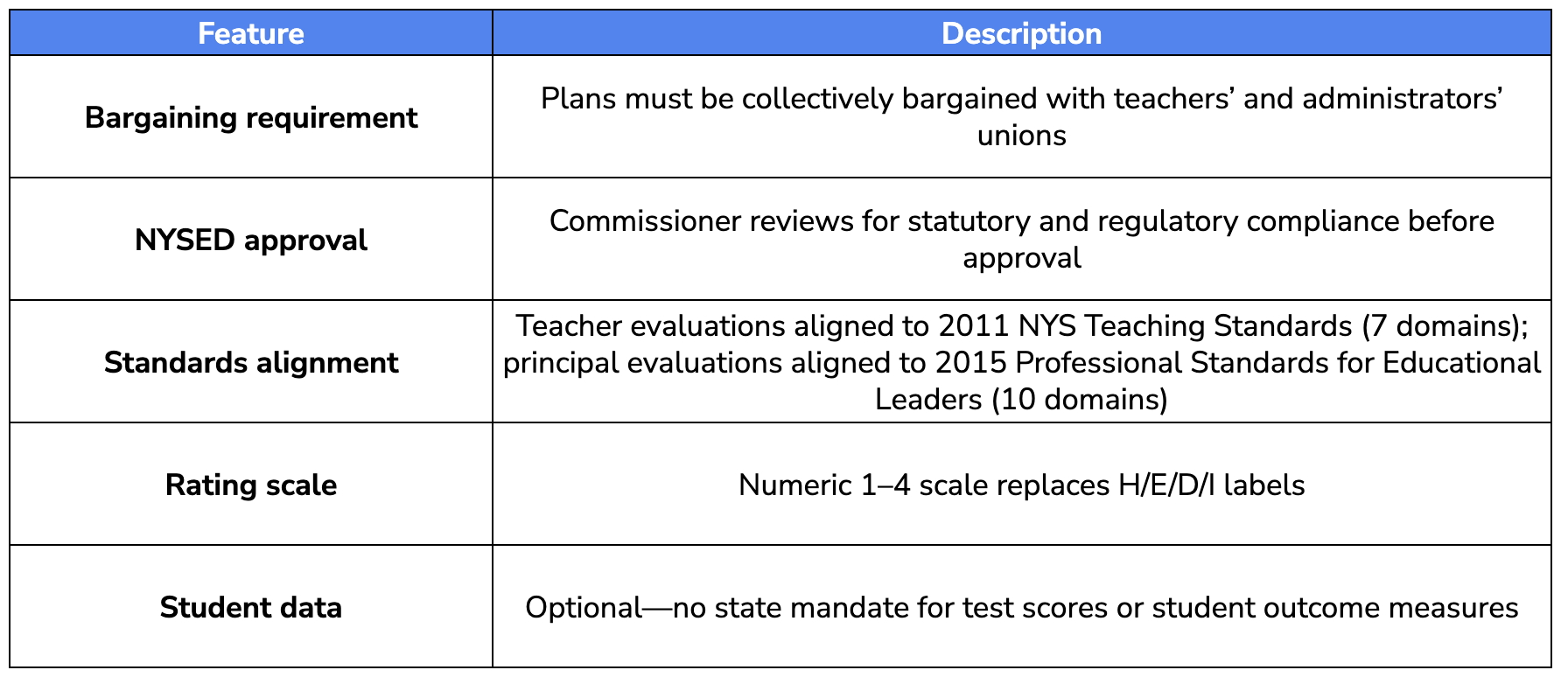
Student achievement data, like standardized test results, is no longer required in the state framework. Districts may include such data as one of several measures, but the choice is local.
Many school districts transitioning to STEPS are explicitly excluding state test data, while others are incorporating locally designed measures of student learning aligned to their instructional priorities.
A locally negotiated STEPS plan can incorporate diverse, multi-measure evaluation instruments, including:
- Classroom Observations: Utilizing a locally adapted rubric to assess specific instructional standards.
- Collaborative Goal Setting: Tracking professional learning targets developed jointly by teachers and building principals.
- Educator Portfolios: Compiling peer collaboration evidence and diverse student work samples.
- Stakeholder Surveys: Analyzing structured feedback from students, peers, or community members.
- Optional Outcome Data: Utilizing locally selected student achievement metrics, completely detached from state testing mandates.
The Smithtown CSD STEPS plan, approved in July 2025 and posted publicly on NYSED’s website, illustrates how a district with strong administrative capacity can design a sophisticated multi-measure system using all of these elements.
Transforming Compliance into Coaching at Lynwood Christian Academy
Before transitioning to Education Walkthrough, Lynwood Christian Academy (LCA) relied on a single spiral notebook to document instruction. When an upcoming accreditation visit demanded hard evidence of teacher growth, Director Eva Mitchell realized that “sticky-note compliments” wouldn’t suffice.
Instead of using generic state forms, LCA used the Education Walkthrough to build custom templates that reflect their specific standards. Teachers received these rubrics in advance, turning observations into transparent coaching sessions rather than high-stakes surprises.
The impact was immediate. By spring, the school’s dashboard revealed clear instructional trends, allowing leaders to target professional development exactly where it was needed. When accreditors arrived, LCA provided a single export showing time-stamped evidence of growth. By turning a “compliance headache” into a strategic design opportunity, LCA proved that custom-built evaluation systems fuel culture, accountability, and continuous improvement.
Read the Full Lynwood Christian Academy Case Study
What Are the Transition Timelines and Submission Requirements for STEPS?
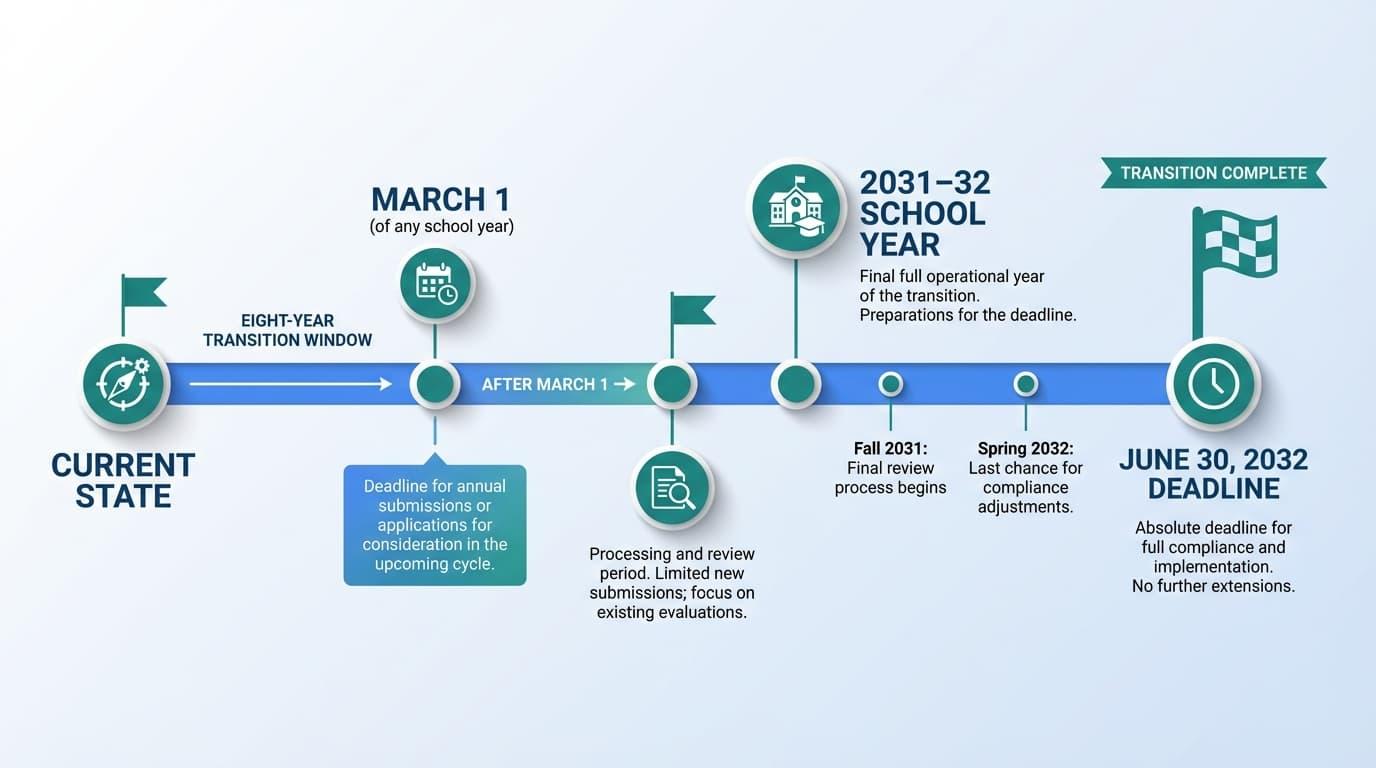
New York is in an eight-year transition window during which both §3012-d and §3012-e can legally operate. However, each district must select one framework at a time for each group of educators and maintain it for a full evaluation cycle.
Critical State Deadlines for the 2032 Transition Window
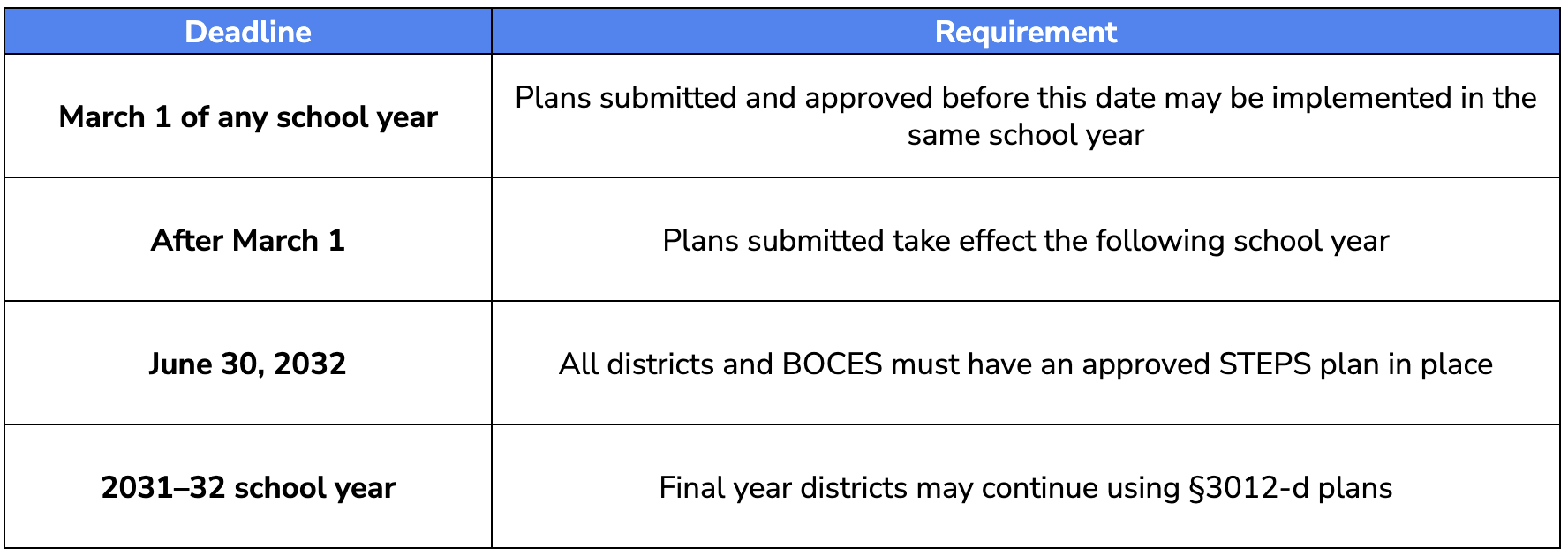
District administrators must collectively bargain their STEPS plans with local unions and subsequently submit the finalized documents through the NYSED Business Portal, ensuring the inclusion of cryptographic signatures from the superintendent, Board of Education president, and applicable union presidents.
The Commissioner reviews for compliance with statute and regulations before granting approval. Once approved, NYSED posts STEPS plans publicly on its website, and plans remain in effect until formally amended or replaced.
Strategic Planning Frameworks for District Administrators
For administrators and district leaders, the March 1 deadline creates a practical rhythm. If your district wants to implement STEPS in the 2026–27 school year, you need a fully negotiated, submitted, and approved plan before March 1, 2027. This means bargaining negotiations should begin in fall 2026 at the latest and ideally earlier.
Involve HR, legal counsel, union leadership, and instructional leaders early. Rushed negotiations and last-minute compliance issues create both legal risk and damaged labor relationships.
What Are the Core Components of a Compliant STEPS Evaluation Plan
Under 8 NYCRR Subpart 30-4, all STEPS plans must be standards-based and multi-measure, requiring districts to generate defensible, documented evidence of practice for every classroom teacher and building principal.
Mapping Scoring Rubrics to NYS Teaching Standards
Each NYS Teaching Standard (for teachers) and each Educational Leadership Standard (for principals) must have one or more measures tied to it, with:
- A clear scoring rubric or instrument mapped to specific standards
- A process to translate evidence into a 1–4 standard score
- Documentation that provides “direct evidence” of professional practice
Local Flexibility in Classroom Observation Frequency and Structure
Districts may adopt a variety of evidence-based instruments to create a more holistic view of professional practice.
- Educator portfolios of student work samples and instructional materials
- Professional goal setting and attainment of locally developed goals
- Stakeholder surveys (colleagues, supervisors, students)
- Teacher or principal projects demonstrating practice
- Optional student outcome data aligned to standards
All measures must be implemented in ways that are transparent, consistently scored, and feasible for evaluators to manage across the school year. The regulations specify that evidence must be “direct” (not inferred), “appropriate” (matched to the specific standard), and “accurate” (reliably scored).
Managing a multi-measure system shouldn’t mean managing a mountain of paperwork. Education Walkthrough streamlines the collection of portfolios, goal-attainment data, and rubrics into one defensible dashboard. We ensure your STEPS plan is transparent, accurately scored, and easy to execute.
Try Education Walkthrough for free
Observation Flexibility Under STEPS
The bill signed by Governor Hochul eliminates the strict state formulas of §3012-d, including the “80-10” independent evaluator requirement. Observation frequency and structure are now locally determined.
State regulations establish bare minimums:
- Probationary Teachers: Two observations per year.
- Tenured Teachers: Two observations per evaluation cycle.
Districts have substantial flexibility above these minimums. A STEPS-aligned system might favor fewer but more focused classroom visits.
For example, feedback conversations can center on the 2–3 specific NYS Teaching Standards a teacher is targeting for growth. This creates an opportunity to transform observations from compliance checkpoints into genuine coaching conversations.
How Does STEPS Change Tenure Eligibility and Educator Disciplinary Processes?
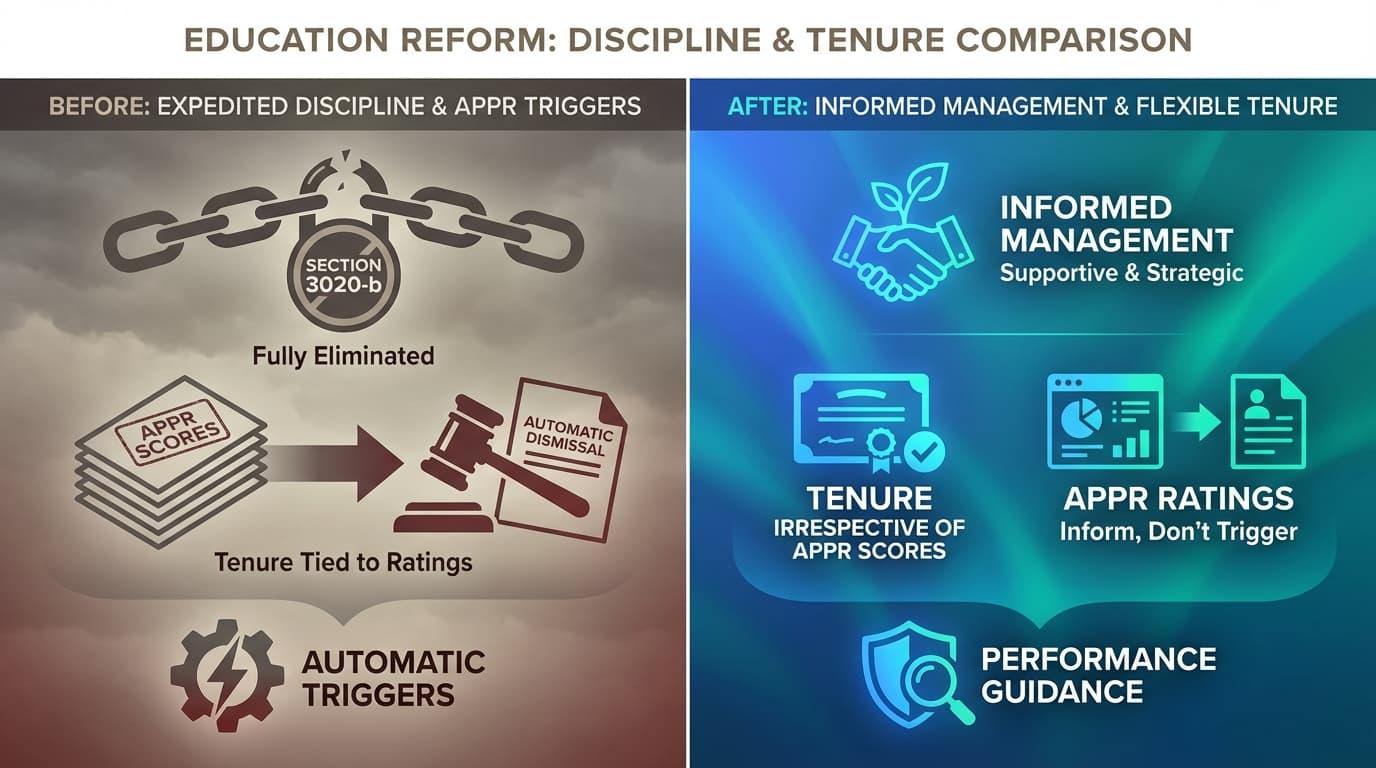
The 2024 reforms fundamentally changed the stakes attached to APPR ratings, particularly regarding tenure decisions and expedited discipline processes.
The Elimination of Section 3020-b Expedited Discipline
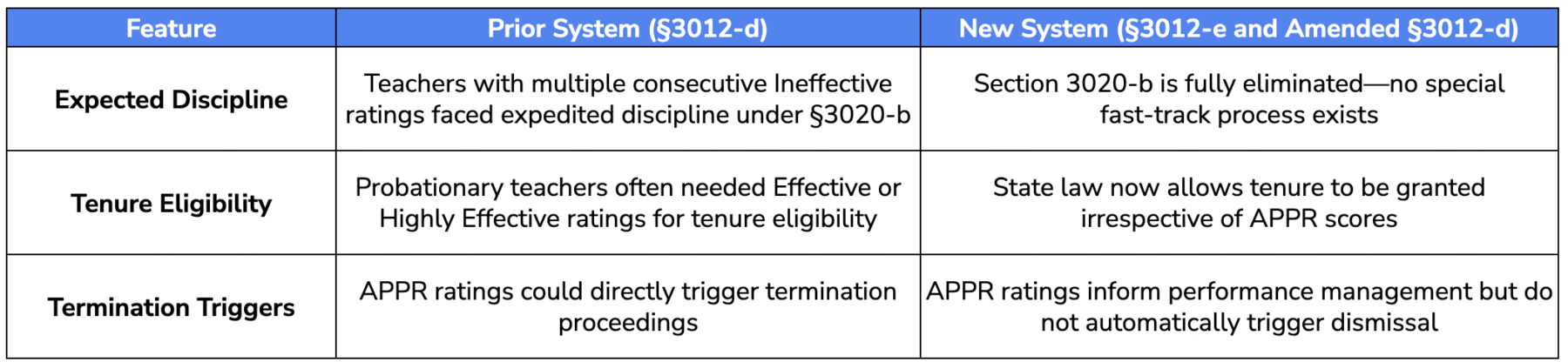
The elimination of §3020-b applies to both legacy §3012-d plans and the new STEPS framework. Even districts staying with the old model are no longer charged with managing the expedited discipline track.
Navigating Legacy Tenure Conditions in Active Collective Bargaining Agreements
In our audits of over 50 transition plans, we have found that while state law formally delinks APPR from tenure, existing Collective Bargaining Agreements (CBAs) frequently contain legacy language legally conditioning tenure upon ‘Effective’ ratings. District administrators must legally audit all active appointment letters before granting tenure
For example, if a contract requires an “Effective” rating for tenure, that provision remains binding until the parties renegotiate the terms.
Districts should audit current contracts and consult legal counsel on pending cases. It is vital to update board policies to reflect the new legal landscape while maintaining high performance expectations.
The general discipline statute (§3020-a) remains fully available. Leaders can still address chronic low performance through documented feedback, robust support plans, and formal proceedings when necessary.
How Will STEPS Transform Daily Workflows for Instructional Leaders?
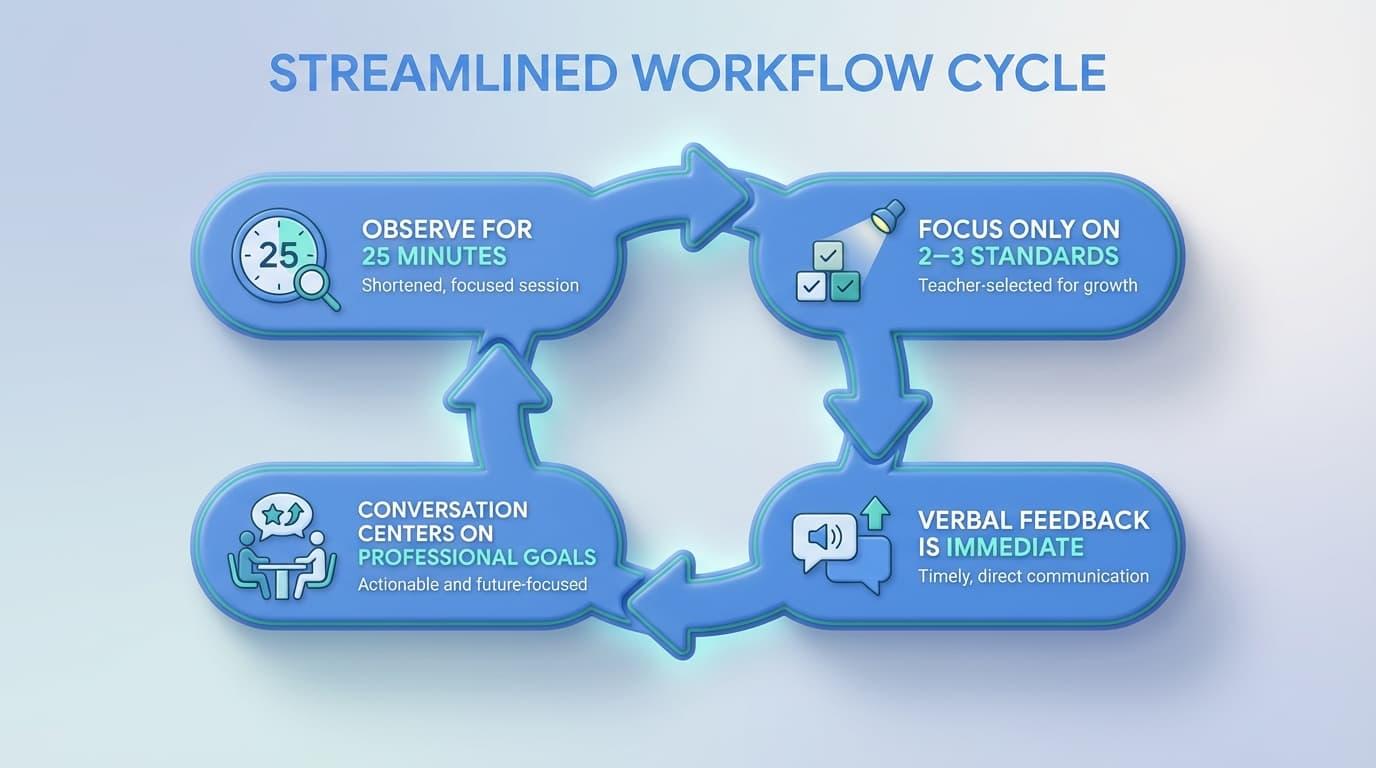
STEPS moves the needle from compliance to daily workflow. It allows school leaders to redesign how they spend their time.
Reducing the Administrative Burden of §3012-d Compliance
The legacy §3012-d framework generated a massive administrative workload by requiring building principals to conduct up to 40 formal observations annually, complete with mandatory pre-meetings, rubric scoring, and Student Learning Objective (SLO) data collection.
This rigid compliance architecture routinely consumed 20% of an administrator’s contractual year, directly impeding their ability to provide targeted, real-time instructional coaching.
For a leader on a 240-day contract, that is 40 days lost. These are days not spent on coaching. Strategic leadership suffers when paperwork takes over.
Transitioning from Rote Scoring to Targeted Instructional Coaching
Local flexibility changes the game. Districts can now simplify calendars and cut redundant paperwork. Visits become shorter but higher in quality. The goal shifts from form compliance to meaningful feedback.
Consider this contrast:
- Legacy approach: You conduct a 45-minute observation. You score 76 Danielson elements. You write a 3-page report and hold a long post-conference. The focus is the rubric.
- STEPS-aligned approach: You observe for 25 minutes. You focus only on 2–3 standards the teacher selected for growth. Verbal feedback is immediate. A brief summary follows. The conversation centers on professional goals.
Ensuring Inter-Rater Reliability Through Quarterly Calibration
Inter-rater reliability remains a significant compliance risk because distinct evaluators frequently apply subjective interpretations to NYS Teaching Standards, resulting in inconsistent numeric ratings across different school buildings.
Districts should schedule quarterly calibration sessions. Administrators can score the same video and discuss the results. This identifies if someone is rating too strictly or too leniently. It allows for better coaching on rubric interpretation.
Practical strategies like the following help reduce the burden.
- Use consistent forms.
- Adopt digital platforms with evidence tags.
- Set clear timelines for feedback to ensure you meet NYSED requirements without drowning in files.
Education Walkthrough makes navigating these New York regulatory shifts effortless by mapping your locally designed STEPS rubrics into a mobile-friendly interface. You can capture direct evidence on the go and deliver same-day feedback with one tap.
What Are the Common Compliance Risks and Myths of the STEPS Transition?
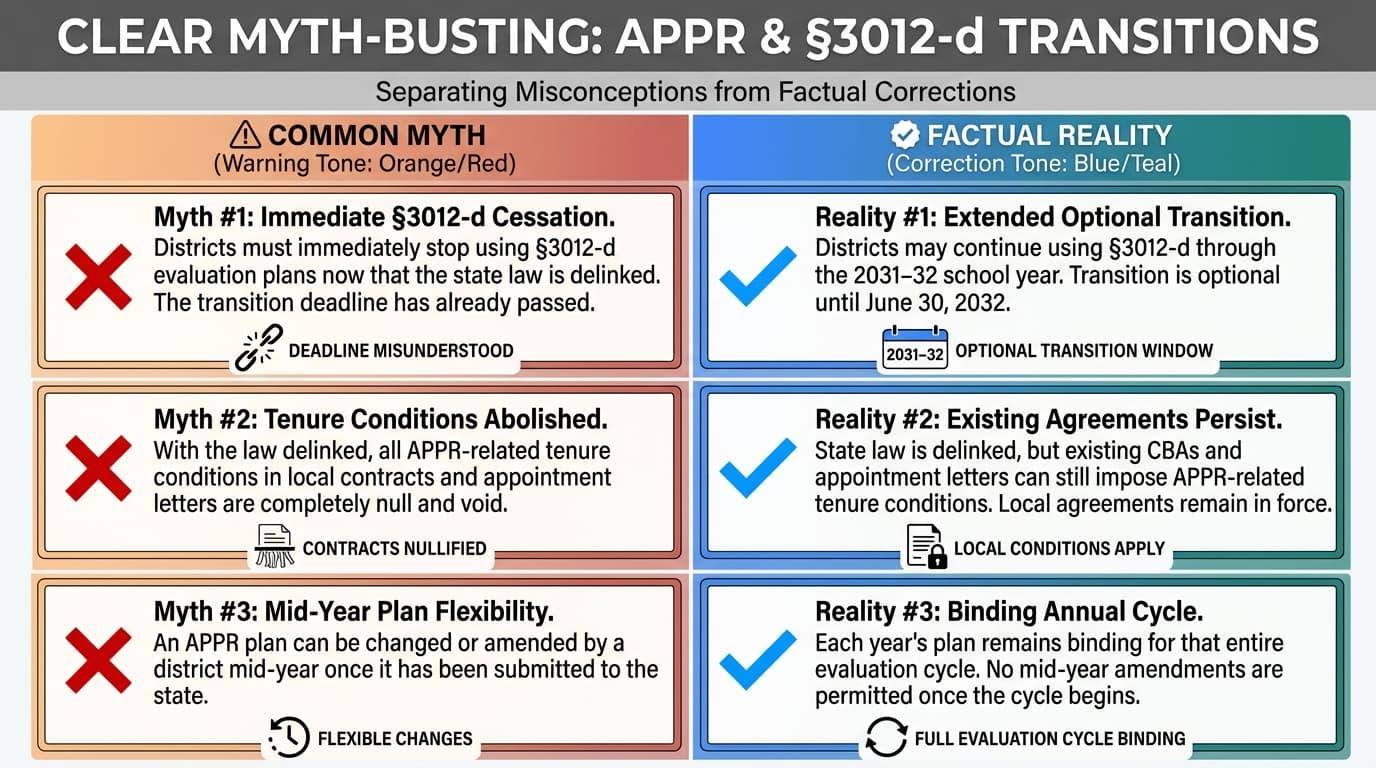
Confusion is common whenever state evaluation systems change. Here are the misconceptions and real risks that trip up districts most often.
Myth vs. Reality
Compliance Risks to Watch
- Dual-track confusion: Districts operating under §3012-d must maintain full compliance with legacy rules. This includes the “80-10” observation formula. Negotiating a future STEPS plan does not erase current legal obligations. Early transitions never eliminate legacy requirements mid-stream.
- CBA override complexity: The de-linkage of APPR from tenure is significant but not absolute. Many active contracts contain specific APPR-conditioned tenure language. Districts must audit all appointment letters to identify these binding provisions.
- Enforcement uncertainty: As of early 2026, NYSED hasn’t released final enforcement protocols for §3012-e non-compliance. To mitigate risk, districts are designing conservative plans. They often include more measures than the bare minimum to ensure they withstand state scrutiny.
Unresolved Issues and Future Outlook
Research on STEPS remains limited. No districts have finished a full cycle to report definitive data. Community perception is also evolving.
Parents may question how removing state test mandates impacts classroom rigor. Leaders must clearly explain how standards-based feedback ensures quality. Stay close to NYSED updates as peer implementation data finally becomes available.
FAQ: New York State APPR / STEPS Evaluation System
How does the new STEPS system change the role of student test scores?
The §3012-e framework removes the statewide mandate to use standardized test scores in teacher evaluations. Student outcome data is now strictly optional. Districts and unions must locally negotiate whether to include these measures. Leaders should communicate clearly with staff about which specific data points will remain part of the local plan.
Can a school district switch to STEPS in the middle of a school year?
No. You cannot change systems mid-cycle once observations have begun under a specific framework. While plans approved by March 1 can technically be implemented that same year, districts should align transitions with the start of a new school year. This prevents confusion, ensures consistency, and avoids potential labor-related legal disputes.
Who is required to be evaluated, and who is excluded?
The system applies to all classroom teachers and building principals in school districts and BOCES. It does not apply to teaching assistants, teacher aides, or pupil personnel titles like school psychologists and counselors. To comply with state law, your HR systems must clearly distinguish these roles to avoid misclassification during mandatory reporting.
Does eliminating §3020-b make it harder to address low performance?
While the “fast-track” discipline for poor ratings is gone, the general disciplinary process under §3020-a remains fully available. Leaders can still address performance issues through documented feedback and support plans. The path is simply no longer automatically triggered by APPR scores alone, requiring more comprehensive documentation of a teacher’s practice.
Where can I find examples of approved STEPS plans?
NYSED publicly posts approved STEPS plans on its official website. Reviewing plans from districts of similar size and configuration helps you balance rigor with practical feasibility. These public documents serve as excellent starting points for local design conversations. They help ensure your customized measures align perfectly with state instructional priorities.