


A classroom management plan becomes useful when school leaders can see whether it’s actually working in daily instruction.
Three goals make that possible:
- Clear routines and expectations
- Productive student engagement
- Consistent, non-punitive responses
During brief classroom walkthroughs, principals and instructional coaches can gather evidence related to each goal without turning the visit into a formal evaluation. Repeated observations then create a stronger basis for focused, supportive coaching.
In this guide, we’ll go over the three goals every classroom management plan should have as well as how to measure them to track and improve performance.
Key Takeaways
- Students know what to do, how to transition, and where to find materials without repeated directions.
- Students actively complete the intended work rather than simply appearing quiet or compliant.
- Teachers address disruptions calmly and predictably while protecting instructional time.
- Leaders should look for patterns across several low-stakes visits rather than drawing conclusions from a single snapshot.

What Are the Three Goals of a Classroom Management Plan?
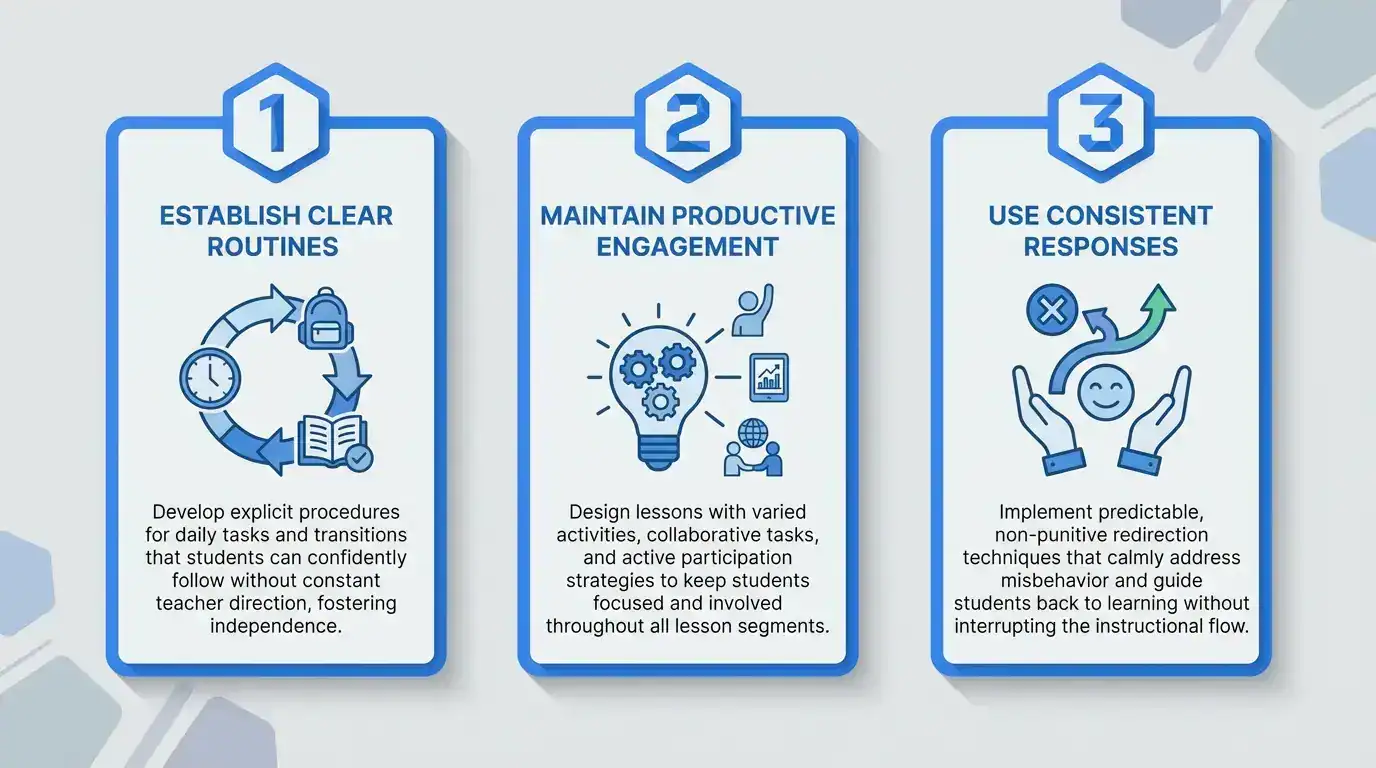
The strongest classroom management goals describe the results that leaders and teachers can observe as part of an effective classroom management plan. They connect effective classroom management to a shared focus for noticing conditions, discussing evidence, and choosing a manageable next step.
- Goal 1: Establish clear routines and expectations that students can follow independently.
- Goal 2: Maintain productive student engagement throughout different parts of the lesson.
- Goal 3: Use consistent, non-punitive responses that redirect behavior without disrupting instruction.
These goals focus on what successful implementation looks like, and a well-crafted plan serves as a reference for teachers and students.
Teachers and leaders who need to build a broader planning process can use this resource for building a complete classroom management plan, including rules, procedures, classroom organization, and family communication.
Goal 1: Create Clear Routines and Classroom Expectations
Routines protect learning time by allowing students to follow them without waiting for repeated reminders. Expectations are also more useful when teachers establish rules with specific expectations and clear and consistent boundaries so students understand what they look like because they are modeled, practiced, and revisited, rather than merely posting them on a wall.
A 2023 meta-analysis found that teacher-provided structure, including clear expectations and predictable guidance, was positively associated with students’ engagement, competence beliefs, and achievement, supporting student success and a stronger learning environment.
Observable Look-Fors for Routines
A short walkthrough can’t show every part of a teacher’s management plan. It can, however, capture concrete evidence of whether classroom routines reduce uncertainty and help students work independently.
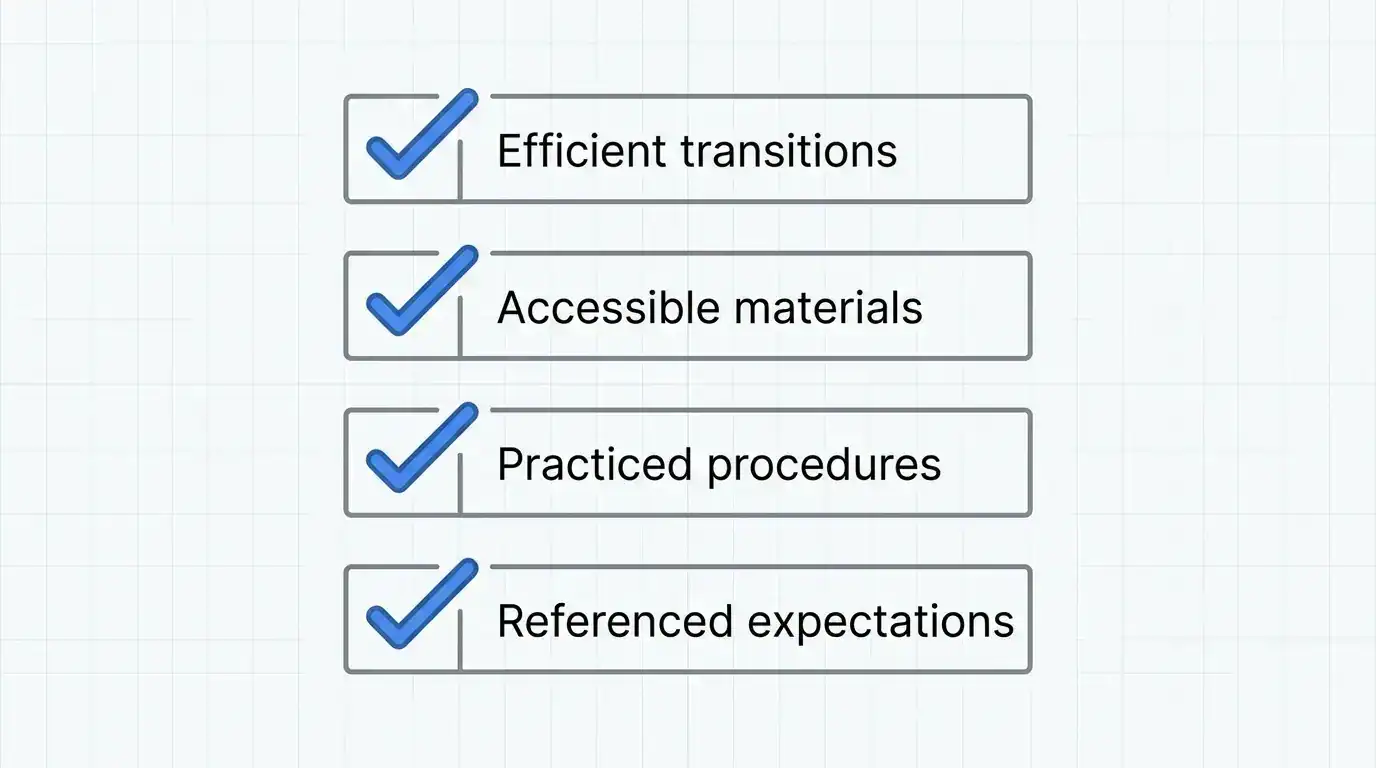
- Efficient transitions: Students respond to a familiar cue and move between classroom activities with minimal waiting or repeated direction.
- Accessible materials: Students know where supplies are located and can retrieve or return them without stopping the lesson.
- Practiced procedures: Common tasks, such as submitting work or requesting help, follow a process students recognize.
- Referenced expectations: The teacher uses specific, student-friendly language that connects redirection to established classroom rules.
Coaching Questions for Routines
The follow-up conversation should help the teacher interpret the evidence, not defend the classroom. Leaders can use questions such as:
- Teaching the routine: Which routine required the most practice, and what tells you students now understand it?
- Finding the friction point: Where do transitions still slow down or require repeated reminders?
- Planning the next step: Which procedure would save the most instructional time if students could complete it more independently?
Goal 2: Strengthen Productive Student Engagement and Positive Behavior
A calm classroom isn’t automatically evidence of students engaged in learning. Productive engagement means students are doing the intended cognitive or collaborative work, and teachers should teach engaging content that supports active participation, whether that involves writing, discussing, reading, revising, solving, or practicing.
Leaders should therefore look beyond noise level and record what students are actually doing during the visit, since students learn more effectively when the environment is approachable and structured, which can encourage positive behavior and reduce behavior problems.
Observable Look-Fors for Engagement
Engagement may show up first in how the whole class responds, even though it still looks different by subject and grade level, so the evidence should match the learning task. These look-fors keep the walkthrough grounded in observable behavior rather than assumptions about student motivation.
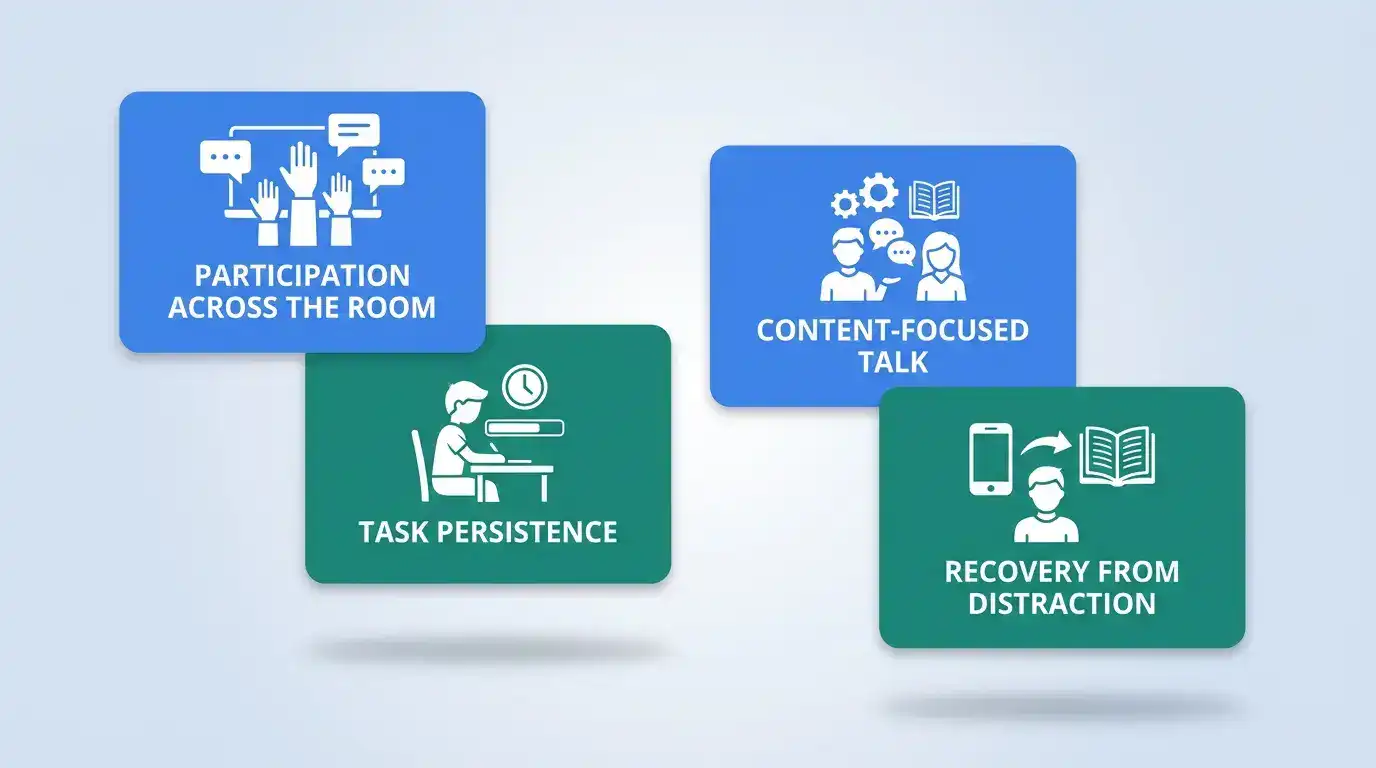
- Participation across the room: More than the same few students contribute, respond, or demonstrate their thinking, including whether middle school students and peers in different parts of the room are participating.
- Task persistence: Students continue working when the teacher moves away or begins supporting another group.
- Content-focused talk: Student questions and conversations remain connected to the lesson objective or task.
- Recovery from distraction: Student behavior returns to the task independently or after a brief prompt.
The What Works Clearinghouse found positive effects on classroom behavior for CW-FIT, an approach that explicitly teaches classroom skills and reinforces their use. View the CW-FIT evidence snapshot.
Coaching Questions for Engagement
These questions help leaders and teachers distinguish active learning from passive compliance:
- Interpreting the task: What would productive engagement look or sound like during this part of the lesson?
- Noticing participation: Which students entered the task quickly, and which students needed another access point?
- Adjusting instruction: Where did engagement change, and what was happening in the lesson at that moment?
Goal 3: Use Consistent, Non-Punitive Responses
As part of effective classroom management, responses should be predictable, proportionate, and brief so teachers can address student misbehavior calmly.
The goal isn’t to remove every disruption; it’s to help the teacher redirect behavior while maintaining student dignity and keeping the rest of the class engaged.
Consistency matters more than severity, and clear rules and consequences help because inconsistent enforcement creates confusion among students, as they can respond more quickly when expectations and corrections remain familiar.
Observable Look-Fors for Responses
One incident cannot establish a teacher’s usual response pattern. Leaders can still record low-inference details during each visit and examine whether the same pattern appears over time.
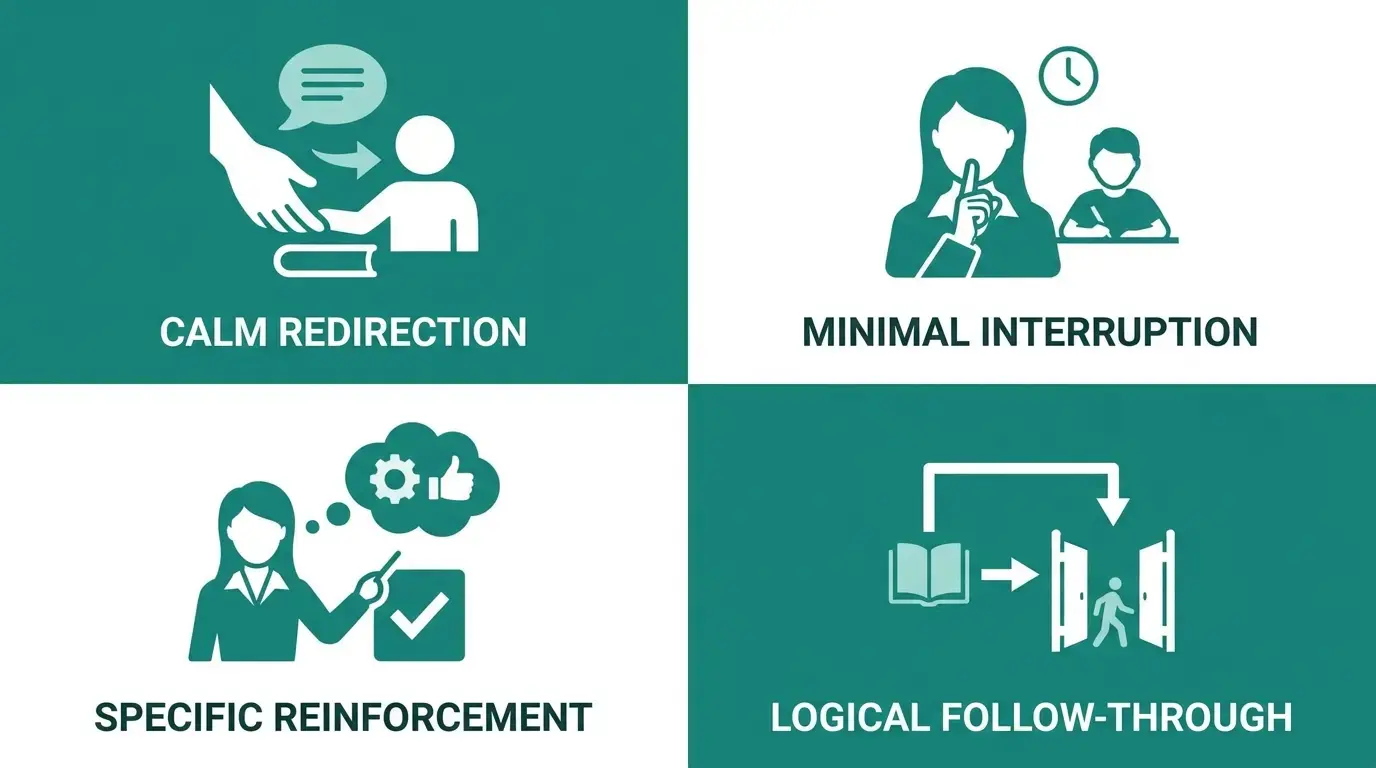
- Calm redirection: The teacher uses a neutral tone and avoids turning a minor disruption into a public confrontation.
- Minimal interruption: Instruction and student work continue while the teacher responds.
- Specific reinforcement: The teacher names the specific behavior being reinforced rather than relying solely on general praise, using options such as verbal praise and positive notes home, which can improve student behavior and engagement.
- Logical follow-through: The response connects to the behavior and aligns with classroom and schoolwide expectations through consistent consequences.
The Institute of Education Sciences identifies clear expectations, reminders, positive attention, instructional choice, and opportunities to respond among evidence-based classroom behavior management practices.
Coaching Questions for Consistency
Questions about responses should remain specific and growth-focused. Useful prompts include:
- Checking predictability: Which behaviors receive the same response each time, and where is consistent follow through harder to maintain?
- Protecting instruction: Which positive strategies helped reinforce positive behavior and return students to learning with the least interruption?
- Aligning systems: How does the classroom response connect with the language or expectations used across the school and in the school’s policies?
How the Three Goals Change Across Grade Levels
The goals remain stable from elementary through high school across the full school year, but the evidence changes as students gain independence, including how behavioral issues show up and how students learn independence.
Leaders should calibrate their look-fors to the grade level, lesson format, and learners’ needs before entering the classroom.
| Grade Band | Routines | Engagement | Responses |
|---|---|---|---|
| Elementary | Visual cues and practiced transition signals for young learners | Hands-on work, partner talk, and visible participation | Short prompts, modeling, and consistent boundaries |
| Middle school | Student-managed materials and familiar procedures within a predictable system | Sustained individual or group work with quick recovery | Private redirection and predictable follow-through |
| High School | Posted agenda and independent entry tasks | Task persistence and subject-specific discussion | Brief, respectful correction that preserves autonomy |
How Leaders Can Use the Goals Across Repeated Walkthroughs
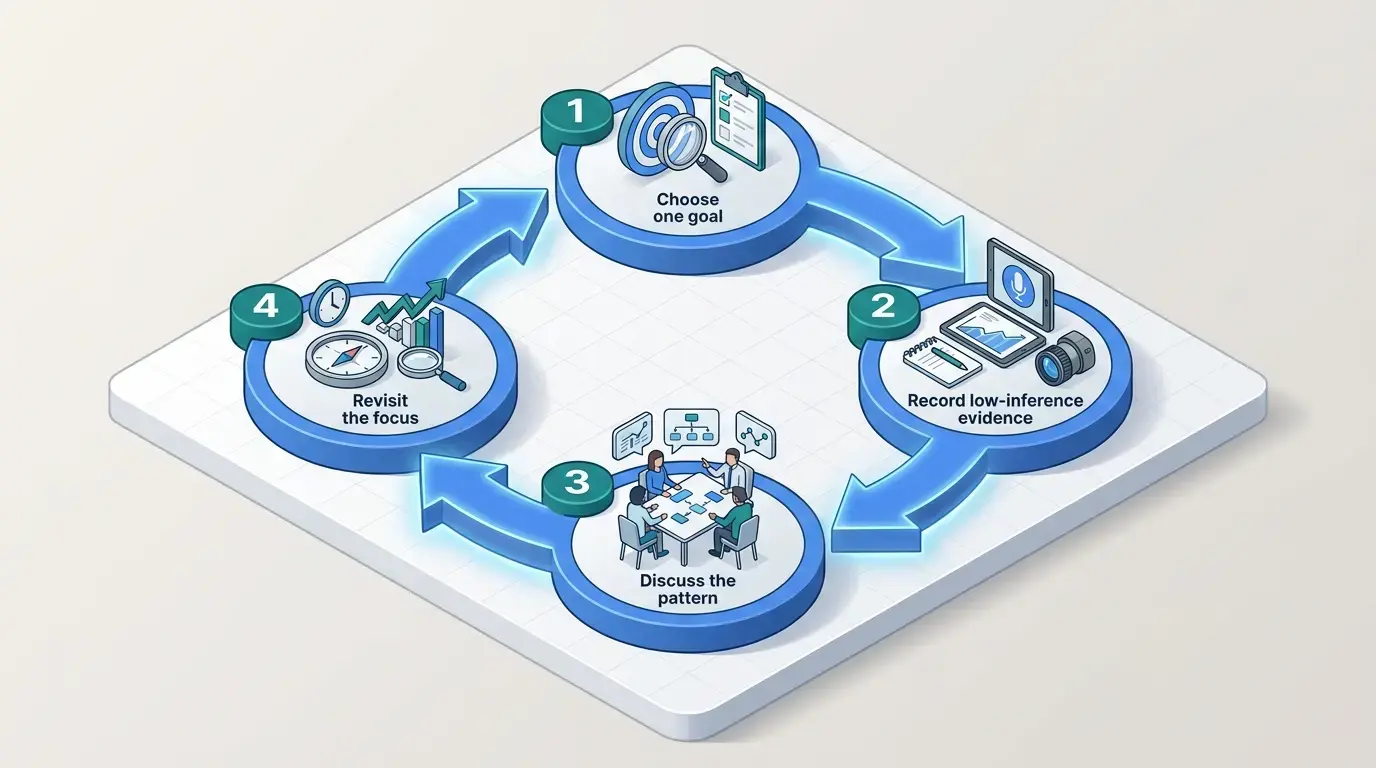
A classroom walkthrough is a brief, low-stakes snapshot, not a formal teacher evaluation. Its value comes from repeating the process, sharing evidence, and returning to an agreed coaching focus. Leaders can use the three goals in a simple improvement cycle:
- Choose one goal: Select routines, engagement, or responses so the visit has a clear focus.
- Record low-inference evidence: Write what students and the teacher did or said without assigning a rating or intention.
- Discuss the pattern: Invite teacher reflection, share the evidence, and agree on one realistic next step.
- Revisit the focus: Return for another short visit and examine what has changed under normal classroom conditions.
Review your classroom management plan after the first month. Gather student feedback through surveys twice per semester.
This cycle prevents a difficult period or an unusually smooth lesson from carrying too much weight. It also gives teachers feedback they can use while the lesson and context are still fresh.
Turn Classroom Management Goals Into Targeted Coaching
Education Walkthrough helps instructional leaders record brief classroom visits using customizable templates, review observation history through teacher growth profiles, and use school-wide analytics to identify trends. These tools help leaders organize evidence around shared classroom management goals without treating a walkthrough as a scored evaluation.
The platform is designed for principals and school leaders who want classroom visits to lead to clearer feedback and more focused coaching conversations.
Classroom Management Goals FAQs
These short answers clarify how the three goals fit within a broader management plan and a school leader’s walkthrough process.
What Should a Classroom Management Plan Include?
A complete plan should set classroom expectations, outline daily procedures, instructional routines, positive reinforcement, corrective responses, classroom organization, and family communication, and involve students in shaping classroom rules.
Involving students in rule-making increases their investment in behavior, strengthens their commitment to behavior expectations, and helps build classroom culture and a positive classroom culture.
It should also describe how routines and expectations will be taught, practiced, and revisited throughout the year, and the finished agreement can include a step where students sign it.
Students listen more when teachers involve students in the process; they take pride in proposing solid expectations, and failing to do so can reduce buy-in.
How Can Classroom Management Goals Be Measured?
Leaders can measure progress through observable indicators such as transition time, task participation, independent use of procedures, frequency of repeated directions, and the length or intensity of redirections, supported by informed schedules and a syllabus plan when expectations are communicated clearly.
These indicators should be reviewed across several visits and discussed as coaching evidence, not converted into a single high-stakes score, and a planned syllabus establishes expectations students can refer to when tracking procedures and participation.
Are Classroom Walkthroughs the Same as Teacher Evaluations?
No. Classroom walkthroughs are brief, frequent, informal visits used to collect evidence and support reflection or coaching. Formal teacher evaluations follow district policy, contractual requirements, and applicable law; a walkthrough should not replace that process.
How Often Should Leaders Revisit a Classroom Management Goal?
There is no universal interval that fits every school, but revisiting the goal should support an effective classroom management plan across the school year.
Leaders should revisit the goal often enough to see whether a change holds across different lessons and classroom conditions, while giving the teacher reasonable time to practice the agreed strategy and enough time for students to build plan informed schedules around routines and expectations. The emphasis should remain on patterns and progress rather than surveillance.
