
Teacher evaluation conversations rarely stay simple for long. What starts as a question about teaching quality often turns into a debate. This debate focuses on frameworks, evidence, and what effective teaching looks like in real life.
At this point, you might be wondering: Which framework truly helps teachers improve, rather than just adding more paperwork?
The Marzano Framework is one of the most popular teaching frameworks in U.S. schools, and it’s easy to see why. Robert Marzano, the creator, spent years turning classroom research into practical tools for principals and coaches.
The framework, however, is more than a checklist of teacher behaviors. It’s a practical map for discussing what good teaching looks like.
If you’re still learning about instructional frameworks, this article will show you where Marzano fits in. You’ll also see why many instructional leaders keep returning to it.
What is the Marzano Framework, and Where Does It Come From?

The Marzano Framework is a research-backed model for effective teaching, created by Robert Marzano. It draws on years of meta-analytic research to identify the teaching methods that best boost student success.
The framework was published and expanded in The Art and Science of Teaching. This book is the core text for the model and is kept up by the Marzano Evaluation Center.
What makes it distinct from other classroom observation frameworks is its dual purpose.
The Marzano Teacher Evaluation Model is meant for formal evaluations and ongoing professional growth. It’s a guide for educators to have clearer, more focused talks with teachers. It’s not just a compliance checklist for state education boards or district accountability teams.
The Four Domains at a Glance
The framework organizes teacher practice across four domains:
- Classroom Strategies and Behaviors: Covers the instructional moves teachers make during lessons, from content delivery to student engagement and classroom management.
- Planning and Preparing: Addresses how teachers design units, lessons, and assessments before instruction begins.
- Reflecting on Teaching: This domain focuses on how teachers evaluate their own practice and set goals for improvement.
- Collegiality and Professionalism: It captures how teachers contribute to the broader school community and their own professional development.
These four areas help you observe, discuss, and improve teaching practices. They cover the whole teaching process, not just one lesson.
The Nine High-Yield Instructional Strategies
Robert Marzano did not arrive at his framework through intuition. He and his team looked at thousands of studies. They wanted to find out which teaching strategies really improved student achievement.
The result was nine strategies with clear effect sizes. These strategies give principals something concrete to observe during walkthroughs. They also have specific topics for learning targets and coaching discussions.
[Image: Visual chart showing the nine high-yield instructional strategies from the Marzano Framework with brief descriptions of each]
What Makes a Strategy High-Yield?
High-yield does not mean universally effective in every lesson. It often means that research in many classrooms shows a positive impact on student results.
Marzano’s meta-analytic approach assigned a measurable effect size to each strategy. This approach sets his list apart from mere opinion. That said, effect sizes are averages. Context, implementation quality, and teacher skill all shape real-world results.
The Nine Instructional Strategies That Boost Student Learning
The Mastering the Marzano Elements resource outlines how these strategies connect to teacher effectiveness in practice. Here is what each one covers:
- Identifying Similarities and Differences: Students compare, classify, and analyze content to deepen conceptual understanding.
- Summarizing and Note-Taking: Students distill information into their own words, strengthening retention and comprehension.
- Reinforcing Effort and Providing Recognition: Teachers connect student effort to achievement, building motivation and a growth mindset.
- Homework and Practice: Structured practice extends learning beyond the classroom and reinforces key skills.
- Nonlinguistic Representations: Students use graphic organizers, imagery, and physical models to process content in multiple ways.
- Cooperative Learning: Small group structures give students opportunities to construct knowledge together.
- Setting Objectives and Providing Feedback: Clear goals paired with actionable feedback help students understand where they are and what comes next.
- Generating and Testing Hypotheses: Students apply knowledge by making predictions and investigating outcomes across subject areas.
- Cues, Questions, and Advance Organizers: Teachers activate prior knowledge and preview new content to prepare students for learning.
These nine strategies form the instructional core that observers can look for during classroom visits.
How the Framework Applies to Teacher Evaluation
The Marzano Teacher Evaluation Model gives instructional leaders a clear way to observe and assess teaching practices. Evaluators don’t just rely on general impressions. They use an observation protocol to score teachers on specific elements of the framework.
Each element maps to a five-level performance scale:
- Not Using: The teacher is not yet implementing this practice in the classroom.
- Beginning: The teacher has begun using this practice, but it is inconsistent or emerging.
- Developing: The teacher is using the practice more regularly and with growing confidence.
- Applying: The teacher uses the practice skillfully and adapts it to different lessons.
- Innovating: The teacher uses the practice with mastery and modifies it creatively to meet student needs.
This scale provides a common language for both the observer and the teacher. It helps describe the current state of practice and its potential direction. That shared language is what makes the purpose of teacher evaluations shift from compliance to genuine professional growth.
The full model includes more than 60 elements across its four domains. That depth is valuable, but it can feel overwhelming for schools just getting started.
The Focused Teacher Evaluation Model
So what happens when a school needs something more manageable?
That’s exactly what the Focused Teacher Evaluation Model (FTEM) was designed for. FTEM simplifies the entire framework into key elements. This makes it easier for schools to use research-based evaluation without having to score over 60 indicators at once.
FTEM does not sacrifice rigor; it sharpens it. Evaluators still use the same performance scales and observation protocol structure. The only change is the number of elements assessed at once.
This distinction is important because the goal of both models remains the same. To generate clear, usable, and actionable feedback that supports teacher growth.
To use the Marzano Framework well, whether fully or with FTEM, focus on walkthroughs. Also, pay attention to structured feedback cycles. It’s not just about scores.
The Research Behind the Framework
The Marzano Framework didn’t emerge from a single study or a single classroom. It was based on a blend of meta-analytic studies about instruction and schools. These studies included hundreds of research projects, each providing effect-size data. This data showed that some teaching behaviors are linked to better student achievement.
That foundation is what separates it from frameworks built solely on professional consensus. Robert Marzano and the Marzano Evaluation Center based their model on clear evidence. They closely examined research. They wanted to see what good teaching looks like and what the data shows about teacher effectiveness.
The Art and Science of Teaching serves as the primary conceptual anchor for the instructional framework. It turns research into a practical model. Administrators can use this model during walkthroughs, coaching cycles, and evaluation talks.
The framework is now used in K-12 settings in the U.S. and around the world, giving it many real-world applications.
Understanding key standards for educational success underscores why a research-based framework is vital. It helps principals and coaches make consistent progress. That said, just because there’s a lot of research doesn’t mean it’s without debate. The framework has faced criticism, which is important to understand before putting it into action.
Honest Limitations and Critiques Worth Knowing
The Marzano Framework is well-researched, but it still faces criticism. Instructional leaders who know the limits can use the framework better, not worse.
Here are the critiques most worth knowing:
The Debate Around Causal Impact
Educators often ask if the nine high-yield strategies really improve student achievement or just go hand in hand with it. The original meta-analyses show strong effect sizes. Critics argue that the relationship is more complex and depends on context, unlike what the framework suggests. Keeping this in mind helps you use the strategies as flexible guides rather than guaranteed formulas.
The Burden of a Comprehensive Model
The full Marzano Framework has over 60 elements in four areas. It can be overwhelming, especially for schools with fewer resources. Without enough coaching time and support, implementation may become just paperwork, not a real change in practice. This is why schools often choose the Focused Teacher Evaluation Model, a smaller set of elements, or use platforms like Education Walkthrough to simplify walkthroughs and feedback delivery.
From Growth Tool to Compliance Checklist
When misapplied, the Marzano Framework can shift from a growth‑oriented tool to a rigid scoring checklist. Teachers may focus more on “checking boxes” than on refining their practice in authentic ways.
Seeing this risk early lets you set up evaluation cycles. These cycles can focus on conversation, coaching, and steady improvement instead of just ticking boxes.
Concerns About Research and Marketing
Commentators in sources like Education Week have raised concerns about how confidently Marzano’s research has been advertised compared to the evidence behind it. They argue that promotional language sometimes outpaces the data’s strength or nuance. Recognizing this helps leaders see the framework as a research-based choice, not a fixed standard.
Underemphasized Context Factors
The framework doesn’t fully consider differences in school demographics, funding, or teacher experience. These factors can affect how well strategies work in practice. In high‑needs or under‑supported schools, the same instructional move can yield very different results. Understanding these context variables will help enable you to adapt the framework rather than expecting a one‑size‑fits‑all outcome.
None of these critiques disqualifies the framework. They do, however, give a more honest starting point for implementation.
Inter-Rater Reliability in Marzano Observations
What happens when two observers watch the same lesson and score it differently?
That’s the inter-rater reliability problem, and it’s more common than most districts want to admit. Inter-rater reliability refers to the consistency with which different observers score the same teacher using the same observation protocol.
When calibration is weak, scores show more about the observer than the teacher. This hurts the fairness of the Marzano Teacher Evaluation Model.
The Marzano Evaluation Center tackles this by offering calibration training and certification. This helps observers align on performance scales before evaluations start. A study of multiple teacher evaluation models found that observer consistency is one of the most significant variables affecting evaluation validity across frameworks.
Key reliability considerations for school leaders include:
- Building regular calibration sessions into the evaluation cycle, not just at the start of the year.
- Using anchor videos and scored examples to align observer judgment.
- Treating score variation as a system signal, not a personal failure.
- Revisiting calibration after personnel changes or framework updates.
Low inter-rater reliability is a system problem, not a framework flaw. The framework provides the tools, but it’s left to you to use them consistently.
The Difference Between the Marzano and the Danielson Framework
Both the Marzano and Danielson Frameworks are widely used for teacher evaluation in U.S. K-12 schools. Education administrators often encounter both, and the question of which to use comes up regularly.
Both frameworks aim to improve teacher effectiveness, but they do it in different ways.
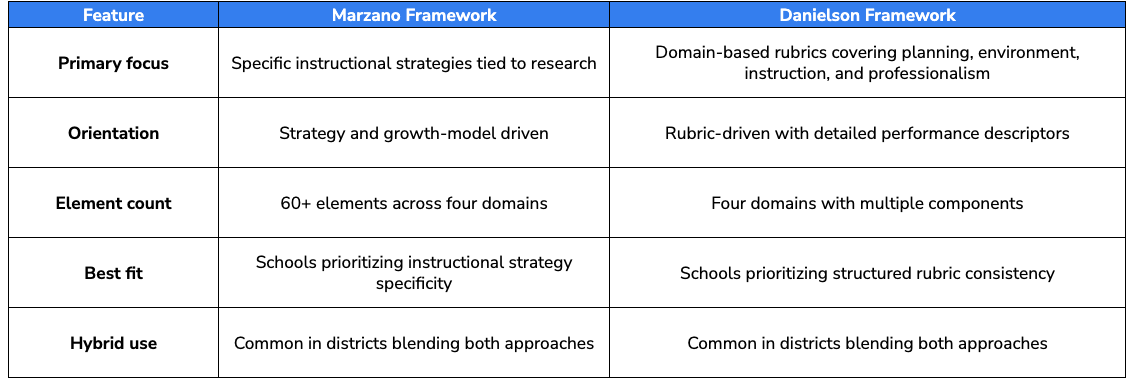
Key differences worth keeping in mind:
- Focus and Emphasis: The Danielson Framework organizes teacher practice into four domains covering planning, classroom environment, instruction, and professional responsibilities, while Marzano places heavier emphasis on specific instructional strategies and research-backed behaviors tied to student outcomes.
- Structure and Orientation: Danielson is often considered more rubric-driven, with detailed performance descriptors at each level. The Marzano leans more toward a strategy-and-growth model orientation, giving observers a concrete instructional vocabulary to work with.
- Fit Over Superiority: Neither instructional framework is universally better. The right choice depends on your school’s context, the existing evaluation culture, and what educators are actually trying to accomplish.
Some districts don’t choose between them at all. Hybrid evaluation systems mix classroom observation frameworks. They’re common when a district wants Danielson’s domain structure and Marzano’s strategy specifics.
Platforms like Education Walkthrough can help you manage these walkthroughs, feedback cycles, and observation data without adding more administrative complexity.
Try Education Walkthrough today
Putting the Framework Into Practice
Most educators who struggle with the Marzano Framework aren’t struggling with the research; they’re struggling with the gap between knowing the framework and actually using it well within a real school calendar.
[Image: Diagram illustrating an instructional feedback loop cycle connecting classroom observation, coaching conversation, and professional development planning]
The Mindset Shift That Moves From Compliance to Helping Teachers Grow
The biggest change in Marzano implementation isn’t about scoring, but about what you do after you record the score.
When evaluation data drives coaching conversations rather than just ratings, the framework begins to do what it was designed to do. Teachers begin to see observation as something that happens to them, not something that happens to them. That shift changes buy-in, and buy-in changes everything.
Below are a few practical moves that support this transition:
- Start with a small number of focus elements rather than all 60+ elements at once.
- Use the framework’s shared language in talks before and after observations, not just in formal write-ups.
- Link the teachers’ views on Marzano’s strategies to the professional development goals they value.
Remember that the Marzano framework works best when it functions as a coaching map, not a compliance checklist.
Building Feedback Loops Into Your Evaluation Cycle
What does a real feedback loop actually look like inside a Marzano observation cycle?
An effective feedback loop involves quickly sharing observation data with teachers. It links this data to professional development and reviews the same elements in follow-up visits. Giving teachers clear and timely feedback helps make the observation protocol a constant part of the year.
To strengthen the feedback process, here are some challenges you should plan for:
- Observer time and scheduling pressure can delay timely feedback and follow-up conversations.
- Calibration drift between evaluation cycles often weakens consistency and trust in observation scores.
- Data management across multiple teachers and domains usually feels overwhelming without a proper system.
- Teachers’ buy-in when evaluation culture has historically felt punitive or disconnected from growth.
Platforms designed to streamline walkthroughs and feedback can greatly lessen administrative tasks. This makes it easier to complete the cycle before the next classroom visit.
Pairing that with key resources every educator should have links the instructional framework to wider professional learning. This way, it stays connected instead of being stuck in evaluation paperwork.
Making the Marzano Framework Work for Your School
The Marzano Framework is a research-grounded, flexible tool that supports both teacher evaluation and genuine professional growth. Its value is in how educators use it to spark better conversations with teachers, rather than the number of elements scored. A growth mindset over a compliance mindset makes all the difference.
At Education Walkthrough, we help instructional leaders put frameworks like Marzano into practice through frequent, feedback-focused classroom visits. Our platform helps you capture observations, boost instructional talks, and promote measurable teacher growth in your school or district.
Try Education Walkthrough today
Frequently Asked Questions
What Are the Four Domains of the Marzano Framework?
The four domains are Classroom Strategies and Behaviors, Planning and Preparing, Reflecting on Teaching, and Collegiality and Professionalism. They focus on instructional delivery, lesson design, teacher reflection, and professional collaboration. These areas help everyone in the school community grow continuously.
What Are the Nine High-Yield Instructional Strategies?
The nine strategies include identifying similarities and differences, summarizing and note-taking, cooperative learning, feedback, homework and practice, and other evidence-based approaches. Marzano linked these strategies to research that shows clear gains in student achievement in different classrooms.
What Is the Focused Teacher Evaluation Model?
The Focused Teacher Evaluation Model simplifies the Marzano Framework by cutting down on the number of scored elements in each evaluation cycle. However, it keeps the original performance scales and observation structure while making implementation more practical for schools and instructional leaders.
How Does the Marzano Framework Differ From Danielson?
The Marzano Framework emphasizes research-based instructional strategies and teacher growth, while the Danielson Framework relies more heavily on detailed performance rubrics across broad teaching domains. Schools often decide between them based on their evaluation priorities, coaching goals, and culture.
Can the Marzano Framework Be Used Without High-Stakes Evaluations?
Many schools use the Marzano Framework mainly for coaching, professional learning, and informal observations. They rely less on it for high-stakes evaluations. The framework encourages reflective talks, focused feedback, and better teaching. It also helps educators create a common language about effective teaching practices.
How Can Teachers Use the Marzano Framework in Their Own Practice?
Teachers can use the framework to reflect on lessons, identify growth areas, and set focused instructional goals. Its high-yield strategies provide practical classroom techniques that teachers can refine through observation, coaching conversations, peer collaboration, and ongoing professional development activities.
Does the Marzano Framework Work Across All Grade Levels and Subjects?
The Marzano Framework works for all grade levels and subjects. This makes it adaptable to different educational settings. Classroom application may vary, but the framework’s teaching strategies and domains are important for both academic and elective courses.

