


Wondering how to justify the budget for classroom observation software in your district?
It’s essential to demonstrate clear return on investment through time savings, improved teacher feedback, and enhanced student outcomes.
Platforms like Education Walkthrough are built to streamline walkthroughs, turn observation notes into actionable feedback, and reduce administrative burden for school leaders and coaches.
If you’re a principal, instructional coach, or district leader, this article provides a step-by-step guide to crafting a compelling budget justification that connects software costs to measurable benefits, helping you secure approval from finance directors and school boards alike.
In this guide, you’ll find answers to questions such as:
- What hidden costs does my current observation process really incur?
- How can classroom observation software accelerate teacher growth and retention?
- What ROI metrics matter most to decision-makers?
- How do I align my budget request with funding sources and strategic goals?
- What common objections should I be prepared to address?
Ready to build a data-driven budget justification that gets results? Dive in and start turning observation software into a strategic investment today.
Key Takeaways
- Classroom observation software delivers measurable ROI by saving time, speeding feedback, and improving teacher retention.
- Budget justifications must link software costs to labor hours saved, targeted PD, and reduced turnover, using district data.
- Digital tools turn observations into real-time coaching with instant feedback and actionable insights.
- Success depends on aligning funding, involving educators, training users, and setting a clear observation schedule.
Building a Compelling Budget Justification for Classroom Observation Software
Imagine preparing your 2026 budget and seeing this line item: “Classroom Observation Software – $XX,XXX.” The cell next to it reads “Justification.”
You know the tool will pay for itself. Coaches have been asking for it. Feedback cycles are slow right now. Your clipboard and email system already eats hours every week. Yet the finance director wants hard numbers, not just stories.
This guide helps principals, assistant superintendents, and coaching directors turn those intuitive benefits into dollar figures that boards can approve. The focus is specifically on classroom observation platforms like Education Walkthrough, not generic edtech. You will learn how to defend the purchase with clear math on labor hours recaptured, turnover avoided, and feedback cycles shortened.
For context, the global classroom observation software market is projected at around $2.14 billion in 2024 and is expected to keep growing through 2033. Boards now expect solid ROI logic for this category.
By the end of this guide, you will have a customizable budget narrative and a simple ROI calculator you can add to a slide deck or funding request this month.

Why Classroom Observation Software Belongs in Your Next Budget
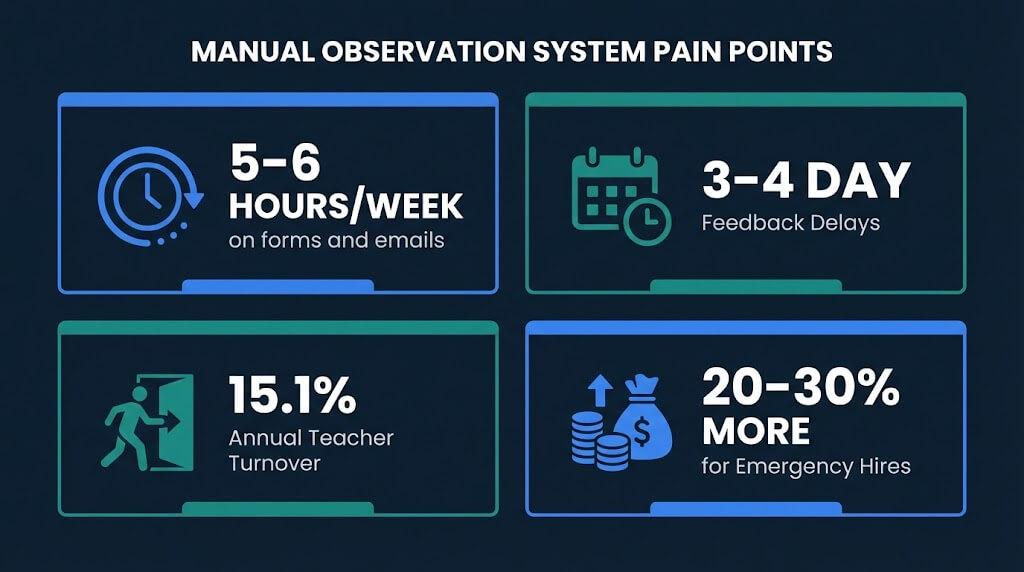
“We’ve always used clipboards or spreadsheets” is no longer a defensible financial argument when labor costs and teacher turnover are rising. The real question is not whether you can afford observation software. It is whether you can afford to ignore the hidden costs built into your current process.
Here are the concrete problems that dedicated observation software solves:
- Coaches spending 5–6 hours per week building forms, revising templates, and emailing feedback documents.
- Feedback delays of 3–4 days (or longer), making the teachable moment irrelevant by the time it arrives.
- Lack of district-wide visibility into who has been observed and when they were observed.
- Painful data pulls every time accreditation visits or state reviews demand documentation.
Teacher turnover remains high, with about 15.1% of U.S. teachers moving schools or leaving the profession each year. This constant churn strains school operations and finances, since replacing teachers is costly and time‑consuming.
Any tool that improves support, working conditions, and retention can therefore have a real budget impact. Mid‑year emergency hires tend to cost districts 20–30% more than planned‑cycle hires. This is mainly because recruitment is rushed, onboarding is compressed, and districts often cover gaps with substitutes, bonuses, or temporary contracts.
Step 1: Map Your Current Observation Costs (Before Software)
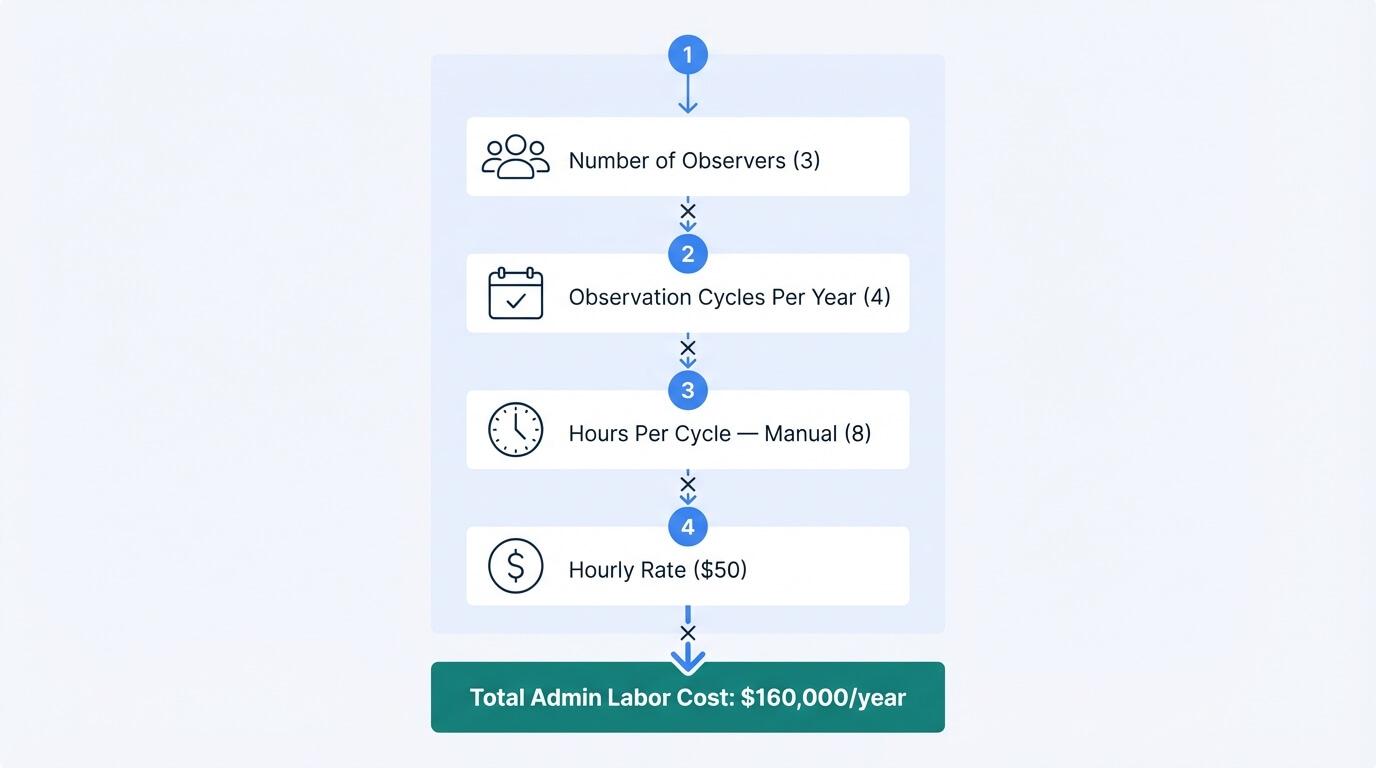
Budget justification starts by pricing the status quo. What do clipboards, Google Forms, and other “free” tools really cost in staff time and missed opportunities?
Think about your typical 2024–2025 workflow. It probably involved creating observation templates in Google Docs, emailing spreadsheets to principals for consolidation, and manually aggregating data whenever someone requests mid-year reviews or state reports. These activities consume hours that rarely appear on any cost sheet, yet such costs add up across the district.
Collect this data before building your justification:
- Number of observers (principals, APs, instructional coaches) involved in teacher observations
- Average hours per teacher per observation cycle spent on pre‑work, observation, and post‑observation paperwork (benchmark: 8–12 hours/teacher/cycle)
- How often teachers are formally or informally observed per year (typically 3–4 times)
- Average fully loaded hourly rate of observers (salary ÷ 1,920 annual hours; use $50/hour for easy math)
Example calculation for a mid-size district:

At $50/hour, that’s $160,000 in annual labor before any actual coaching improvement happens.
To make the invisible cost feel real, consider this: Coaches at one junior high documented spending an entire evening per cycle building templates and assembling feedback PDFs to email. That’s 15+ hours annually per coach on clerical work that such costs lock into the system, rather than redirecting to actual coaching.
Step 2: Identify the Four Primary ROI Levers for Observation Software
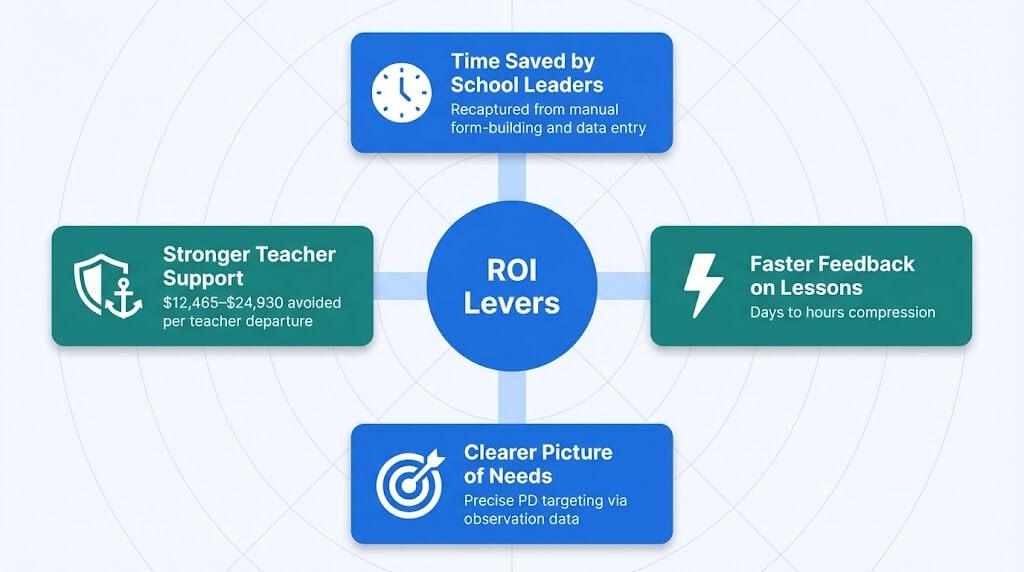
Not all benefits need to be quantified for a board presentation, but four areas almost always can be expressed in dollars:
- Time Saved by School Leaders: Administrator and coach time recaptured from manual form‑building, data entry, and report creation around teacher observations.
- Faster Feedback on Lessons: Compression of feedback cycles from days to hours, increasing the velocity at which teachers refine their own lessons within the same semester.
- Clearer Picture of Needs: More precise professional development targeting through observation data, avoiding generic PD days that don’t match actual classroom needs.
- Stronger Teacher Support: Teacher retention improvements through better support, avoiding replacement costs documented at $12,465 — $24,930 per teacher, and helping school leaders build more stable teams.
These are your four budget talking points. Each can be copied directly into a board memo with its own mini-calculation.
ROI Lever 1: Administrator and Coach Time Savings
Most educators underestimate how many hours are spent on clerical work during teacher observations. Building forms, chasing emails, copying notes into spreadsheets, and generating reports all add up fast.
Education Walkthrough’s work at Adair Elementary School (AES) illustrates this shift. Before implementation, coaches at AES spent 3–4 days processing observations and sending feedback. After adopting the platform, the same work dropped to minutes, with same‑day or near‑immediate email delivery of reports. Coaches no longer re‑typed notes or rebuilt forms, and principals could see trends at a glance instead of chasing scattered data.
This kind of time savings frees up a large part of each observer’s weekly workload. Feedback moves from a multi‑day process to a matter of minutes. Therefore, leaders can spend more time on coaching, modeling, and co‑planning rather than on clerical tasks.
Use this formula for your district:
Time saved per observer per week × Number of observers × School weeks × Hourly rate = Annual labor value recovered
Worked example:

Compare that $45,000 to a realistic software cost range of $30 — $150 per teacher per year. For a 100‑teacher district at $80/teacher, annual licensing is $8,000. That is an immediate 5x+ ROI on time savings alone.
ROI Lever 2: Faster Feedback Cycles and Instructional Days Saved
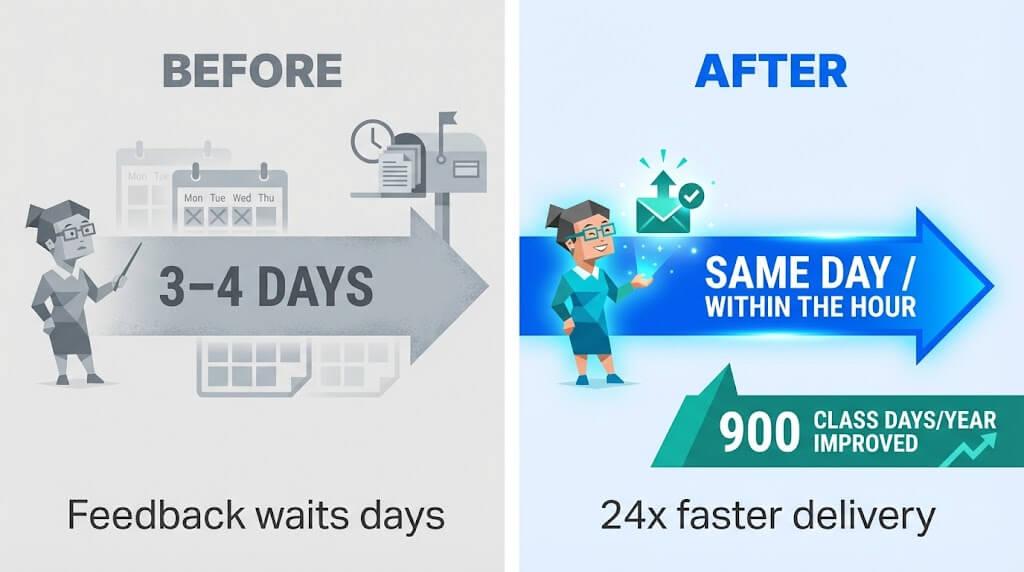
Manual observation processes often mean teachers receive feedback 3–4 days after a walkthrough, and sometimes even longer. By then, the specific moments in the lesson are no longer fresh. The opportunity for real-time feedback is lost.
Schools implementing observation software with a single system for data have documented significant improvements such as:
- Feedback going from 3–4 days to same-day delivery (“24x faster”).
- Other sites shrinking feedback lag from “over a week” to “within the hour.”
Translating this into dollars:
When teachers can adjust instruction by the next class instead of next week, you avoid ineffective instructional days. This supports district goals such as improving Tier 1 instruction and reducing costly Tier 2/Tier 3 interventions later.
Back-of-the-envelope calculation:
- If same-day feedback avoids 1 “lost” instructional day per teacher per month.
- 9 months × 100 teachers = 900 class days/year improved.
For districts with performance-based funding, a 1–2-point proficiency gain linked to state accountability bonuses can translate into $45,000+ annually in a mid-size district. This should be labeled as conservative and framed as an “instructional efficiency and funding-readiness” argument that finance boards recognize.
ROI Lever 3: Targeted Professional Development and PD Spend Reallocation
Without unified observation data, PD is often generic. Full‑day workshops cover topics that only 20% of teachers truly need. Real gaps in classroom management or questioning techniques often go unaddressed.
Aggregated observation dashboards pull together observation notes from across the district. They reveal clear patterns, such as classroom management challenges in Grade 6 or weak questioning techniques in Algebra I. This lets leaders design precise PD topics and small, focused cohorts instead of one‑size‑fits‑all sessions.
Using benchmark data from independent ed‑tech ROI studies, curriculum and planning software can recover about 10 hours per semester per teacher. At an effective hourly rate of $50, that adds up to roughly $50,000 in annual labor savings for a 100‑teacher district. The same logic applies when professional learning is guided by observation notes.
Sample calculation:

That $8,000 can flow toward high-impact coaching, stipends for teacher leaders, or smaller-group professional growth opportunities.
Centralized observation notes make it much easier to pull accreditation and state-review evidence. Instead of hunting through emails, binders, and scattered spreadsheets, leaders can access everything in one place.
Districts often spend 30–50 hours each year compiling documentation for these reviews. When observation data is already integrated and stored in a single system, that work shrinks to a fraction of the time. This also reduces stress on staff and lowers the risk of missing evidence.
ROI Lever 4: Teacher Retention and Avoided Turnover Costs
According to the Learning Policy Institute’s 2024 update, replacing a single teacher in a large district can cost about $24,930. This figure covers separation, recruitment, hiring, and training. However, it doesn’t account for harder‑to‑quantify losses such as institutional knowledge or disruption to student success.
Research on DC’s IMPACT evaluation system found that structured, data‑informed evaluations improved teaching quality by about 0.34 standard deviations. They also yielded student achievement gains of +0.21 SD in math and +0.14 SD in reading. Critically, retention of high‑performing teachers increased.
How observation software contributes to retention:
- More timely feedback and actionable insights.
- Clear growth plans through visible observation data instead of opaque teacher evaluations.
- Perception that instructional leaders are present and supportive rather than punitive.
When observation data is well organized and easy to access, it becomes a great resource for coaching, goal‑setting, and retention‑focused conversations.
Quantifiable example for a board slide:

Present retention-related ROI as conservative and additive to time-savings ROI, not the sole justification.
Step 3: Build a Simple ROI Calculator for Your District
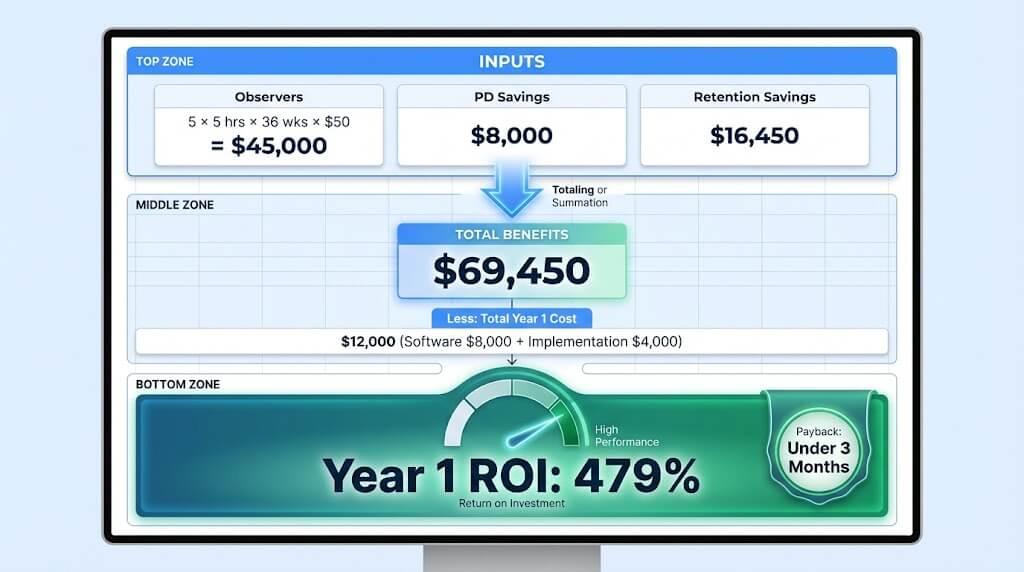
Finance leaders appreciate transparent models. Here’s a plug-and-play calculator framework you can run in Excel or Google Sheets in 10 minutes.
Key input variables:

ROI formula:
ROI (%) = [(Total Quantified Benefits – Total Annual Cost) ÷ Total Annual Cost] × 100
Worked example (mid-size district):
- Time savings: 5 observers × 5 hours × 36 weeks × $50 = $45,000
- Conservative PD savings: $8,000
- Retention (1 teacher): $16,450
- Total benefits: $69,450
- Software: $80 × 100 teachers = $8,000
- Implementation: $4,000
- Total Year 1 cost: $12,000
Year 1 ROI: 479% Payback period: Under 3 months
Even conservative numbers typically produce 200–400% ROI with payback in under 12 months. This aligns with broader edtech‑ROI research that shows well‑implemented technology can generate strong returns through reduced administrative work and improved instructional efficiency.
Step 4: Align Your Justification with Funding Sources and Budget Cycles
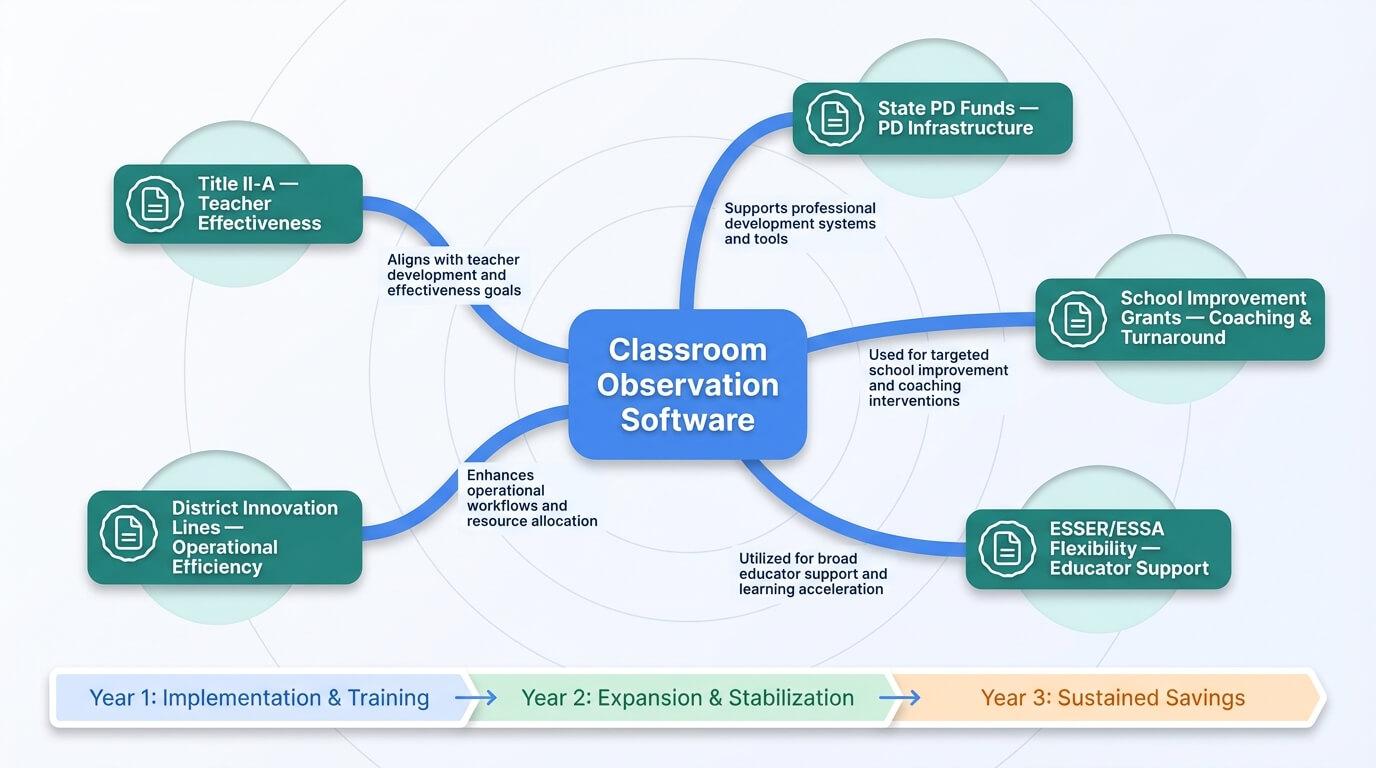
Strong ROI alone sometimes may not secure approval. Proposals must also align with the source of the money and the timing of budget approvals. School board and finance leaders care about how a new tool fits into specific funding streams, such as Title II‑A, state PD dollars, school‑improvement grants, or ESSER‑adjacent lines.
The following funding paths show how each line item can be matched to the right source and narrative.

Aligning Benefits with Policy Language
Show how the software’s benefits directly match the language in federal or state guidance.
- “Increased frequency and quality of feedback to teachers” → Title II-A language on professional learning
- “Data-informed coaching decisions” → School improvement plan objectives
Some vendors offer matching funds or planning support, like Edthena’s Innovation Fund. Check whether your chosen observation software vendor offers similar assistance, but don’t rely on it as your primary funding source.
How to Structure a Three‑Year Investment Story
Frame this proposal as a three-year investment in instructional leadership and operational efficiency:
- Year 1: Implementation, training, adoption ramp-up
- Years 2–3: Expansion, stabilization, sustained savings
This structure shows that the district is not just buying a tool in one year, but building a durable system whose savings and impact grow across the full budget window.
Step 5: Address Common Objections from CFOs and School Boards
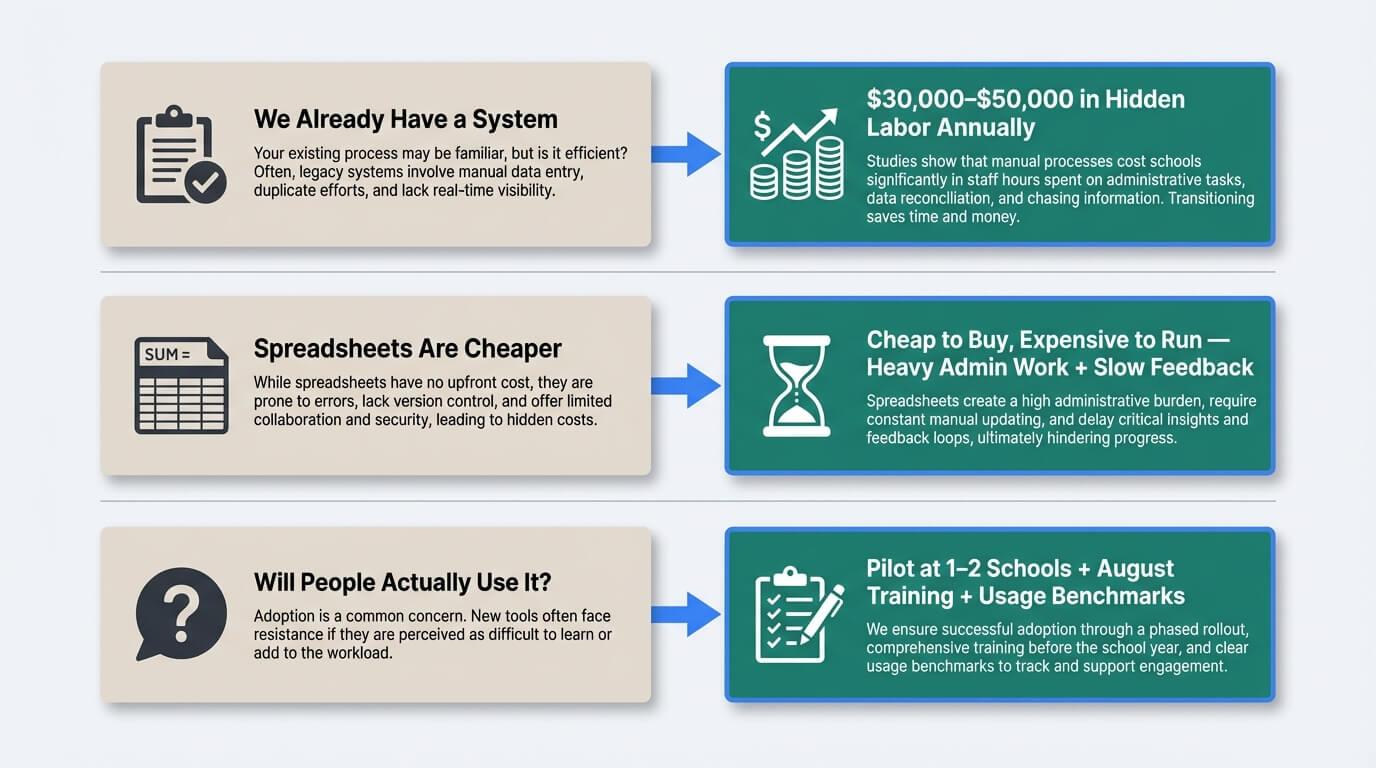
Finance leaders will raise predictable questions and concerns when asked to fund new tools. You also must be prepared with clear, data‑backed responses in advance so you can answer confidently at the board table.
Below are some common objections these leaders will raise and how you can respond with clear, data-backed arguments.
“We already have a system.”
Many districts think they already have a system. They use clipboards, email, and Google Forms instead of licensed software. To determine the price the hidden cost of this approach, include:
- Manual hours spent building forms and chasing data
- Delayed feedback cycles
- Scrambling for accreditation and state reviews
A “no‑license‑cost” setup can easily cost $30,000–$50,000 in labor annually. Coaches spend hours building templates, chasing emails, and compiling data.
“Spreadsheets are cheaper.”
Spreadsheets are cheap to buy but expensive to run. They create heavy administrative work and slow responses to instruction.
Observation‑specific platforms track progress automatically. They also provide usable feedback within hours.
“Will people actually use it?”
Expect this question from finance and board members. Answer it with a clear rollout plan.
- Pilot at 1–2 schools in fall 2025 with volunteer early adopters
- Train coaches during August PD with clear expectations
- Set benchmarks: X walkthroughs per teacher per quarter
You can also add built‑in reporting to track adoption by showing how many observations occur per week and how quickly feedback is delivered after each observation. This helps you see whether the tool is being used as planned and where support may be needed.
Note: Frame responses in risk‑management language. One risk is shelfware—software that is purchased but never used. Another risk is keeping expensive, low‑visibility manual systems that waste staff time and slow improvement. Usage monitoring, coaching support, and clear analytics help reduce both risks and show that the investment is being managed responsibly.
Step 6: Drafting Your Budget Justification Narrative (Template Outline)
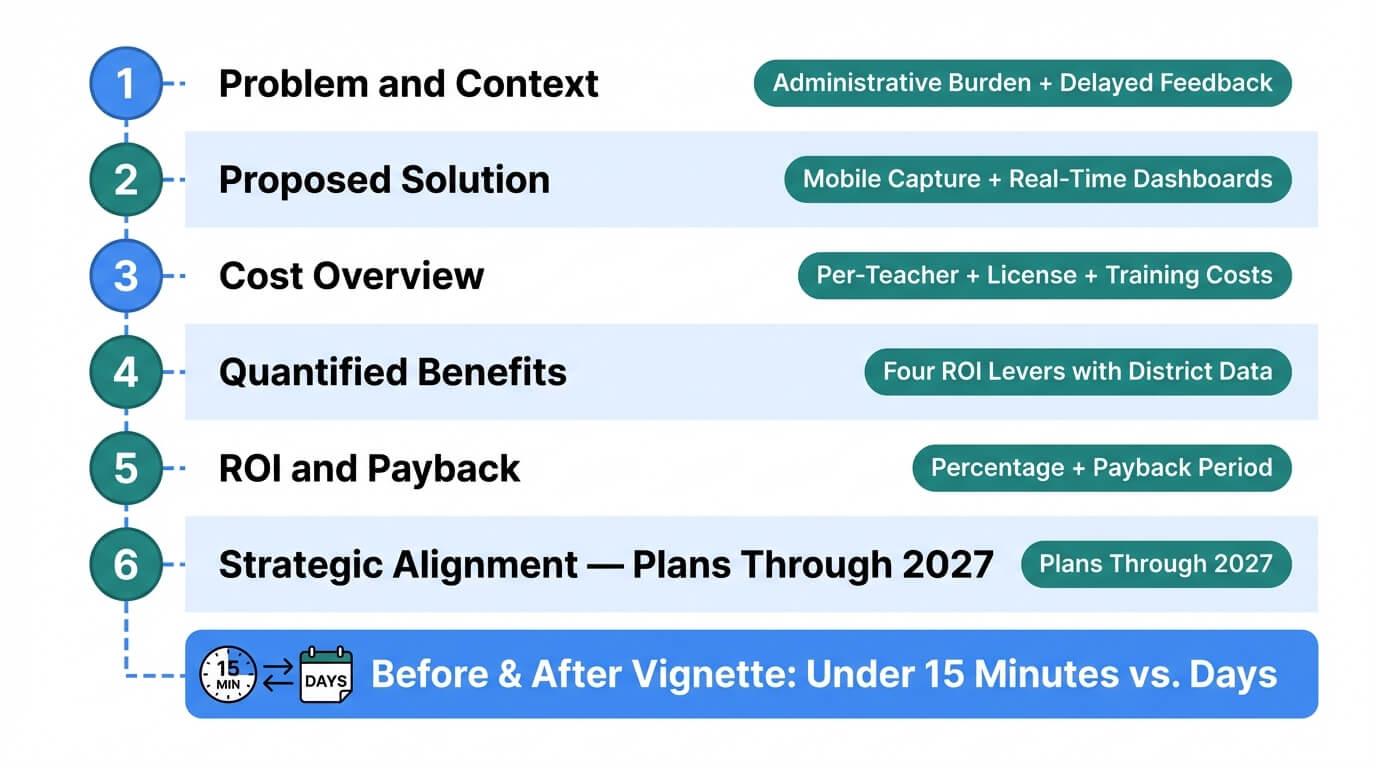
Here’s a ready‑to‑edit outline for a 1–2 page budget narrative suitable for inclusion in a 2025–2026 board packet or grant application. This structure keeps the text focused, scannable, and grounded in costs, benefits, and district priorities.
1. Problem and Context
Describe the current observation process, including high administrative burden, manual data entry, and delayed feedback cycles. Explain how scattered systems and paper‑based forms create fragmented data integration and make it hard to track trends across the district.
Include specific feedback from teachers and leaders on how the current system feels. Highlight how time‑consuming processes push meaningful conversations about instruction to the back burner. The goal here is to show that the status quo is costly, slow, and hard to improve without a coordinated system.
2. Proposed Solution
Present the classroom observation software as the proposed project, focusing on what it does rather than the brand name. Emphasize mobile capture of evidence, real‑time data aggregation, and dashboards that turn raw notes into actionable feedback.
Explain how the platform reduces administrative burden by replacing clipboards and Google Forms with a single, unified system. Stress that data integration makes it easier to track growth, support coaching, and align with district‑wide improvement goals.
3. Cost Overview
List the main financial components as a short bulleted section:
- Per‑teacher cost: $XX
- Total annual license: $XX,XXX
- One‑time implementation/training: $X,XXX
- Total Year 1 investment: $XX,XXX
This format makes it easy for board members to see the full cost at a glance while understanding what each line supports.
4. Quantified Benefits
Use the four ROI levers (Time Savings, Faster Feedback, Targeted PD, Teacher Retention) with district‑specific dollar estimates. For each lever, show how the platform reduces administrative burden and improves the quality of data integration.
Explain how the platform enables data‑informed decisions by surfacing patterns in feedback, strengths, and areas for growth. Connect this to improving teaching practices across all grade levels and creating a more consistent coaching experience.
5. ROI and Payback
Present the ROI percentage and expected payback period using the calculator methodology. Highlight how the tool supports data collection for federal and state compliance, making audits and reviews less time‑consuming.
Frame this as a predictable, low‑risk investment that pays for itself quickly and then continues to generate value over time.
6. Strategic Alignment
Connect the investment directly to district strategic plans, school improvement plans, and teacher development goals through 2027. Emphasize how the platform makes school‑wide strengths visible and helps individual teachers receive targeted support.
Show how data integration supports long‑term improvement, not just a one‑year project.
Before‑and‑After Vignette
To make the benefits feel concrete, anchor them in a realistic before‑and‑after story from a district site.
“Prior to implementation, principals at X Middle School spent an entire evening per cycle building forms and assembling feedback emails. With the new platform, the same work can be completed in under 15 minutes, and teachers receive actionable feedback the same day instead of waiting days. This transformed observations from a compliance task into meaningful coaching conversations.”
Specify a realistic start date. For example, “implementation begins July 2026 with training during August in‑service days; full usage starts by September 2026.”
Keep language neutral and finance‑oriented. Use clear headings and short paragraphs so board members can scan the narrative in under 5 minutes.
Risks, Gaps, and How to Present a Balanced Case
Honest budget documents note more than just benefits; they also note limits, data gaps, and implementation risks. This transparency can actually increase board trust and make your case feel more credible.
Furthermore, it’s important to acknowledge the evidence landscape. You can state that, as of 2026, there is no peer‑reviewed study that isolates the ROI of classroom observation software alone. Most evidence comes from broader evaluation systems or MTSS platforms.
Retention gains are influenced by many factors, such as leadership quality, compensation, and workload. Attribution to the software must therefore be conservative and framed as supportive rather than causal.
Key Risks and Mitigations
In the table below, each risk is paired with a concrete step the district can take to reduce it.

Address data security concerns proactively. Confirm that the platform meets federal regulations and district requirements for access controls, data privacy, and data retention.
Finally, the closing statement for your narrative could be “Even when we count only verified time-savings and minimal retention impact, the investment meets our district’s 24-month payback threshold and aligns with our board’s commitment to efficient, evidence-based spending.”
Final Thoughts: From Intuition to Evidence-Backed Approval
Classroom observation software turns walkthroughs from paperwork into high‑yield coaching. Its ROI can be measured in hours and dollars in the first year, not in distant test‑score promises.
This guide helps you map current costs, quantify key ROI levers, build a simple calculator, and draft a board‑ready justification for the 2026–2027 budget cycle.
Plug your own numbers into the formulas. Bring district‑specific figures, not generic claims, to your next finance or school board meeting.
The difference between “we need this tool” and “here’s how this tool pays for itself” is often the difference between a rejected request and an approved line item.
As the global classroom observation software market grows, districts that treat these tools as strategic investments will be better positioned to support teachers, improve instruction, and protect budgets through 2030 and beyond. The ROI case relies less on speculation and more on a calculator plus your district’s own data.
Education Walkthrough is an all-in-one classroom walkthrough platform that turns observation into simple, visual, and actionable coaching. It reduces administrative burden, speeds feedback, and helps districts protect their budgets while improving teaching every day.
Try Education Walkthrough today
Frequently Asked Questions (FAQs)
Why is classroom observation software a strategic investment for school districts?
Classroom observation software saves administrative time, accelerates feedback cycles, and improves teacher retention, thereby enhancing student outcomes. It transforms the observation process from a compliance task into a dynamic coaching system with real-time data and actionable insights.
How can I justify the budget for classroom observation software to my school board?
A strong budget justification connects software costs to measurable benefits, such as recovered labor hours, targeted professional development, reduced teacher turnover costs, and improved instructional quality. Using district-specific data and ROI calculations helps make a compelling case.
What are the main ROI levers for classroom observation software?
The primary ROI drivers include recaptured administrator and coach time, faster feedback cycles that improve instructional days, more precise professional development targeting, and improved teacher retention that avoids costly turnover.
How does digital observation software improve the feedback process compared to traditional methods?
Digital tools enable real-time data capture and instant feedback, reducing delays from days to hours or minutes. This timely, specific feedback helps teachers refine their practice more effectively and supports continuous professional growth.
What steps should I take to successfully implement classroom observation software?
Successful implementation involves aligning the budget with funding sources, involving educators in the selection process, providing thorough training, establishing a manageable observation schedule, and fostering a culture of trust and continuous improvement.
How does classroom observation software support compliance with data security and privacy regulations?
Reputable classroom observation platforms like Education Walkthrough comply with federal regulations such as FERPA by ensuring secure data storage, access controls, and privacy protections. This safeguards sensitive observation data and builds trust among educators and administrators.
