


Many instructional coaching efforts fall short not because teachers are resistant to growth, but because there is no shared framework guiding the work. Conversations stay surface-level, goals change from meeting to meeting, and meaningful growth becomes difficult to sustain.
So what does effective instructional coaching look like when there is a clear structure behind it?
One of the most influential answers comes from Jim Knight, researcher, author, and founder of the Instructional Coaching Group. Drawing on research from the University of Kansas Center for Research on Learning, Knight developed a coaching model built around partnership, reflection, and evidence-based practice.
In this article, we’ll explore the core components of the Jim Knight coaching model, unpack the Impact Cycle and PEERS framework, and examine why it remains one of the most widely used coaching approaches in K–12 education.
What Actually is the Jim Knight Coaching Model?

The Jim Knight coaching model is a structured approach that explains what an instructional coach is and how the coach should work alongside teachers. It was developed through the Instructional Coaching Group, which Knight founded to bring research-backed structure to a field that had long operated without a shared playbook.
The model is built on four interdependent components. Together, they define not just what coaches do, but how and why they do it.
The Four Components at a Glance
The four components of the Jim Knight coaching model are created to work together as an integrated coaching framework, often pictured as a venn diagram to show how the parts overlap rather than stand alone, and they are often presented in a written overview or on a single page. Each component plays an essential role, and if one is missing, the model becomes far less effective.
The components are:
- Beliefs: Every coaching conversation starts with a set of underlying values about how adults learn and grow. These values shape how coaches approach collaboration, reflection, and teacher development.
- The Coaching Cycle: A clear process keeps coaching focused and productive. This component provides the structure for moving from goal-setting to implementation and ongoing improvement.
- Coaching Skills: Strong relationships depend on more than good intentions. Coaches rely on communication and interpersonal skills to build trust and facilitate meaningful conversations.
- Strategic Knowledge: Coaches need more than facilitation skills to support growth. They also need a solid understanding of evidence-based practices they can introduce when teachers are ready to explore new approaches.
Running through all four components are the seven partnership principles. These principles shape every interaction between the coach and the teacher, making the relationship a collaborative one.

The Seven Partnership Principles That Shape Every Coaching Conversation

Jim Knight on partnership in coaching identifies seven principles that sit beneath every interaction in this model. These principles are the active filters that shape what you say as an instructional coach, how you listen, and what you ask your teachers to do.
The seven principles are equality, choice, voice, dialogue, reflection, praxis, and reciprocity. Let’s break down what each of them means in practice:
Equality
The principle of equality recognizes that coaching works best when the coach and teacher act as two partners and equals, with each bringing valuable knowledge and expertise to the conversation. The coach brings knowledge and perspective, but so does the teacher. Neither viewpoint outranks the other in their level of contribution.
Choice and Voice
Choice and voice work together to keep teachers in the driver’s seat. Teachers and coaches collaboratively identify goals that are student-focused, and teachers have genuine input in deciding what to work on. This is what makes maximizing teacher empowerment possible in practice.
Dialogue
Professional growth happens through conversation. Rather than delivering fixed verdicts, you ask questions, listen carefully, and think alongside your teachers. This is what dialogical coaching looks like in practice.
Reflection
Growth becomes more sustainable when teachers reflect on their own practice. Your responsibility here as a coach is to create a space for teachers to analyze what happened, why it happened, and what they might do differently moving forward. Before deciding next steps, check their thinking against what actually happened in the lesson.
Praxis
Learning only matters when it connects to action. This principle keeps coaching grounded in classroom practice rather than abstract theory that never reaches a lesson plan.
Reciprocity
The learning relationship goes both ways. You support teachers’ growth, and also learn from the teachers through the coaching process, creating a partnership where both parties continue to develop. That reciprocity helps keep the relationship respectful and focused on learning with other people rather than enforcing a one-way hierarchy.
These principles explain why Jim Knight consistently argues against using this model as an evaluation tool. When teachers know a conversation is tied to their performance rating, equality disappears and honest dialogue becomes impossible.
The Impact Cycle and How the Coaching Process Works

The Impact Cycle is the practical manifestation of Knight’s beliefs and the operational engine of his instructional coaching model, giving coaches and teachers a shared structure for working in the complex reality of classrooms.
It gives coaches and teachers a shared structure for moving from identifying a problem to building a skill to measuring real change. The cycle has three stages, with each stage defining the fundamental actions for both the coach and the teacher, and the whole process is designed to repeat and refine over time.
You can also watch a brief video explanation of how the three phases connect and loop together in practice.
Identify: Seeing Current Reality Clearly
The Identify stage is where current reality gets established, and it starts with video. Knight recommends that coaches and teachers review video of the teacher’s own lesson together before any goal-setting conversation begins.
This joint review removes the interpretive filter that live observation always carries. When a teacher watches themselves teach, they see what actually happened, not what they remember happening. What is shown in the video helps coach and teacher ground the conversation in evidence rather than opinion.
The focus at this stage is not on you providing answers, but on helping teachers make sense of what they see in their own teaching. Two of the most effective questions Knight recommends for guiding teacher reflection are:
- On a scale of 1 to 10, how would you rate this lesson?
- What would an ideal lesson look like?
Those two questions invite honest self-assessment without triggering defensiveness, and they move ownership of the goal to the teacher.
The goal that emerges from this stage must meet the PEERS criteria, which gets its own full treatment in the next section. What matters here is that the goal is student-focused and chosen by the teacher, not handpicked by the coach. That shared ownership is central to how the Impact Cycle builds ownership and commitment.
Learn: Building the Skills to Hit the Goal
Once the goal is clear, the coach moves into the Learn stage. This stage is where the Instructional Playbook becomes one of the coach’s key resources.
Here, you’ll identify evidence-based practices that directly address what the teacher is working toward and share them during meetings or by email in a way that is practical and immediately applicable, so teachers can revisit those resources during implementation. These are concrete teaching strategies aligned to the teacher’s goal.
The teacher reviews the options and chooses the strategy that fits their classroom and their students. The teacher’s choice is important here because it sustains commitment through the harder work of implementation.
Improve: Measuring Progress and Adjusting
The Improve stage is where data re-enters the cycle. You and the teacher track whether the chosen strategy is producing the intended student outcomes. If it’s not, you adjust the strategy and try again. If it is, you both decide whether to continue, refine, or set a new goal.
This process is usually an ongoing feedback loop in instructional coaching that keeps the work honest and responsive. Your role here is to support the iteration, not to evaluate performance.
Jim Knight on the Impact Cycle and PEERS goals describes this continuous loop as the core of what makes instructional coaching different from one-time professional development. The cycle is meant to be repeated, and mastering the coaching cycle means getting comfortable with that ongoing rhythm rather than treating each pass as a finished product.
PEERS Goals and How Coaches Set Targets That Actually Stick

The quality of a coaching conversation often depends on the quality of the goal behind it. In the Jim Knight coaching model, the goal that emerges from the Identify stage has to meet a specific standard before the work moves forward. The goal serves as the foundation for everything that follows, from strategy selection to measuring impact.
That standard is captured in the PEERS framework, which gives coaches and teachers a shared language for what a good goal actually looks like.
What Each Letter in PEERS Stands For
PEERS goals explained by Jim Knight break down into five criteria, each doing distinct work in the goal-setting process.

A well-formed PEERS goal is at the heart of the coaching cycle because it keeps later decisions focused.
That last criterion is what separates PEERS from more generic goal-setting approaches. The student-focused requirement keeps the coaching work anchored to the reason the Impact Cycle exists in the first place.
The coach and teacher build the PEERS goal together. When teachers have ownership of the goal, they’re more likely to stay committed when implementation becomes challenging.
As a coach, asking thoughtful professional development questions early on can help you uncover meaningful starting points and shape a goal that genuinely matters to the teacher.
The Three Coaching Approaches and When To Use Each One
One of the most persistent misconceptions about instructional coaching is that effective coaches must always be non-directive. Knight’s model pushes back on that directly. Before exploring the three approaches to coaching, it helps to see how they compare side by side. All three approaches have distinct strengths and weaknesses depending on the coaching context.
Facilitative, Directive, and Dialogical Coaching Compared
Knight identifies three distinct approaches a coach might use. Each has a place, and knowing when to use which one is part of what separates skilled coaches from well-intentioned ones.

Facilitative coaches play a crucial role in this model by listening empathetically, asking powerful questions, and encouraging teachers to share their ideas openly. Giving teachers meaningful influence over decisions helps them feel heard and valued, supports continuous improvement, and strengthens principal and teacher relationships.
Paul Bambrick-Santoyo, author of Leverage Leadership and a leading voice in instructional leadership, takes a more directive approach to coaching. His model emphasizes frequent observation, targeted feedback, and deliberate practice around specific teaching techniques.
Both models have their advantages. Each of the three approaches has unique strengths and weaknesses in supporting teachers. The difference lies largely in how teacher growth is supported.
Knight’s dialogical approach places greater emphasis on partnership, reflection, and teacher ownership of goals. Bambrick-Santoyo’s approach places more emphasis on rapid skill development through focused coaching and clear next steps.
The best fit often depends on the context of the coaching relationship. Knight’s model tends to work well when the goal is building long-term professional autonomy and reflective practice. A more directive approach can be especially effective when teachers need to master a new skill quickly or when schools are working toward a specific instructional priority.
Effective coaches understand when to lean more facilitative, more directive, or more dialogical across three approaches. The goal is not to stay locked into a single mode, but to respond to what the teacher and situation need most.
Platforms like Education Walkthrough help make that flexibility easier in practice. You can easily capture observations, track growth, and deliver feedback in ways that support different coaching approaches and teacher needs.
Start Better Coaching Conversations
The Instructional Playbook and Strategic Knowledge in Practice

Strategic knowledge is the fourth component of Knight’s coaching model. It refers to what you actually know about effective teaching practices and how to introduce them at the right moment.
The primary vehicle for that knowledge is the Instructional Playbook. This is a curated collection of high-leverage, evidence-based practices that you can draw from when teachers are ready to try something new. Think of it as a more definitive guide to high-leverage strategies coaches can draw on when supporting teachers, so you do not need to reinvent the wheel.
During the Learn stage of the Impact Cycle, the playbook becomes the coach’s main tool. Once a teacher has a clear PEERS goal, you identify strategies from the playbook that align with that goal and share them in a way the teacher can act on immediately.
Instead of prescribing a single approach, you share possible strategies and help the teacher decide what will work best in their classroom. The teacher reviews the options and selects what fits their classroom context. This keeps the teacher in control of instructional decisions throughout the process.
A shared playbook also creates consistency across a school’s coaching program. When all administrators draw from the same set of practices, the approach to differentiated instruction in coaching stays coherent without becoming rigid. Teachers get flexibility in how they apply strategies, while the coaching program maintains consistency across the school.
When the Model Works and What Gets in the Way
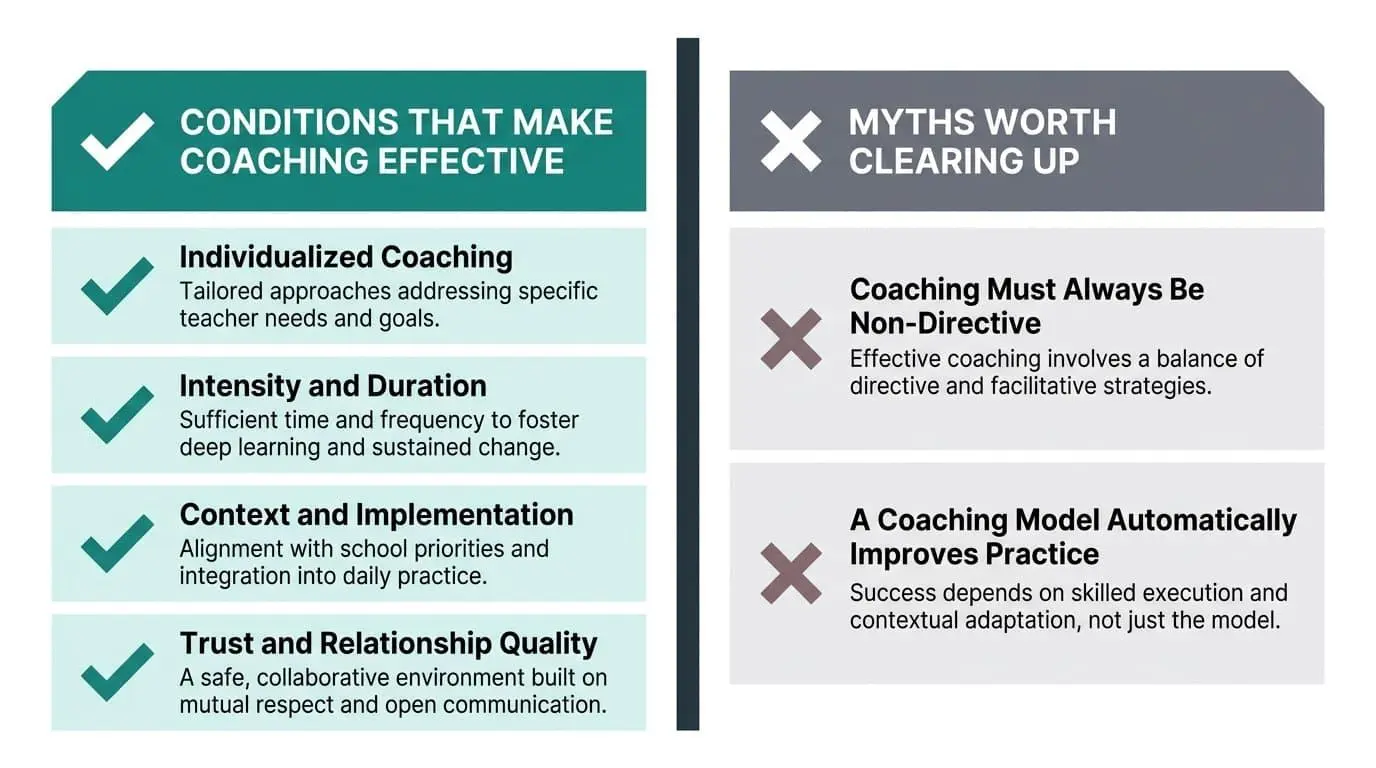
The Jim Knight coaching model does not produce results on its own. The conditions surrounding its implementation are just as important as the framework itself, and effective use also depends on a few core success factors beyond the model itself.
The two areas that deserve special attention are: the structural conditions that make coaching effective, and the misconceptions that can quietly undermine it.
Conditions That Make Coaching Effective
What actually determines whether instructional coaching leads to meaningful change in practice?
The answer is less about a single technique and more about the conditions surrounding the work itself. The key highlights are consistency, fit to teacher need, and enough time for the work to take hold.
Individualized Coaching
Coaching works best when it’s tailored to the teacher in front of you. When every teacher receives the same support regardless of experience, classroom context, or instructional need, the result is predictable: limited movement in practice. Effective coaching responds to where each teacher is starting and what they are trying to improve.
Intensity and Duration
Research on instructional coaching effectiveness from the University of Kansas Center for Research on Learning shows that sustained coaching produces stronger outcomes than isolated sessions. One conversation rarely changes instructional practice in a lasting way. Growth develops through repeated cycles of feedback, reflection, and application over time.
Context and Implementation
Coaching is shaped by the environment in which it takes place. School culture, teacher readiness, and available time all influence whether coaching translates into action. When the framework is treated as a fixed script instead of something adaptable, implementation often loses its impact.
Trust and Relationship Quality
The relationship between you and the teacher plays a decisive role in how far your coaching can go. A coaching framework can guide the process, but teachers are far more likely to engage openly when trust is present. Without it, even well-designed systems struggle to take root.
READ MORE: 11 Ways Principals Can Inspire Teachers
Myths About Coaching Models Worth Clearing Up
Two misconceptions show up repeatedly in conversations about instructional coaching, and both can limit how effectively the model is used in practice.
Myth 1: Coaching Must Always Be Non-Directive
A common assumption is that effective coaching means coaches should only ask questions and never provide direction. Knight’s model challenges that idea. Instead, it promotes dialogical coaching, where coaches contribute knowledge and guidance while still preserving teacher voice and ownership.
In practice, you’re still bringing your expertise into the conversation as a coach. You’ll ask thoughtful questions, share relevant knowledge when appropriate, and help teachers think more clearly about their practice.
The goal isn’t to step back completely, but to think alongside teachers in a way that supports their decision-making rather than replacing it. This is fundamentally different from holding back input and waiting for teachers to arrive at solutions without support.
Myth 2: A Coaching Model Automatically Improves Practice
Another misconception is that simply adopting a coaching model will lead to stronger teaching. In reality, the framework alone doesn’t produce change.
Outcomes depend on several supporting conditions such as:
- The quality of relationships between the coaches and the teachers.
- The time and consistency devoted to the coaching process.
- The coach’s ability to adapt the model to the teacher’s needs and context.
- Ongoing commitment to the coaching cycle rather than one-off conversations.
Without these elements in place, even a well-designed model struggles to influence classroom practice in meaningful ways. Coaching isn’t self-executing. It only becomes effective when the system around it supports how the model is meant to function.
Bringing the Jim Knight Model Into Your School
The Jim Knight coaching model works because it pairs clear structure with genuine teacher partnership. The Impact Cycle gives instructional coaching a repeatable process. The partnership principles keep that process grounded in trust and teacher ownership. Together, they make real classroom change possible.
At Education Walkthrough, we built our platform to support exactly this kind of work. When coaches conduct walkthroughs and share immediate, growth-oriented feedback, they reinforce the same routines that Knight’s model depends on. The tools also help coaches share follow-up insights and resources after walkthroughs, reinforcing the ongoing process between meetings.
If you want a deeper blog post on implementation, you can explore additional resources across our site. If you want a faster, cleaner way to give teachers actionable feedback during walkthroughs, we would love to show you how we can help.
Frequently Asked Questions
What Are the Seven Principles of Jim Knight?
The seven partnership principles are equality, choice, voice, dialogue, reflection, praxis, and reciprocity. These principles shape every coaching conversation by positioning teachers as professional partners rather than recipients of feedback. They are the philosophical foundation beneath every stage of the Impact Cycle.
What Are the Three Types of Coaching Jim Knight Uses?
Knight identifies facilitative, directive, and dialogical coaching. Facilitative coaching centers the teacher’s thinking through questions and listening. Directive coaching offers specific guidance when a teacher needs concrete input. Dialogical coaching blends both and is the preferred mode in this model.
What Are the Five Parts of the PEERS Goal Model?
PEERS stands for Powerful, Easy to Explain, Emotionally Compelling, Reachable, and Student-Focused. Each criterion ensures that goals set during the Identify stage are meaningful, sustainable, and anchored to real student outcomes rather than teacher behavior alone.
What Is the 80/20 Rule in Coaching?
In coaching conversations, the general principle is that coaches should spend roughly 80 percent of their time listening and asking questions, and 20 percent talking or directing. This ratio supports the dialogical approach Knight advocates and keeps teachers doing most of the thinking. For a practical example of how these conversations are structured, see the related post.
