
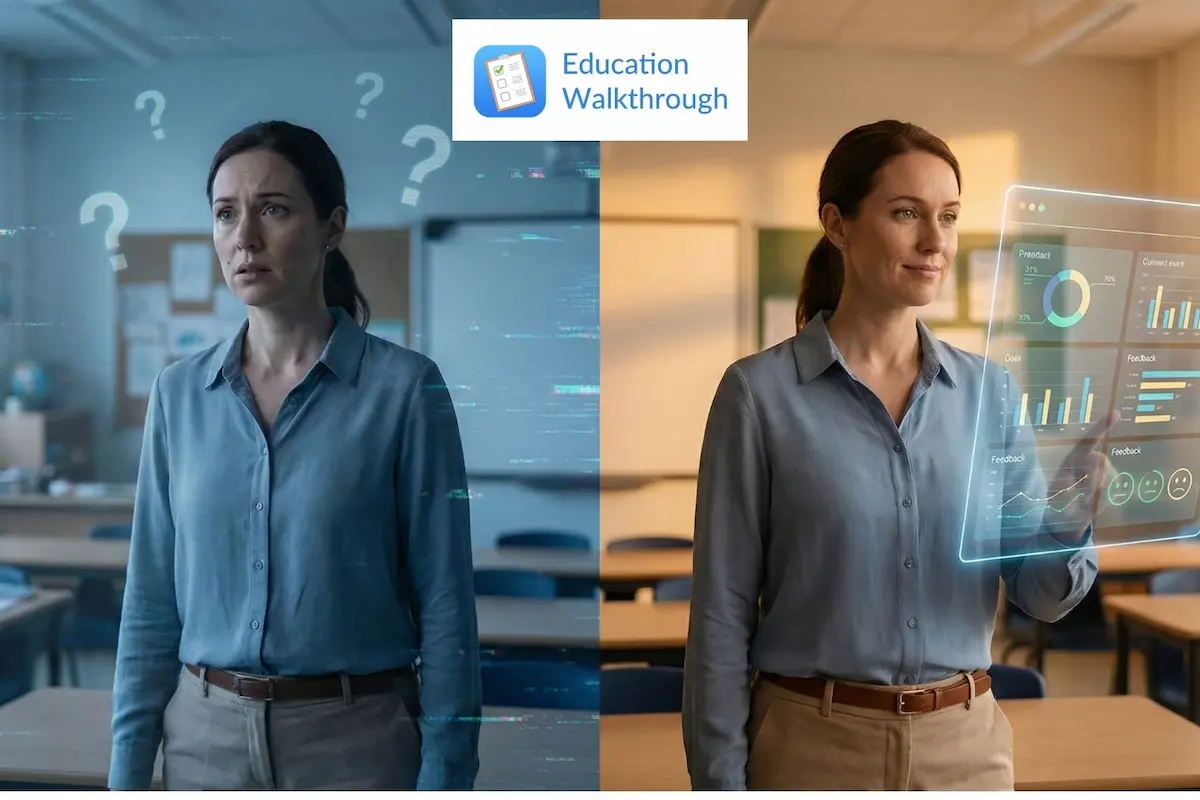

You’ve probably seen it happen: Two leaders walk into the same classroom, observe the same lesson, and leave with very different notes. Both followed the schedule. So, what went wrong?
The issue may not be how often you conduct walkthroughs. It’s how consistently you conduct them.
Classroom observation is most powerful when everyone follows a shared standard. When each observer uses a different focus, looks for different things, or records evidence in their own way, walkthrough data becomes harder to trust. Teachers may also start to see visits as unpredictable or even evaluative, rather than as part of a clear process for growth.
Walkthrough consistency changes that. In this guide, we’ll look at why classroom walkthroughs break down, what gets in the way of reliable observation, and practical ways to build a process your leadership team and teachers can trust.
Key Takeaways
- Consistent walkthroughs rely on shared criteria, evidence, timing, and observation practices.
- Different observers can interpret the same lesson differently without clear look-fors and calibration.
- Low-inference evidence gives leaders a more reliable foundation for feedback and instructional decisions.
- Predictable walkthrough routines help teachers understand what to expect and build trust over time.
- Regular calibration keeps leadership teams aligned and prevents observation standards from drifting.
- Walkthroughs are most valuable when observations lead to specific feedback and actionable next steps.
What Makes a Classroom Walkthrough Consistent for School Leaders and Classroom Management?

A consistent walkthrough follows the same basic process each time. Observers use shared look-fors, follow a reliable cadence, and record evidence in a common way. An inconsistent classroom walkthrough leaves more room for individual judgment. Two leaders can observe the same lesson and come away with very different records.
The issue isn’t simply how often you visit classrooms. It’s whether each visit follows a process your leadership team can repeat.
The University of New England’s walkthrough review connects effective walkthroughs with focused criteria, evidence collection, follow-up, and observer calibration. Simply visiting classrooms every week won’t have the same impact if each leader is looking for something different or recording observations in their own way.
District-wide observation consistency rests on four parts that your leadership team can control. When those pieces are aligned, principals, assistant principals, and coaches can build a shared record that supports better teacher feedback and instructional decisions. Frequency matters, but observation works best once the process itself is consistent.
Here are four controllable elements that make up this shared process:
| Controllable Part | What It Covers |
| Who observes | The principal, assistant principal, or coach conducting the visit |
| What they look for | The specific criteria guiding the walkthrough |
| When visits occur | The cadence or schedule of visits |
| How evidence is captured | The method used to record what happens in the room |

Why Observers See the Same Lesson Differently

Two leaders can observe the same lesson and walk away with very different notes, but that doesn’t necessarily mean one of them was wrong. It often means they were paying attention to different things.
For example, during the same 10-minute visit, a principal familiar with the Danielson Framework might focus on questioning techniques. A coach focused on curriculum implementation might pay closer attention to how students engage with a particular task. In both cases, the goal should be to collect evidence about what is happening in the room rather than rely on impressions.
Several factors can shape what makes it into an observer’s notes.
- Framework Fluency: Differences in training and calibration can affect how leaders interpret what they see, even when they use the same framework.
- Time In The Room: Someone who arrives during independent practice sees a different part of the lesson than someone who observes the opening.
- Prior Relationships: Familiarity with a teacher can influence which patterns an observer notices or expects to see.
- Personal Preferences: Individual preferences can also affect which details stand out and which get left out.
A shared template can reduce some of these differences, but leaders also need practice using the same look-fors and applying them to real classroom examples. Just as important, they need to separate what they actually observed from what they think it means.
Research on how principals perceive the purpose of walkthroughs shows that leaders may approach walkthroughs with different goals, including supervision, professional growth, and school improvement. Those goals can influence what they choose to record.
Without a shared reference point, walkthrough notes can become opinions instead of reliable evidence. Clear teacher evaluation frameworks, common look-fors, and regular calibration give your leadership team a stronger basis for comparing observations and making instructional decisions, and multiple short visits provide a fuller picture than judging a single lesson in isolation.
Two Things That Can Undermine Walkthrough Consistency

Reliable walkthroughs depend on criteria that teachers and observers can understand, along with a schedule they can anticipate. Vague look-fors make it harder for leaders to agree on what they see. Irregular visits can make the process feel less dependable.
When Look-Fors Mean Different Things to Different Observers
“Student engagement” might mean students speaking to one observer, writing to another, and answering questions to a third. Without clear definitions, several observers can watch the same lesson and reach different conclusions.
Your look-fors should describe behaviors someone can actually see or hear, and clear, focused observations make the feedback more actionable. Instead of simply looking for student engagement or classroom management, for example, you might look for students explaining how they reached an answer or for a well managed classroom through visible routines, rules, and fair consequences. Research on walkthrough observation practices connects useful classroom visits with a clearly defined focus and shared expectations. The goal is to center student engagement and improvement, not evaluation.
A simple test can help: Could two observers recognize the same behavior? If not, the look-for may need to be more specific.
When Walkthroughs Happen Too Often or Too Rarely
A schedule that runs weekly in September and disappears by November can make walkthroughs feel dependent on a leader’s availability rather than part of a dependable routine across the school year. Regularly scheduled walkthroughs can also help normalize leadership presence in classrooms.
The same applies to observation frequency. The value of a schedule weakens when the pattern keeps changing.
A predictable cadence helps teachers know what to expect. When unclear criteria are combined with an uneven schedule, teachers may be unsure what leaders will notice or when they will arrive. That uncertainty can weaken trust in the walkthrough process.
As a practical benchmark, most principals can sustain three visits per day, with each visit lasting about 5 to 15 minutes.
Better Evidence Makes Walkthrough Data More Useful

Walkthrough data becomes unreliable when leaders collect evidence differently. A note such as “good energy in the room” captures an observer’s impression, but it doesn’t tell you what teachers or students actually did. Low-inference notes focus on observable actions, giving your team evidence it can revisit and compare.
Walkthrough forms can improve consistency, but only when everyone uses them in the same way. Strong evidence might capture:
- The task students are working on
- Student responses or behaviors
- Teacher prompts or questions
- Other observable actions tied to the walkthrough criteria
Shared evidence-collection tools also help schools aggregate patterns and identify professional development needs.
One leader might record these details while another selects a broad label without supporting evidence. When those records are combined, it’s hard to tell whether a pattern reflects instruction or documentation habits.
A reliable process starts with a documented evidence-collection process. Shared forms can also help you manage observation data without the chaos, but the form is only part of the solution. Your team also needs shared definitions and examples of strong evidence.
When you discuss a pattern with a teacher, the record should support the conversation with specific observations. That keeps feedback grounded in what actually happened and gives teachers something concrete to reflect on and act on. Standardized feedback should stay specific and actionable, because inconsistent feedback can weaken the value of professional development over time. It also helps leaders make better decisions with confidence.
Education Walkthrough gives principals, coaches, and instructional leaders a simple way to structure observations, capture evidence, and keep walkthrough data organized across classrooms. With a shared system for your team, you can spend less time managing notes and more time using walkthrough data to support teachers.
Predictable Walkthroughs Build Teacher Trust

A walkthrough can affect more than the notes left behind. When teachers aren’t sure what a visit is looking for or what will happen afterward, it is partly human nature to feel unsettled, and teachers tend to become anxious or defensive instead of seeing the process as an opportunity to grow.
Unpredictable observations can also damage trust between teachers and administrators.
Fortunately, most teachers welcome walkthroughs when the schedule and expectations are fully transparent, even though 48% of teachers report stress tied to evaluations.
When Walkthroughs Feel Like Surprise Inspections
Teachers who can’t predict a walkthrough’s focus may start to see the visit as surveillance rather than support. Even with good intentions, changing criteria, timing, or follow-up from one visit to the next can create unnecessary stress.
You can reduce that uncertainty by making the process easier to understand. For example:
- Share the focus before the walkthrough.
- Keep the visit schedule reasonably predictable.
- Explain how evidence will be used.
- Make follow-up part of the routine.
Inconsistent classroom walkthrough routines can weaken psychological safety and leave teachers more guarded during classroom visits. A recognizable process gives teachers a clearer sense of what to expect.
Inconsistent Evidence Weakens Feedback
Teacher feedback becomes harder to trust when the evidence changes depending on who visited, what they noticed, or how they recorded the lesson. Timely feedback is essential for effective teacher development, and feedback based on uneven observations can feel arbitrary, especially when teachers cannot connect the conclusion to something that actually happened in their classroom.
Heather Beaulieu’s research on teacher perceptions of walkthrough feedback looks at how educators experience walkthroughs and the feedback that follows. It highlights why the quality and delivery of that feedback can shape how teachers view the entire walkthrough process. Follow-up feedback should be provided within 48 hours of a walkthrough.
Leaders can also learn why teachers stop trusting feedback. When feedback feels disconnected from what happened in the classroom, teachers may struggle to see it as useful or fair.
The goal is simple. Anchor feedback in observable actions, shared criteria, and a clear instructional purpose. When teachers can see the evidence behind the conversation, feedback feels more useful and gives them something concrete to reflect on and act on. Inconsistent or delayed feedback can also harm professional growth, and 48% of teachers report adverse effects on professional growth.
When Walkthroughs Don’t Lead to Better Instruction, Student Learning, or Student Engagement
Informal walkthroughs can lose their value and fail to improve overall effectiveness when leaders focus on frequency instead of structure, which can lead to fragmented learning outcomes for students. Repeated visits may create plenty of notes, but without shared criteria, consistent evidence collection, and timely coaching, those visits may do little to change classroom practice.
Instructional Empowerment’s report on the predictive validity of structured observation connects organized observation systems with stronger instructional and academic outcomes. Francis Whalen’s dissertation also identifies components that positively impact instructional delivery, including purposeful feedback and follow-through.
A useful walkthrough should give both the leader and teacher something they can act on. That means:
- A clear focus for the observation
- Evidence tied to that focus
- A specific next step for improvement
Effective classroom management supports student engagement and learning by creating a stable learning environment for meaningful teaching.
Without that feedback loop, sporadic drop-ins can feel more like attendance-taking than instructional leadership. Teachers know someone visited, but they may leave without guidance they can apply to planning, instruction, or professional development.
Over time, observation gaps and teacher turnover can also weaken the relationships that make feedback useful. Uneven oversight can also create unequal student experiences across classrooms when teaching quality fluctuates without follow-through. A dependable walkthrough routine keeps the focus on what leaders and teachers can do next.
Turning Individual Judgment Into a Shared Standard

Calibration helps your leadership team align what it notices, records, and communicates to teachers. When observers apply the same standards, their notes become easier to compare, and coaching conversations have a stronger foundation.
Start With Shared Criteria
Shared criteria work best when they describe observable teacher and student behaviors rather than broad ideas such as engagement, which also supports evidence based conversations with teachers after visits. Low-inference notes then capture what actually happened, such as a teacher prompt or student response, without adding a conclusion the evidence cannot support.
Research on measuring research-based instructional practices shows why observers need clear definitions and consistent application. With a shared baseline, leaders can compare records instead of debating individual interpretations.
Observe Together to Align Your Team
Co-observation gives two leaders a chance to visit the same classroom, record evidence independently, and compare notes afterward in support of professional growth, not fault-finding. Differences can reveal which look-fors need clearer examples and where personal assumptions may have influenced the record.
Resolving those differences before sharing feedback teachers can act on helps protect trust and gives teachers a clearer coaching point, while creating opportunities for ongoing reflection and collaboration among teachers and leaders.
Keep Your Standards From Drifting
Regular norming sessions help teams revisit sample notes, discuss borderline evidence, and practice applying shared criteria. Even short check-ins during leadership meetings can keep calibration from fading as schedules get busy, keeping the big picture in view so standards do not drift over the course of the school year.
Teams can also practice feedback conversations with resistant teachers so their evidence and language remain aligned. Repeated professional dialogue keeps the shared standard consistent across classrooms and over time.
See What Consistency Looks Like in Practice
The Washington Latin Public Charter School case study shows how a shared walkthrough system can turn consistency into action. Teachers who struggle with pacing often find they receive more support when observations are standardized.
By using Education Walkthrough to track observation coverage and standardize feedback, the school’s leaders could quickly spot teachers who were being overlooked, balance coaching visits, and give educators a more consistent experience across observers. The result was a clearer, more equitable process for keeping every teacher connected to instructional feedback.
Building a Walkthrough Schedule That Survives Interruptions

A walkthrough schedule needs to work during disrupted weeks, not just when the school calendar goes according to plan. Testing, conferences, school events, and unexpected priorities will interrupt even the best schedule. The goal is to build a routine that can recover without falling apart.
If your team is facing this challenge, start small with one classroom each day before scaling up; the harder challenge is sustaining that habit through interruptions.
Three simple practices can help:
- Reserve Catch-Up Windows: Set aside lighter periods to reschedule visits that were missed during busy weeks. This keeps postponed walkthroughs from quietly becoming forgotten ones.
- Rotate Visit Order: Change the order of classroom visits so teachers with harder-to-manage schedules don’t keep getting pushed back. This also helps your team maintain fair coverage across the school.
- Use a Shared Template: Keep the same focus and evidence prompts across visits. A consistent template helps observers collect comparable information and gives teachers a familiar process.
A simple roster can also help your leadership team track who has been observed and ensure no classroom is skipped while other teachers are visited repeatedly. Education Walkthrough supports streamlined observation routines with templates teams can use across a school or district.
The Institute of Education Sciences also offers guidance on sustaining instructional leadership routines. A durable cadence gives your team a process it can restart without reinventing it each time the calendar gets disrupted.
Busy school calendars shouldn’t derail your walkthrough routine. Education Walkthrough helps leadership teams keep observations organized and stay focused on using walkthrough data to support teachers.
Streamline Your Walkthrough Routine
Make Walkthroughs a Routine for Growth
Walkthroughs support teacher growth when educators know the criteria and cadence before a leader enters the classroom. A visible routine replaces the surprise-inspection feeling with shared expectations about what observers will notice, record, and discuss.
Instructional coaching requires more than completing a checklist. Leaders should pair classroom evidence with a follow-up conversation that can encourage teachers to reflect, identify a practical next step, strengthen positive relationships, and connect feedback to relevant professional development. Research on instructional leadership tied to student achievement supports treating classroom visits as part of ongoing instructional improvement. Done well, building relationships can reduce disruptive behavior by up to 75%.
Consistent walkthroughs turn everyday visits into a reliable engine for continuous instructional growth. Structured observation cycles can build teacher confidence through predictable expectations and feedback, reinforcing school culture and helping more teachers feel supported when only 1 in 3 teachers report mental health support. When leaders maintain shared criteria, steady timing, and honest conversations, walkthroughs strengthen instruction rather than simply document it.
Building Walkthroughs Teachers Can Actually Trust
Classroom walkthroughs become more trustworthy when leaders and teachers share clear criteria, meaning walkthroughs directly drive student success. Consistent look-fors, evidence, and predictable follow-up help teachers understand what walkthroughs are for and how feedback will be used, and when support systems are inconsistent, classroom management problems can increase student misbehavior.
Just as important, calibration helps leaders stay aligned, so observations reflect what actually happened in the classroom.
At Education Walkthrough, we believe consistency should make instructional leadership easier, not add another task to an already busy day.
Our platform helps principals, instructional coaches, and school leaders create a repeatable walkthrough process, capture evidence, monitor patterns, and keep feedback connected to teacher growth. Keeping evidence connected to teacher growth is one thing rubric-based evaluation software should be checked for before you commit.
That consistency is built through practical classroom management strategies, strong classroom routines, and a clear classroom management plan, not isolated snapshots from an entire lesson or a formal observation that is typically scheduled.
It also gives teachers fairer support for the hard work they already do, which matters when teacher turnover remains high at about 23% each year. When the process is clear, walkthroughs can become a trusted part of improvement.

