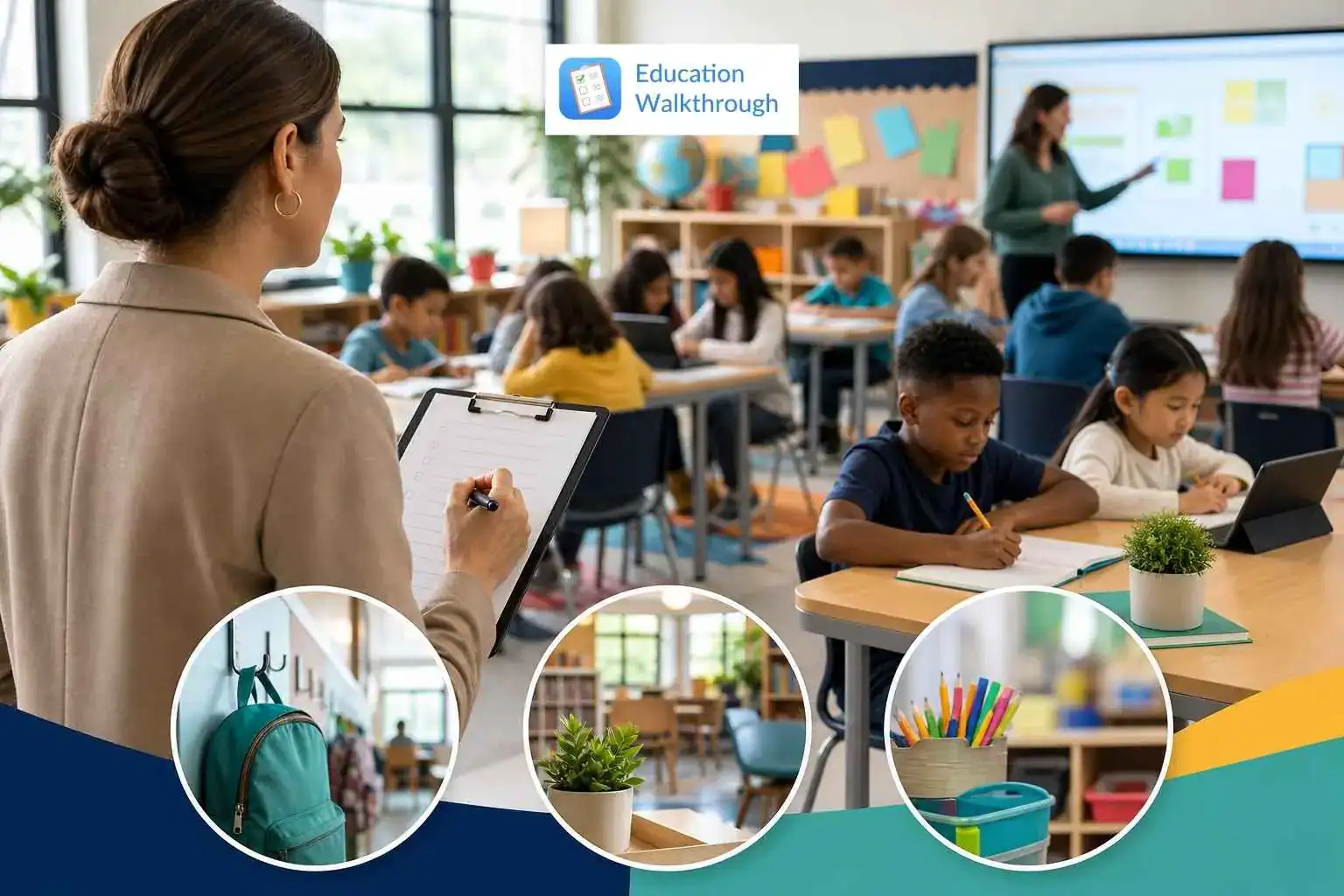

The first few weeks of school reveal early instructional patterns that leaders can easily miss later in the year. Classroom walkthrough look-fors are the specific, observable indicators instructional leaders focus on during classroom visits—especially in August and September—to notice routines, student engagement, academic talk, learning targets, formative assessment, and the overall classroom environment as those patterns are taking shape.
Paired with a clear system for delivering feedback to teachers immediately after observations, these look-fors become powerful tools for shaping instruction early.
Early walkthroughs can surface routines, engagement patterns, and instructional habits before they become harder to shift.
For school administrators, instructional coaches, and other educators who conduct walkthroughs and support teacher development, that makes this window especially useful for spotting school-wide trends early and responding with timely support instead of waiting until those patterns are ingrained.
This trends report highlights the classroom walkthrough look-fors instructional leaders should pay attention to during August and September.
Rather than serving as an evaluation guide or checklist, it offers a practical lens for recognizing early instructional trends, distinguishing look-fors from compliance-style lists, aggregating walkthrough data, calibrating observers, and turning those observations into meaningful coaching conversations and professional development.
Key Takeaways
- Classroom walkthrough look-fors help instructional leaders focus on specific, observable evidence during back-to-school observations.
- Early walkthroughs can reveal school-wide trends around routines, academic talk, learning targets, formative assessment, and classroom environment.
- Look-fors should support coaching conversations, not feel like formal evaluations or teacher rating tools.
- Consistent look-fors make walkthrough data easier to compare across classrooms, grade levels, and departments.
- Observer calibration before the first walkthrough helps leadership teams collect more reliable evidence.
- Early-year walkthrough data can guide coaching priorities and professional development decisions before patterns become harder to shift.

What Are Classroom Walkthrough Look-Fors?
Every walkthrough starts with one question: What evidence should I pay attention to?
Classroom walkthrough look-fors answer that question by giving leaders clear, observable indicators to focus on during each classroom visit.
That specificity is what makes them useful. When you define your look-fors in advance, your observations will differ less from those of another instructional leader, even if you both visit the same classroom. Instead of focusing on different aspects of the lesson, you’ll notice the same instructional evidence, making your walkthrough data more consistent, comparable, and useful for coaching.
Look-Fors vs. Checklists: A Practical Distinction

It’s easy to mix instructional look-fors with a formal observation checklist, but they serve very different purposes.
A checklist is often used to document performance during a formal observation and may be tied to:
- Evaluation frameworks or teaching standards
- Performance ratings or scores
- Compliance and documentation requirements
Look-fors, on the other hand, are designed for a non-evaluative walkthrough. They help you focus on collecting observable evidence that supports coaching conversations and professional growth, rather than judging or rating teacher performance.
The Association for Supervision and Curriculum Development (ASCD) describes look-fors as tools that focus observer attention on specific, agreed-upon indicators of effective practice. It’s important to establish that shared focus before walkthroughs begin.
When teachers know a walkthrough protocol is built around growth rather than compliance, their perception of classroom observation begins to change.
Agreeing on look-fors before the school year starts is what turns early observation data from anecdotal notes into something actionable.
Five Instructional Patterns Instructional Leaders Consistently See in August and September
If you visit several classrooms during the first two weeks of school, you’ll likely see the same five patterns across buildings, grade levels, and student groups. These are not isolated teacher issues. They are early instructional trends that can emerge across a school. They’re classroom observation trends that show up when you use consistent classroom walkthrough look-fors during the first month of school walkthroughs.
Recognizing these patterns early helps you know what to watch for and how to respond.
Classroom Routines and Structures Are Still Being Established
During the first few weeks of school, transitions often take longer than expected, students may still depend on the teacher for basic procedures, and classroom routines may not feel automatic yet. These early patterns are common as teachers and students establish expectations.
This is important because routines are the foundation of effective instruction. When they’re still developing, both teachers and students spend more mental energy on procedures, leaving less time and attention for learning.
As you conduct walkthroughs, record specific routine-related evidence using low-inference notes. For example, “Students waited 90 seconds for materials to be distributed” provides far more useful coaching evidence than simply writing “transitions were slow.” Specific observations make feedback clearer and more actionable.
Academic Talk Is Noticeably Absent in the First Weeks

During the first few weeks of school, you’ll often notice that most classroom conversations flow from the teacher to students. Classroom discussion—including pair discussions, group conversations, and peer-to-peer academic dialogue—is often limited or still developing, with students rarely using academic language to explain or challenge ideas.
Student discourse is one of the high-impact observation indicators of cognitive engagement. When meaningful academic conversations are largely absent from your early walkthrough data, it often points to an instructional gap, since strong talk often reveals higher-order thinking such as problem-solving, analysis, and critical thinking that can become more pronounced as the school year progresses.
One simple way to monitor this is by adding a talk-ratio look-for to your walkthrough template. Even a rough estimate of teacher talk versus student talk can reveal useful patterns and provide a clear starting point for your next coaching conversation.
Learning Targets Are Posted But Rarely Referenced
In many classrooms, you’ll see the learning objective displayed on the board, but when you ask students what they’re learning or why, they often struggle to answer. The target is visible, but it isn’t actively guiding the lesson.
When students can’t connect their work to a clear learning purpose, engagement often becomes task-focused rather than learning-focused. A learning target only adds value when it’s regularly referenced throughout the lesson.
During your walkthrough, ask a student, “What are you learning today?” Their response often tells you more than what’s written on the board. Be sure to document what you hear, not just what you see.
Formative Assessment Practices Are Inconsistent Across Classrooms

One classroom may include frequent checks for understanding, with the teacher adjusting instruction based on student responses. Another may move through the lesson without any visible check on student learning. These differences are common in the first few weeks of school.
Without regular formative checks, learning gaps can develop unnoticed. What instructional learning walks make visible is exactly this kind of school-wide pattern that a single classroom visit cannot reveal.
To identify those patterns early, track formative checks as one of your classroom walkthrough look-fors. The patterns you uncover can guide early coaching and professional development.
Classroom Environment Signals Do Not Always Match Instructional Intent
A classroom may look organized, but its layout, wall displays, and learning materials don’t always support the type of instruction taking place. It’s common to see collaborative seating arrangements paired with lessons that rely entirely on whole-group instruction, or displays such as anchor charts that don’t connect to current learning.
The physical environment shapes students’ expectations before the lesson even begins. It should also reinforce a classroom culture of respect, inclusion, and positive interactions. When the setup doesn’t align with the instructional approach, it can send mixed messages about how students are expected to learn and participate.
As you observe, look for alignment between the learning environment and the instructional practices taking place, and whether the setup and materials support instruction.
To keep your observations focused and consistent, use our classroom observation checklist guide to document these five patterns across your school from the first day of school.
Student Engagement as a Core Category of Look-Fors

Student engagement is one of the most observed categories of classroom walkthrough look-fors, and unfortunately, it’s also one of the most misunderstood during the first few weeks of school. It’s common for instructional leaders to walk into a classroom looking for engagement, but they end up documenting student compliance and classroom behavior, not genuine cognitive engagement.
What Does Student Engagement Look Like in Practice?
When performing walkthroughs, it’s easy to notice signs of behavioral compliance, such as students sitting quietly, facing the teacher, following directions, or completing the assigned task. These are all indicators of a well-managed classroom.
But do they necessarily indicate meaningful learning? Not always. Compliance tells you very little about whether students are actively thinking and engaging with the content.
Instead, look for signs of what engagement looks like in a given class through genuine cognitive engagement, such as:
- Students asking unprompted questions
- Students building on what a peer just said
- Students catching their own mistakes and self-correcting mid-task
- Students connecting new content to something they already know
These are the moments worth capturing in low-inference notetaking. Not “students were engaged,” but “three students referenced yesterday’s lesson without prompting.” That specificity is what makes walkthrough data useful across classrooms.
Why Engagement Indicators Tell You More Than Behavior Management Does
It’s easy to mistake a quiet, orderly classroom for an engaged one. But students can follow directions, stay on task, and remain silent without doing much meaningful thinking.
That’s why it’s important to look beyond behavior management during walkthroughs. When students are asking thoughtful questions, building on each other’s ideas, or making connections to prior learning, you’re seeing evidence that the lesson is encouraging deeper thinking.
On the other hand, when students are compliant but passive, it often points to an instructional design opportunity rather than a classroom management issue.
Principal observation practices that prioritize cognitive engagement over surface behavior produce more meaningful classroom observation trends. Early in the school year, this helps instructional leaders identify which teaching strategies are encouraging deeper thinking and where additional coaching or support may be needed.
How Walkthrough Data Reveals Building-Wide Instructional Patterns

Individual classroom visits give you a snapshot of what’s happening in a single lesson. When you aggregate classroom walkthrough data across multiple visits, you begin to see the bigger story behind instruction across your school.
Aggregated walkthrough data helps leaders stop focusing only on individual teaching moments and start identifying school-wide instructional patterns that can guide coaching, professional learning, and leadership decisions.
When One Classroom Trend Becomes a School Trend
If you observe a single teacher with inconsistent formative assessment practices, that’s usually a coaching opportunity. But when you notice the same pattern across multiple classrooms within a grade level or across the school, it’s a clear sign that professional development should become a priority.
So, how do you know when an isolated classroom issue has become a school-wide trend?
The answer only becomes clear when your observation data is consistent and comparable.
If every observer focuses on different things or records evidence differently, meaningful patterns are difficult to spot. When everyone uses the same classroom walkthrough look-fors, the data begins to tell the story of the entire school, not just one classroom.
Early-year walkthrough data is especially valuable because it establishes your instructional baseline. What you document in August and September provides a starting point for continuous improvement that makes every observation collected throughout the rest of the year more meaningful.
Instructional walkthrough guidance from Massachusetts highlights this directly: Consistency in observation focus is what makes cross-classroom comparison possible.
What Consistent Look-Fors Make Possible Across a Building
Agreed-upon look-fors do more than keep observers aligned around the same look-fors. They make trend recording across classrooms possible in a way that random observation notes never could.
When every walkthrough captures the same indicators, you can ask real questions such as:
- Are formative checks happening more in upper grades than lower?
- Is academic talk stronger in one department than another?
- Are students demonstrating the same level of cognitive engagement across different grade levels or subject areas?
Platforms like Education Walkthrough are among the observation tools instructional leaders use to aggregate classroom walkthrough data without converting every visit into a formal evaluation.
Designed specifically for walkthrough documentation and trend analysis, it helps teams centralize evidence from informal walkthroughs while keeping that work separate from formal evaluations.
By centralizing observation evidence, trends, and feedback in one place, you can spend less time managing paperwork and more time coaching teachers. This keeps the focus on instructional growth and prevents teachers from treating every walkthrough like a high-stakes event.
See Education Walkthrough in Action
Calibrating Your Observer Team Before the First Walkthrough
Before your first classroom walkthrough, it’s important to ensure every observer and administrator is looking for the same evidence. Calibration around instructional look-fors means that iftwo observers watch the same classroom segment, they should document the same observable indicators.
Without that consistency, your walkthrough data becomes difficult to compare across classrooms.
For example, one observer may mark a look-for as present, while another watching the exact same lesson records it as absent. The pattern you think you’re seeing across classrooms may simply reflect differences in how your observers, including principals, interpret the same instructional practice.
This inconsistency can be especially costly at the beginning of the school year because your early observation data establishes your instructional baseline. If that baseline is built on inconsistent observations, every trend you identify afterward becomes less reliable.
Reviewing walkthrough guidance for instructional leaders before the year begins can help your team align on what consistent documentation should look like and strengthen instructional leadership.
A Simple Norming Practice That Takes Less Than 30 Minutes

The week before school starts, gather your observers, including any instructional coach on your team and other instructional leaders, and watch a short classroom video clip together. Three to five minutes is enough because informal walkthroughs often last three to five minutes and may happen without a checklist.
Each person should document what they notice using your walkthrough template; a google form is one simple way to collect the evidence during calibration. Then read the notes out loud and compare. Take note of the following:
- What did everyone agree on?
- Where did your observations differ?
- Which look-fors were interpreted differently?
If you notice any gaps, those are your calibration targets. Remember, this isn’t a training session. It’s simply a norming conversation designed to build a shared understanding of each look-for before anyone steps into a classroom.
Just 30 minutes of alignment at the start of the school year can prevent months of inconsistent observations and classroom walkthrough etiquette confusion later, and when appropriate, teacher leaders can join that norming conversation too.
Turning Early-Year Walkthrough Data into Coaching and Professional Development (PD) Decisions
As popularly known, the first few weeks of school are data-collection season. The trends you capture during this period give you a clear picture of where teachers are starting, allowing you to build coaching cycles and professional development plans around real classroom evidence instead of assumptions about where support is needed.
From Observation Notes to Coaching Priorities
Not all observation data points to the same response. When a pattern shows up in two or three classrooms, it’s usually a coaching opportunity and a chance to provide effective feedback.
An instructional coach can use those early-year look-for trends to set coaching priorities instead of relying solely on teacher requests, then use a timely follow up conversation with the teacher to reflect on what was observed.
Giving feedback to teachers becomes more targeted when it’s based on what you actually observed, not what you assumed beforehand. Consistent classroom walkthrough look-fors make that possible. Without them, coaching conversations often become too broad to drive meaningful improvement or connect the evidence to other planning tools like lesson plans.
When Trends Point to a Professional Learning Need
Instructional coaching and observation research shows that professional learning built around actual classroom trends is more relevant and better received than generic PD, especially when teams use professional learning communities to study patterns and plan support. When teachers can clearly see the connection between the training and what leaders observed, they’re more likely to engage with it, and sharing those schoolwide patterns in a faculty meeting helps educators understand the why before PD is planned.
Early-year walkthrough data provides that direction. Managing teacher evaluations efficiently starts with knowing the difference between what one teacher needs and what the entire school needs, then aligning support to current instructional priorities and district priorities.
Why Walkthroughs Should Never Feel Like Evaluations

One of the biggest misconceptions in schools is that every classroom walkthrough is an evaluation. It isn’t. A non-evaluative walkthrough is designed to:
- Gather evidence of teaching and learning through observable classroom practices during quick visits
- Support instructional growth through timely, evidence-based feedback. Identify coaching opportunities that strengthen classroom instruction over time
What a non-evaluative walkthrough is not designed to do is assign ratings, determine teacher performance, or treat a single walkthrough as a complete judgment of teaching.
The moment walkthroughs start feeling like formal evaluations, teachers become less willing to take instructional risks, and the quality of the evidence you collect begins to suffer.
Helping Teachers Understand the Difference
Formal evaluations follow a defined protocol with documented outcomes and rubric-based scoring. Walkthroughs, on the other hand, don’t.
Comparing walkthrough and informal observation forms alongside the framework for teaching helps make that structural difference clear for teachers who often confuse the two.
When everyone understands the purpose of each process from the start, clear communication helps build trust around walkthroughs so they are more likely to be viewed as opportunities for coaching rather than another form of evaluation.
Teachers who understand the purpose of a walkthrough protocol are more likely to take instructional risks. They try the new strategy. They let the lesson be messy.
However, if teachers suspect walkthroughs are disguised evaluations, they often teach for the observation rather than for their students. That makes the evidence less useful and the feedback less meaningful.
Being clear about the purpose of walkthroughs helps keep observations honest and coaching conversations productive.
For example, the common challenges in T-TESS evaluation cycles often trace back to exactly this confusion between formative and formal observation. To avoid such confusion, communicate the purpose of walkthroughs early, explain how evidence will be used, involve staff in the process, and reinforce it consistently throughout the school year.
What Are You Seeing in Your School This Fall?
Which of these five trends are already showing up in your building? The first month of school is a short but valuable window. What you observe in August and September establishes the instructional baseline for everything that follows. That opportunity doesn’t last long, so it’s worth making every walkthrough count.
Consistent classroom walkthrough look-fors turn those early visits into evidence you can act on.
At Education Walkthrough, we’ve built our platform to make frequent, growth-focused walkthroughs easier to conduct, document, and analyze. If you’re looking to streamline classroom observations while gaining more actionable data, come see how Education Walkthrough can help.
Frequently Asked Questions About Classroom Walkthrough Look-Fors
Still refining your back-to-school walkthrough process? These quick answers cover how to use look-fors, keep observations non-evaluative, and turn early classroom data into useful coaching conversations.
What are classroom walkthrough look-fors?
Classroom walkthrough look-fors are specific, observable indicators instructional leaders use during classroom visits. They help observers focus on evidence of teaching and learning instead of relying on general impressions.
How are look-fors different from a classroom observation checklist?
A checklist is often tied to formal evaluation, documentation, or compliance. Look-fors are usually used during non-evaluative walkthroughs to collect evidence for coaching, reflection, and instructional improvement.
What should leaders look for during back-to-school walkthroughs?
During the first few weeks of school, leaders should watch for classroom routines, student engagement, academic talk, learning target use, formative assessment, and whether the classroom environment supports the lesson. These areas often reveal early instructional trends.
Why are consistent look-fors important?
Consistent look-fors help leadership teams collect comparable walkthrough data across classrooms. When observers focus on the same indicators, it becomes easier to identify building-wide trends and plan coaching or professional development.
How can walkthroughs support teacher coaching?
Walkthroughs support coaching when leaders document low-inference evidence and use it to guide focused conversations. Instead of saying a lesson was “strong” or “unclear,” leaders can point to specific moments, patterns, and student responses.
How can leaders keep walkthroughs from feeling like evaluations?
Leaders should explain the purpose of walkthroughs before they begin, use shared look-fors, avoid ratings, and frame feedback around growth. When teachers understand that walkthroughs are designed for coaching, the process feels more supportive and less evaluative.